Posted in Additive relationships, Calculating, Fluency, Problem solving

Calculating with target boards 2

Develop fluency with the target boards. Use the target boards to:

  • recall and remember useful number facts;
  • use number facts to calculate mentally;
  • explain thinking and methods of calculating.
  • use mathematical language correctly.

Target board 2

Print Target Board 2

  • Say each number out loud.
  • Put objects on each number – check that you have the correct amount.
  • Say the numbers in order.

Practise addition with the target board.

Ask children to:

Find two numbers that total 5.

  • How do you know you are correct?
  • How did you work it out? Explain your thinking.
  • How many pairs of numbers can you find?
  • Make a list of the pairs you find.

Find numbers that total 10.

  • How do you know you are correct?
  • How did you work it out? Explain your thinking.
  • How many pairs of numbers can you find?
  • Make a list of the pairs you find.

Make up a number story to go with your pairs of numbers, e.g. 3 + 2 = 5 Digit Dog ate 3 bones for breakfast and 2 bones for dinner. He ate 5 bones altogether. How many different stories can you make?

Find other totals and make up stories to go with them.


Find the total of the numbers in the first column. How did you work it out?

Find the sum of the numbers in the bottom row.  How did you do that?

Find the column with the highest total. Which column is easiest to add up? Why?

Find the number that is double 1, double 2, double 3………..


Point at a number and say what double that number is e.g. point at 5 and say “double 5 is 10”

Problem solving with the target board

My total is 8 – find two numbers that you can add together to make my total.  Can you find three numbers to make my total?

One of my numbers is 5. When I add it to another number, my total is 7. What is my second number?

I am thinking of a number. I count on 3 and get to 8. What number did I start with?

I am thinking of a number. I doubled it to make 8. What is my number?


Posted in Patterns, Problem solving

Patterns with bunting

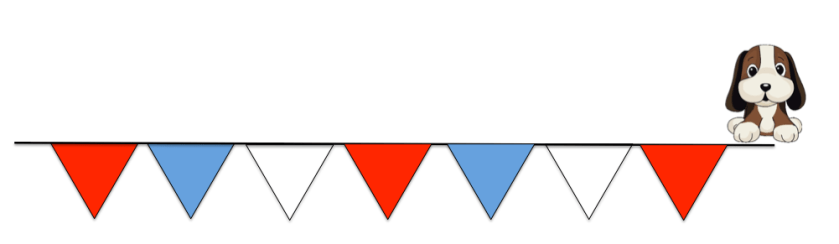
Digit Dog is making some bunting ready for the VE Day celebrations.

DD bunting

He has made a pattern with his flags.

Which colour flag will he put next? How do you know?

What colour will the 10th flag be? What about the 16th flag? How did you work it out?

If he uses 30 flags, what colour will the last flag be?

Can you make a pattern like Digit Dog?


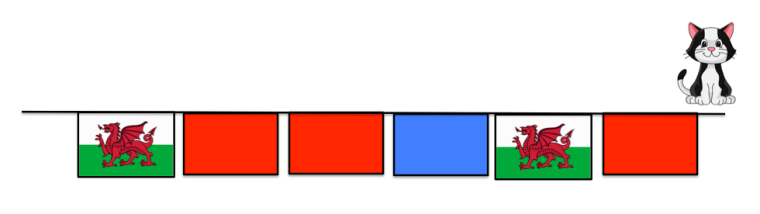
Calculating Cat has made a different pattern.

CC bunting

What do you notice about Calculating Cat’s pattern?

Which flag will she put next? How do you know?

What will the 12th flag be? What about the 17th? How did you work it out?

If she uses 28 flags, which flag will be last?


Look at both sets of flags.

What is the same about them? What is different?


Try making your own bunting. Make some flags and decide on a pattern. See if someone else can spot your pattern.


Posted in Calculating, Conceptual understanding, Easter, Logical reasoning, Problem solving

Two eggs left

Digit Dog has been eating his Easter mini eggs.

He has 2 eggs left.

Calculating Cat is wondering how many eggs he could have had to start with and how many he could have eaten to be left with 2.

two eggs left

How many eggs could he have had at the start? What if it was 6? How many would he have eaten to be left with 2?

What other numbers could he have started with?

What number do you know he couldn’t have had at the start?

How many different solutions can you find?

How did you work it out? Explain your reasoning.

Can you record your solutions?

Can you put your solutions in order?

What if………..

……………he had a different number of eggs left?

………….he was eating bones not eggs?

………..you made up a problem like this about your Easter eggs?

Posted in Easter, Numicon, Problem solving

Collect the Easter Eggs

Collecting eggs

Digit Dog is collecting eggs from the Easter Bunny’s store. Here is a map of the store. (download and print your store here

Digit Dog counters

Screenshot 2019-04-03 15.31.31

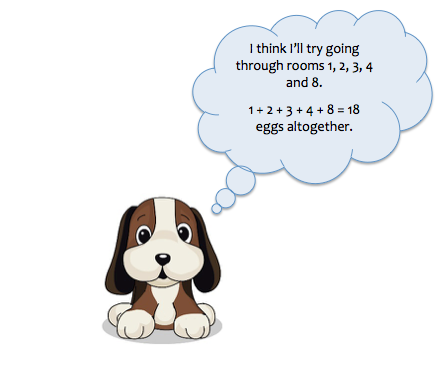
There are 8 rooms and the number tells you how many eggs are in each room. Digit Dog has to go into the rooms and collect the eggs BUT he can only go into each room ONCE.

How many  can Digit Dog collect?

How many different ways can he go though the store?

Can you record his routes? How might you do this?

Screenshot 2019-04-03 15.49.25

Can you do it a different way, Digit Dog, and collect more eggs?

What’s the most eggs you can collect?

What’s the smallest number of eggs?

Look for children who are planning the routes and can explain their thinking.

Make it easier

1. Use the blank store and put just numbers 1, 2 and 3 in the rooms.

2. Put mini-eggs in the rooms and collect them.

Extend the challenge

Use the blank store and put higher numbers in each room.

Challenge children to find all possible routes and to explain how they know they have found them all.

Posted in Easter, Logical reasoning, Numicon, Problem solving, Strategic competence

Cover the Chick

Easter animals

For those of you who enjoyed the Chinese New Year activity Cover the animals, here’s an Easter version.

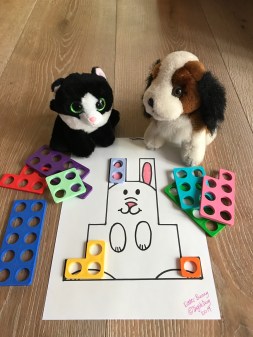
Digit Dog and Calculating Cat are using the Numicon® shapes to cover the picture of the Easter Chick .

You will need the Chick picture (download and print on yellow paper) and a set of Numicon® shapes. Ask learners to use the Numicon® shapes to cover the chick in any way they can.

Screenshot 2019-04-03 13.39.12

How many different ways can you do it? Describe what you’ve done.

Compare your chick with your friend’s. What’s the same and what’s different? How did you check that your way was different from your friend’s?

Play What’s missing?

  1. When the chick is covered with shapes, one child closes their eyes, another takes away one shape. Which one is missing? How do you know?
  2. Put some shapes in a feely bag, take them out one at a time and place on the chick. Can you find the shapes you want by touch alone?  This helps with visualising the shapes.

Ask:

How did you cover the chick? How many shapes did you use? Talk about how you chose the shapes. Which shapes were most useful?

Can you cover the chick again but using different shapes?

How many different ways can you do it?

What is the fewest number of shapes you can use? The most?

Can you just use odd shapes? Even shapes?

What if you weren’t allowed to use the same shape more than once? How many ways can you do it? Is this more difficult? What are you thinking?

Can you use one shape repeatedly to cover the chick? Which shapes will work? Which won’t? Why?

Encourage learners to describe and explain what they are doing.

Look for those learners who have a strategy for choosing shapes and those who use trial and improvement.

Look for learners who swap shapes for other equivalent shapes each time they look for a new arrangement rather than starting from the beginning.

Encourage learners to put all their completed chicks together and ask “what is the same?” “what is different?”


Try the same activities with the Easter Bunny  (download here).


IMG_1332

Posted in Chinese New Year, Numicon, Problem solving

2020 is the Chinese Year of the Rat

It’s the Year of the Rat

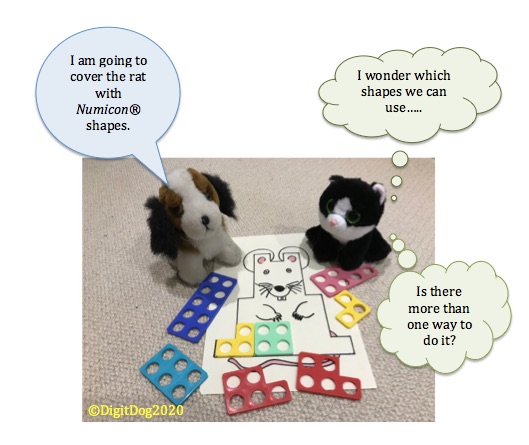
It’s the Chinese year of the rat and Digit Dog and Calculating Cat are using the Numicon® shapes to cover the picture of the rat.

You will need the rat picture (download here) and a set of Numicon® shapes. Ask learners to use the Numicon® shapes to cover the rat in any way they can.

cover the rat

How many different ways can you do it? Describe what you’ve done.

Compare your rat with your friend’s. What’s the same and what’s different? How did you check that your way was different from your friend’s?

  1. When the rat is covered, one child closes their eyes, another takes away one shape. Which one is missing? How do you know?
  2. Put some shapes in a feely bag, take them out one at a time and place on the rat. Can you find the ones you want by touch alone?  This helps with visualising the shapes.

Ask:

How did you cover the rat? How many shapes did you use? Talk about how you chose the shapes. Which shapes were most useful?

Can you cover the rat using different shapes?

How many different ways can you do it?

What is the fewest number of shapes you can use? The most?

Can you just use odd shapes? Even shapes?

What if you weren’t allowed to use the same shape more than once? How many ways can you do it? Is this more difficult? What are you thinking?

Encourage learners to describe and explain what they are doing.

Look for those learners who had a strategy for choosing shapes and those who did it randomly.

Look for learners who swap shapes for other equivalent shapes each time they look for a new arrangement rather than starting from the beginning.

Encourage learners to put all their completed rats together and ask “what is the same?” “what is different?”


Try the same activities with the other animals (download here).


IMG_0849

Posted in Christmas, Problem solving

Christmaths advent calendar


Digit Dog has got a Christmaths challenge for each school day in December.

Click on the images to reveal the first week’s challenges.

December 2ndScreenshot 2019-11-17 13.41.26

December 3rd Screenshot 2019-11-17 13.43.19


Screenshot 2019-11-17 13.44.42December 4thScreenshot 2019-11-17 13.46.21

                                                                                                December 5th

Screenshot 2019-11-17 13.49.21December 6th


Posted in Christmas, Numicon, Problem solving

Start planning your Christmaths with Digit Dog

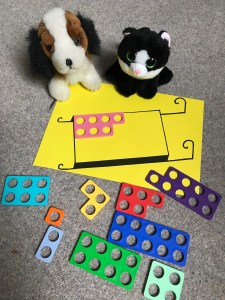
One Santa’s sleigh – put the presents on Santa’s sleigh

You will need Santa’s sleighs (download and print) and a set of Numicon® shapes. Match the shapes to the spaces on the sleigh.

Screenshot 2018-11-30 16.27.13

  1. Give children just the shapes they need and let them match them to the spaces on the sleigh.
  2. Have a complete set of shapes for children to choose from.
  3. When the sleigh is covered, one partner closes their eyes, the other takes away one shape. Which one is missing?
  4. For an extra challenge, put the shapes in a feely bag and find the ones you need by touch alone.

Ask:

How many shapes do you need?

Which shape will fit here…..?

Is the shape that goes here big or small? Bigger / smaller than a red one?

Can you take away one shape and put two in its place?

Which shapes are easy to find?

5. Start with the blank sleigh and ask learners to use the Numicon shapes to cover it in any way they can.

How many different ways can you do it? Compare your sleigh with your friend’s. What’s the same and what’s different?


What if…………

You weren’t allowed to use the same shape more than once? How many ways can you do it? Is this more difficult? What are you thinking?

Can you use one shape repeatedly to cover the sleigh? Which shapes will work? Which won’t? Why?

What is the fewest number of shapes you can use? The most?

You use only odd shapes? Only even?

Find more ideas in the Santa’s Sleigh Challenge Booklet


Posted in Easter, Numicon, Problem solving

Collect the Easter Eggs

Collecting eggs

Digit Dog is collecting eggs from the Easter Bunny’s store. Here is a map of the store. (download and print your store here

Digit Dog counters

Screenshot 2019-04-03 15.31.31

There are 8 rooms and the number tells you how many eggs are in each room. Digit Dog has to go into the rooms and collect the eggs BUT he can only go into each room ONCE.

How many eggs can Digit Dog collect?

How many different ways can he go though the store?

Can you record his routes? How might you do this?

Screenshot 2019-04-03 15.49.25

Can you do it a different way, Digit Dog, and collect more eggs?

What’s the most eggs you can collect?

What’s the smallest number of eggs?

Look for children who are planning the routes and can explain their thinking.

Simplify the task

  1. Put Numicon® shapes in each room so that Digit Dog can collect a shape when he has gone through the room. These can then be added together to find the total number of eggs.

Screenshot 2018-12-04 16.58.53

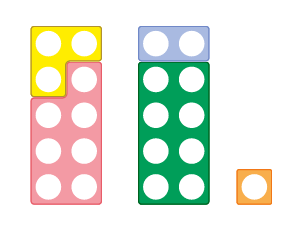
I went to rooms 1, 2, 3, 7 and 8. How many eggs did I collect altogether?

Screenshot 2018-12-04 17.01.28

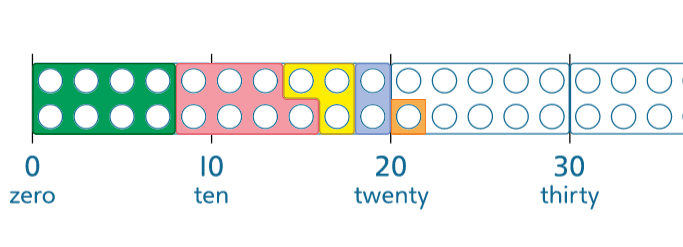
I have put the shapes on the number line so that I can see the total without counting in ones.

Calculating Cat
Calculating Cat says that you can make 10s with the shapes and that makes it easy to find the total. 10, 20, 21


Screenshot 2018-12-04 16.59.30

2. Use the blank store and put just numbers 1, 2 and 3 in the rooms.

3. Put just Numicon® shapes in the rooms – no numerals.

4. Put mini-eggs in the rooms. Instead of counting in ones, put the eggs in the Numicon® ten-shapes to find the total.

Extend the challenge

Use the blank store and put higher numbers in each room.

Challenge children to find all possible routes and to explain how they know they have found them all.

Posted in Easter, Numicon, Problem solving

Cover the animals

Easter animals

Digit Dog and Calculating Cat are using the Numicon® shapes to cover the picture of the Easter Chick .

You will need the Chick picture (download and print on yellow paper) and a set of Numicon® shapes. Ask learners to use the Numicon® shapes to cover the chick in any way they can.

Screenshot 2019-04-03 13.39.12

How many different ways can you do it? Describe what you’ve done.

Compare your chick with your friend’s. What’s the same and what’s different? How did you check that your way was different from your friend’s?

Play What’s missing?

  1. When the chick is covered with shapes, one child closes their eyes, another takes away one shape. Which one is missing? How do you know?
  2. Put some shapes in a feely bag, take them out one at a time and place on the chick. Can you find the shapes you want by touch alone?  This helps with visualising the shapes.

Ask:

How did you cover the chick? How many shapes did you use? Talk about how you chose the shapes. Which shapes were most useful?

Can you cover the chick using different shapes?

How many different ways can you do it?

What is the fewest number of shapes you can use? The most?

Can you just use odd shapes? Even shapes?

What if you weren’t allowed to use the same shape more than once? How many ways can you do it? Is this more difficult? What are you thinking?

Can you use one shape repeatedly to cover the chick? Which shapes will work? Which won’t? Why?

Encourage learners to describe and explain what they are doing.

Look for those learners who have a strategy for choosing shapes and those who use trial and improvement.

Look for learners who swap shapes for other equivalent shapes each time they look for a new arrangement rather than starting from the beginning.

Encourage learners to put all their completed chicks together and ask “what is the same?” “what is different?”


Try the same activities with the Easter Bunny  (download here).


IMG_1332