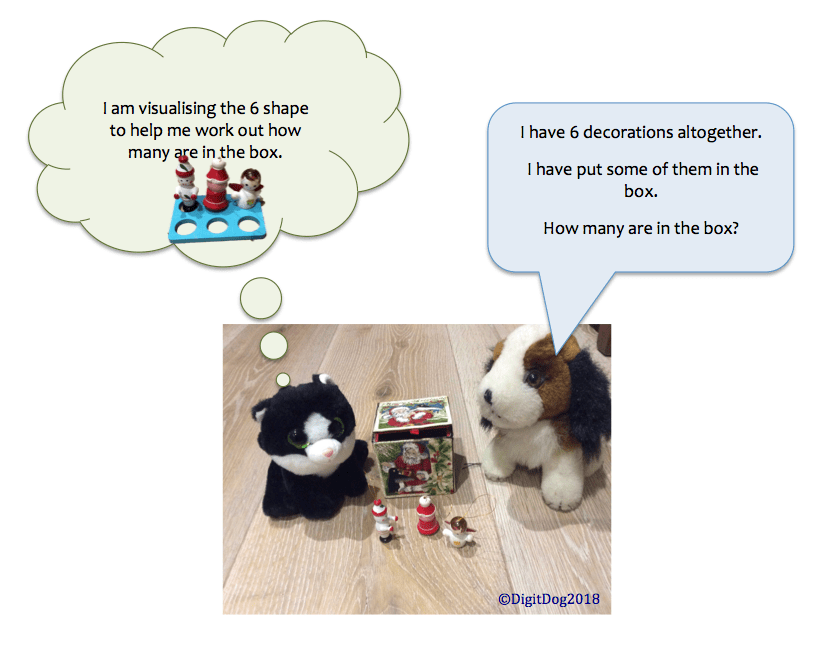
Digit Dog is playing a game with Calculating Cat. He has 6 tree decorations and has hidden some of them in his box. Calculating Cat has to work out how many he has hidden.
Calculating Cat is thinking about the Numicon® shape to help her work out how many are in the box.
She knows the whole is 6 – that’s the number of decorations Digit Dog had to start with.
She knows one of the parts is 3 – that’s the number of decorations not in the box.
Now she can work out the unknown part – that’s the number of decorations in the box – by thinking about the spaces in the Numicon® shape.
She could have solved the problem by using number bonds. If she knows 3 + 3 = 6, she can work out the missing number.
What if………
……….Digit Dog put a different number of decorations in the box?
………..he had more decorations to start with? Fewer decorations?
Try out the game for yourself. One person hides objects in a box, their partner works out how many are hidden. Remember to explain how you work it out.
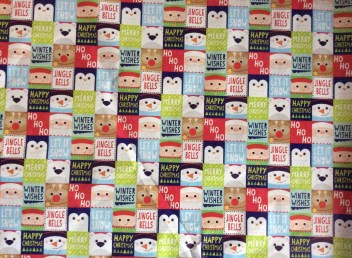
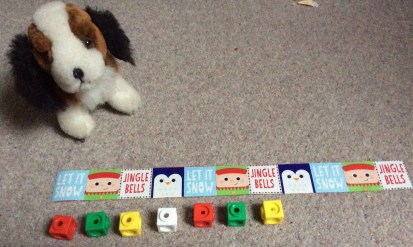
Digit Dog was looking at the Christmas wrapping paper and noticed some patterns.
What do you notice? What is the pattern?
What will the next picture be? And the next? And the one after that? How do you know?
What will the 20th picture be? What about the 35th? How can you work it out? Challenge older children to use their knowledge of multiples to work out the answer.
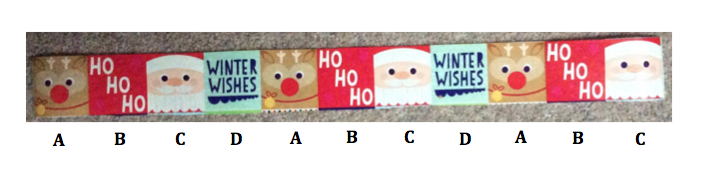
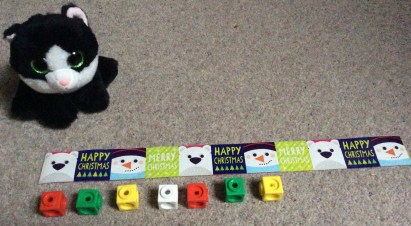
What about this pattern?
What is the same and what is different?
Both patterns have 4 pictures that repeat over and over and over……………
They are ABCD patterns.
Digit Dog has used multilink cubes to make an ABCD pattern. He has used a different colour cube for each picture. What colour will be next?
Calculating Cat has done the same.
What do you notice?
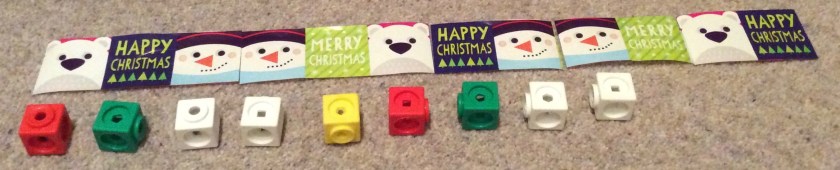
Next Digit Dog and Calculating Cat cut their strips into smaller pieces and rearranged them to make new patterns. What is the same and what is different? Which picture would come next? Which colour multilink cube?
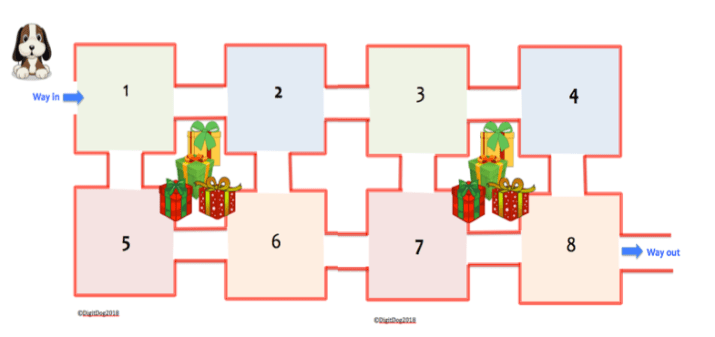
There are 8 rooms and the number tells you how many presents are in each room. Digit Dog has to go into the rooms and collect the presents BUT he can only go into each room ONCE.
How many presents can Digit Dog collect?
How many different ways can he go though the store?
Can you record his routes? How might you do this?
Can you do it a different way, Digit Dog, and collect more presents?
What’s the most presents you can collect?
What’s the smallest number of presents?
Look for children who are planning the routes and can explain their thinking.
Simplify the task
Put Numicon® shapes in each room so that Digit Dog can collect a shape when he has gone through the room. These can then be added together to find the total number of presents.
I went to rooms 1, 2, 3, 7 and 8. How many presents did I collect altogether?
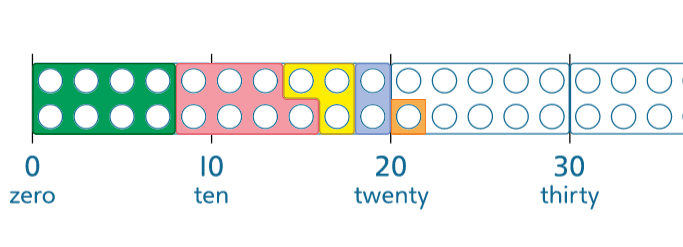
I have put the shapes on the number line so that I can see the total without counting in ones.
Calculating Cat says that you can make 10s with the shapes and that makes it easy to find the total. 10, 20, 21
2. Use the blank store and put just numbers 1, 2 and 3 in the rooms.
3. Put just Numicon® shapes in the rooms – no numerals.
Extend the challenge
Use the blank store and put higher numbers in each room.
Challenge children to find all possible routes and to explain how they know they have found them.
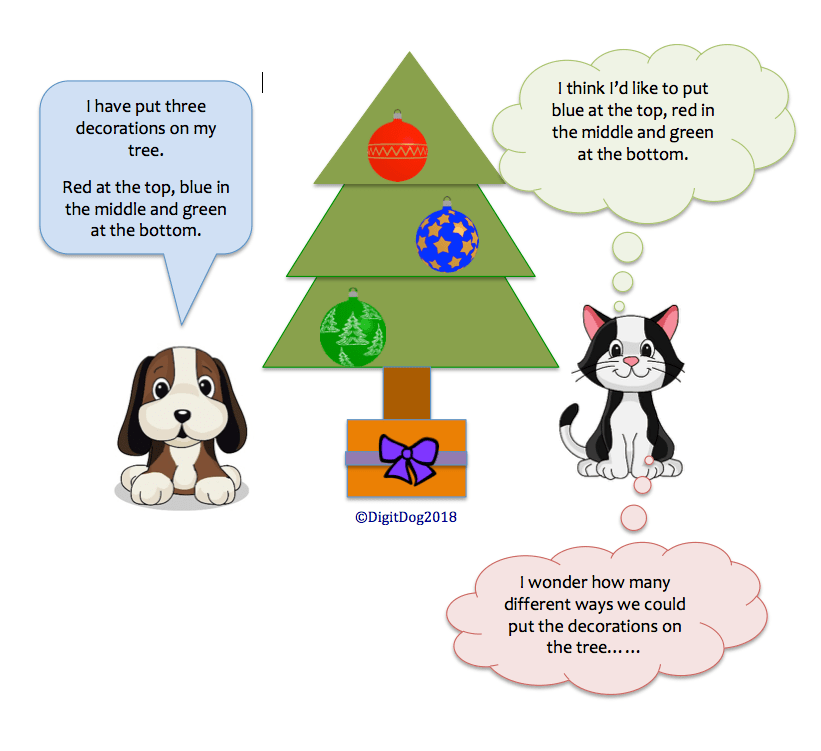
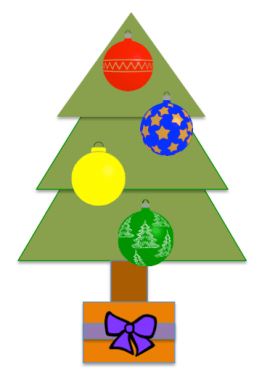
Digit Dog and Calculating Cat have some yellow and purple stars to put on their tree. They can only put 5 stars on the tree and have to decide how many of each colour they use. How many different ways can they do it?
What has Digit Dog done? What is Calculating Cat thinking?
How many different ways do you think they can put the stars on the tree? Why do you think that?
How are you going to record your different ways? How will you remember what you have done?
How do you know you have found all the different ways? Convince me.
Have you found any patterns?
Look for children who are starting to organise their work and systematically look for all the combinations. The activity is about exploring the combinations and reasoning about choices and patterns.
Ways to record
Provide enough stars and trees so that each combination can be kept and checked. Children can then look at all the trees and say what is the same and what is different. Ask them to put the trees in order and look for a pattern.
Have number sentences on card and ask children to match the number sentence to the trees.
What does the 5 represent? – it is the 5 yellow stars. The 0? – there are no purple stars.
Write number sentences for each tree on separate post-it notes. These can then be sorted and put in order.
Use Numicon shapes to represent the number pairs.
What if…………
There was a different number of stars on the tree? Explore any number.
This is a simple game to give young children practice in counting. The game gives you the opportunity to talk about counting and assess children’s thinking. How does the child count the dots on the dice – count in ones or recognise the number of dots without counting? Can the child say the number on the dice and then count that number of counters accurately?
You need to make game boards with it 4 “chimneys” for each child.
How to play: Children have a board each and take turns to throw the 1 – 6 dice and collect the correct number of counters. They then place the counters on one of the chimneys – their choice, but all the counters for that turn have to go on the same chimney. The object is to fill all the chimneys with counters. You have to roll the correct number to finish filling any chimney.
Ask:
How do you know you’ve got the right number of counters to match your roll on the dice?
How many counters did you put on the chimney?
How many more counters do you need to fill the chimney?
Which chimney has most counters? Least counters?
Game 2:
For an easier game play with boards that have 10 spaces and a dice with numbers 1 – 3. Either play with counters in the same way as Game 1 or make links with the Numicon® shapes. Pick up Numicon® shapes instead of counters and place on the chimneys.
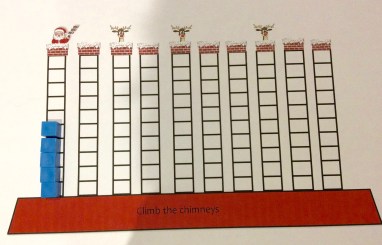
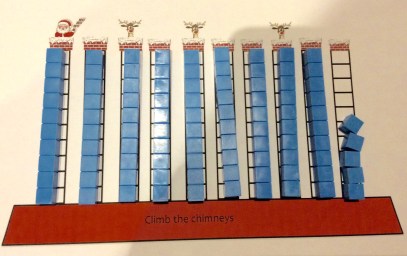
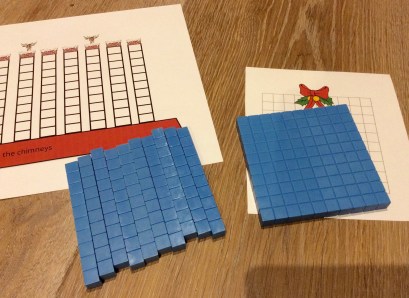
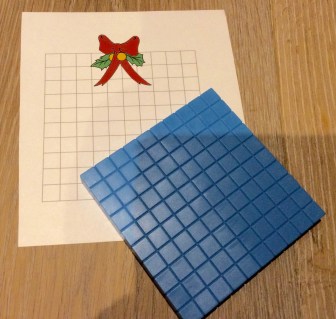
How to play: Children have a board each and take turns to throw the dice. The number they roll indicates how many “ones” they count and place on the first chimney. When they have 10 “ones”, they exchange them for one “ten” and put that on the chimney. Continue until they have 10 tens. When they have 10 tens they exchange this for one “hundred” and collect a present.
Throw the dice, collect the ones and put them on the first chimney.When you have 10 ones, exchange them for 1 ten.Continue in this way until you have 10 tens – you have to have the exact number to finish.Now exchange your 10 tens for one 100 block and claim your present.
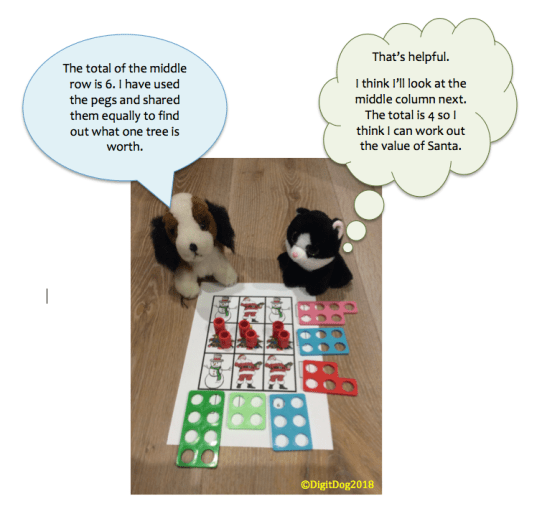
Place the pictures (download here) on the grid so that no pictures that are the same are placed next to each other in any column or row e.g. you cannot have two snowmen in squares next to each other. An activity that encourages children to think logically, check their work and explain their thinking.
Explain how you did it. How did you start? Have you checked that you have followed Digit Dog’s rule?
Is there more than one way to do it?
Digit Dog did this.
Calculating Cat did this.
What do you notice? What is the same and what is different about their grids?













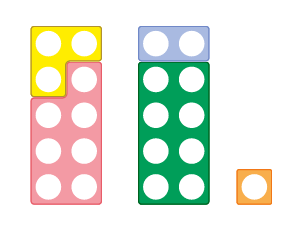

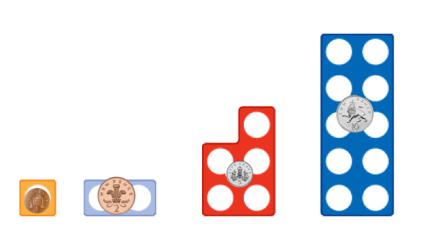

 Vary the amounts and the coins you can use.


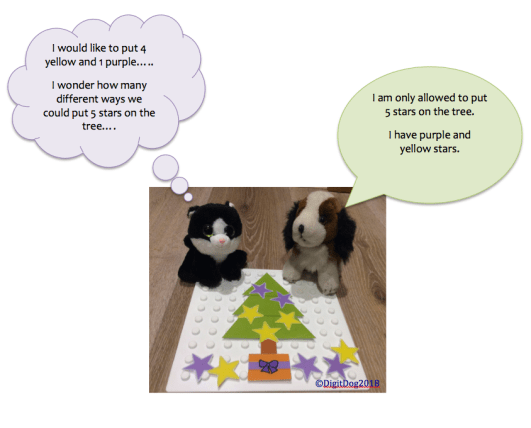 An activity to explore numbers that total 5.




 Digit Dog Challenges