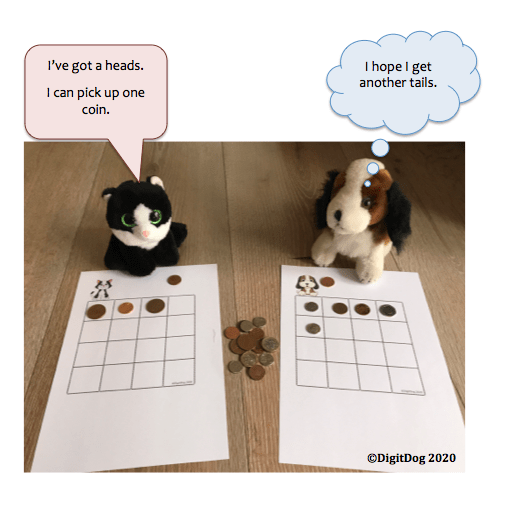
Select the coins that go in the centre according to the needs of the child:
just use one pence coins for a simple counting game.
use coins up to 10p to make calculating easier.
use 5p, 10p and 20p to practise countng in 5s and 10s.
Change the rules:
The game ends when the first person fills their grid but the winner is the player with the most money on the board. If this is the rule, which coins are you going to try and pick up?
The game ends when the first person fills their grid but the winner is the player with the least money on the board. How does changing the rule change the way you choose coins? Which coins do you want to pick up now?
Point at a number and then find that number of objects.
Point at a number –what is 10 more than that number?
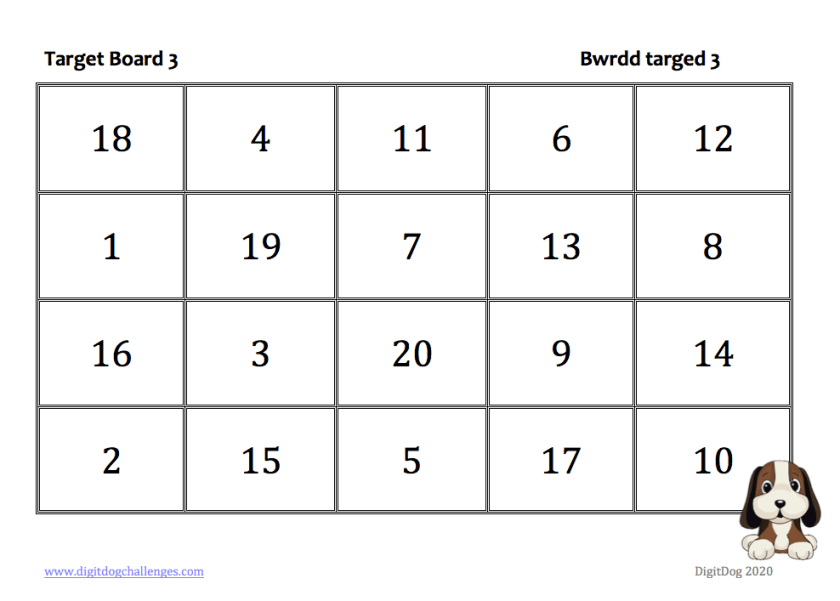
Ask children to look at the target board and:
Find two numbers that total / add up to 20.
How do you know you are correct?
How did you work it out? Explain your thinking.
How many pairs of numbers can you find?
Make a list of the pairs you find.
Make up a number story to go with your pairs of numbers e.g. 13 + 7 = 20 There were 13 ladybirds sitting on a leaf, 7 more came along and now there are 20.
Find more than two numbers that total 20?
Find numbers that make other totals.
Find the total of the numbers in the first column.How did you work it out? Which numbers did you add first? What did you notice? Did you notice that 18 + 2 = 20? How does this help?
Find the sum of the numbers in the bottom row. How did you do that? Which numbers did you add first? What did you notice? What is the easiest way to add up the numbers?
Find the column with the highest total. Which column is easiest to add up? Why?
Find the number that is double 1, double 2, double 3………..
Find the number that is half of 10, half of 12………
Find two numbers with a difference of 2, a difference of 4…………
Make a list of your numbers. Put them in order. What do you notice? Can you find any patterns?
Problem solving with the target board
My total is 16 – find two numbers that you can add together to make my total. Can you find three numbers to make my total?
One of my numbers is 7. When I add it to another number, my total is 13. What is my second number?
I am thinking of a number and when I count on 5, I say 14. Find the number I started with.
I am thinking of a number and when I count back 3, I say 8. Find the number I started with.
I am thinking of a number. I doubled it to make 16. What is my number?
My difference is 5 – find two numbers on the target board that have a difference of 5.
I am thinking of two numbers. When I take away the smaller from the larger my answer is 4. What numbers could I be thinking of?How many pairs of numbers can you find? How do you know you have found them all?
One of my numbers is 15. When I subtract another number, I am left with 9. What is my second number?
Put objects on each number – check that you have the correct amount.
Say the numbers in order.
Subtraction and the target board.
Ask children to:
Choose a number and take away 1. Write a number sentence to show what you have done e.g. 4 – 1 = 3. Use objects to help if you need to. Try taking away other numbers.
Choose two numbers and take the smallest number away from the largest. Write a number sentence to show what you have done.
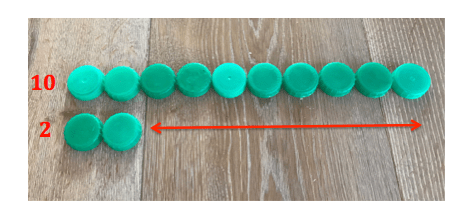
Choose two numbers and find the difference between the numbers e.g. the difference between 10 and 2 is 8. Use bottle tops to help work this out.
Find two numbers on the board with a difference of 1.
How do you know you are correct?
How did you work it out? Explain your thinking.
How many pairs of numbers with a difference of 1 can you find? Make a list of the pairs you find.
Practise counting back. Choose two numbers and count back from the larger to the smaller e.g. if you choose 4 and 9, you start at 9 and say 9, 8, 7, 6, 5, 4.
Use a number line to count back. Choose a number on the target board, count back 2, what number are you on now?
I chose 10: 10 count back 2 is 8; 10, then 2 less is 8; 10 – 2 = 8
Make up a number story to go with your pairs of numbers, e.g. if you choose 4 and 6 you might say:
“Digit Dog had 6 bones in his dish. He ate 4 of them. How many does he have left?”
“Calculating Cat had 6p in her purse and she spent 4p. How much does she have left?”
“Digit Dog has 6 bones and Calculating Cat has 4. How many more bones does Digit Dog have?”
Make up some problems for someone else to solve.
Problem solving with the target board
My difference is 3 – find two numbers on the target board that have a difference of 3.
I am thinking of two numbers. When I take away the smaller from the larger I am left with 2. What numbers could I be thinking of?
One of my numbers is 7. When I subtract another number, I am left with 5. What is my second number?
I am thinking of a number. I count back 3 and get to 4. What number did I start with?
Put objects on each number – check that you have the correct amount.
Say the numbers in order.
Practise addition with the target board.
Ask children to:
Find two numbers that total 5.
How do you know you are correct?
How did you work it out? Explain your thinking.
How many pairs of numbers can you find?
Make a list of the pairs you find.
Find numbers that total 10.
How do you know you are correct?
How did you work it out? Explain your thinking.
How many pairs of numbers can you find?
Make a list of the pairs you find.
Make up a number story to go with your pairs of numbers, e.g. 3 + 2 = 5 Digit Dog ate 3 bones for breakfast and 2 bones for dinner. He ate 5 bones altogether. How many different stories can you make?
Find other totals and make up stories to go with them.
Find the total of the numbers in the first column. How did you work it out?
Find the sum of the numbers in the bottom row. How did you do that?
Find the column with the highest total. Which column is easiest to add up? Why?
Find the number that is double 1, double 2, double 3………..
Point at a number and say what double that number is e.g. point at 5 and say “double 5 is 10”
Problem solving with the target board
My total is 8 – find two numbers that you can add together to make my total. Can you find three numbers to make my total?
One of my numbers is 5. When I add it to another number, my total is 7. What is my second number?
I am thinking of a number. I count on 3 and get to 8. What number did I start with?
I am thinking of a number. I doubled it to make 8. What is my number?
Try using the flik-flaks to practise and use multiplication facts.
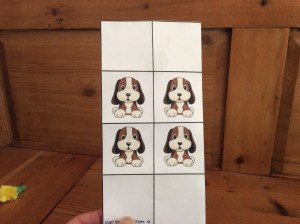
Practise counting in 2s by folding the Digit Dog flik-flak in half and asking:
How many dogs can you see?
How many eyes can you see?
How do you know? Tell me a number sentence.
Each dog has 2 eyes – 2, 4, 6, 8, 10
Five 2s equal 10, 5 lots of 2 equal 10, 5 groups of 2 equal 10, 2 five times equals 10, 5 x 2 = 10
1 dog has 2 eyes 1 x 2 = 2
2 dogs have 4 eyes 2 x 2 = 4
3 dogs have 6 eyes 3 x 2 = 6………..and so on
What patterns can you see? What do you notice about the number of eyes?
Repeat but this time count number of ears.
Challenge:
You can see 5 dogs but how many dogs are hidden? How many eyes are hidden? How did you work it out? Explain your thinking.
If I can see 12 eyes, how many dogs can I see?
Counting in steps of more than 2
You can practise counting in different steps by choosing different flik-flaks and repeating these activities. There are a range of flik-flaks available on www.primarytreasurechest.com
Subitising (recognising small amounts without counting)
Number bonds
Multiplication facts
Using mathematical language
Using reasoning skills
Number bonds
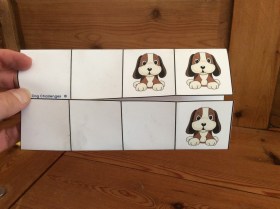
Look for patterns within numbers and help children understand that numbers are composed of smaller numbers e.g. fold the Digit Dog flik-flak in half as shown, ask How many dogs can you see? What else can you see? I can see 4 and 1, and 3 and 2……..Explain your thinking. Repeat by folding to show other numbers.
Use the flower flik-flak, fold it in half to show 6 flowers.
What do you notice? How many flowers can you see? How many purple? How many red? How many yellow? How many altogether?
Use the flik-flaks as a quick way to practise number bonds to 10 (the pairs of numbers that add togther to make 10).
Show children the flik-flak and ask:
“How many dogs can you see?” “How did you count them?”
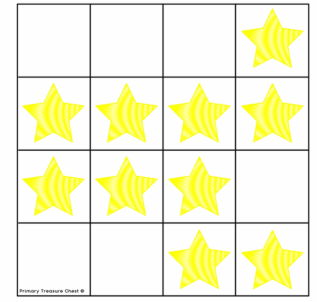
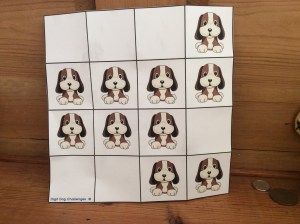
Explore the numbers of dogs in each row and column. Ask questions such as “Which row has most dogs?” “Which row has the fewest dogs?” “Which row has one more than the bottom row?”
Explore the groups of dogs you can see. I can see 5 dogs on the top half and 5 dogs on the bottom, 5 + 5 = 10
Before continuing, make sure children are confident that there are 10 dogs altogether.
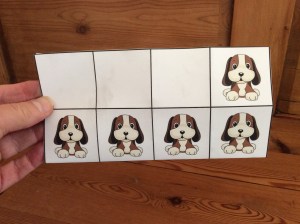
Fold the flik-flak:
Ask:
“How many dogs can you see now?”
“How many dogs are hidden?” “How many dogs can’t you see?” “How do you know?” “Explain your thinking”.
“How many dogs altogether?”
You want children to realise that they know there are 10 dogs altogether, that they can see 5 of them and need to work out how many of the dogs they can’t see. They might:
Count on from 5 to 10
Take away the 5 from 10
Use their knowledge that 5 and 5 equals 10
Expect children to explain their thinking.
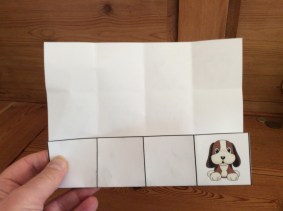
Fold the flik-flak in a different way:
Ask the same questions.
“How many dogs can you see now?”
“How many dogs are hidden?” “How do you know?” “Explain your thinking”.
“How many dogs altogether?”
Keep folding the flik-flak to explore all the combinations of numbers to make 10.
I can see 1 dog. 9 dogs are hidden. 9 + 1 = 10I can see 3 dogs. I know 7 are hidden because 3 +7 = 10.I can see 7 dogs, so 3 dogs must be hidden because 3 + 7 = 10
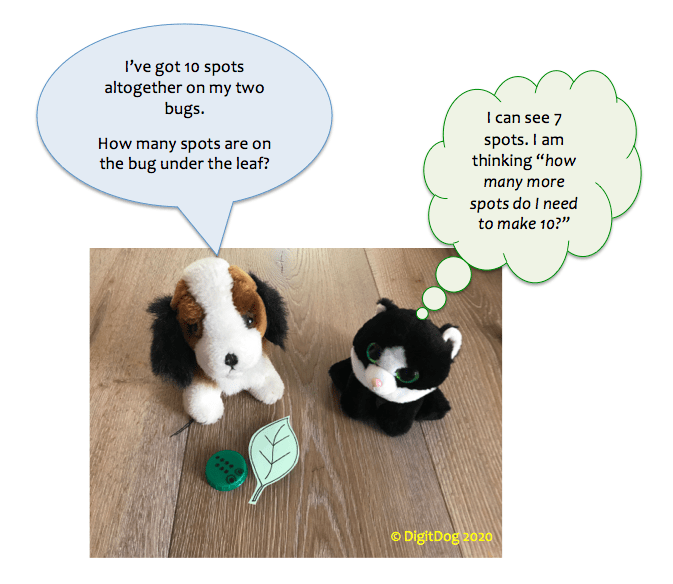
Digit Dog is using the bottle top bugs and leaves to create some number problems.
This type of problem encourages learners to think and talk mathematically and use the link between addition and subtraction.
Ask children to:
Explain what the problem is about in their own words.
Explain what information they know and what they are trying to find out. How many spots are on the bug they can see? What number of spots cannot be under the leaf?
Find a way to work out how many spots are on the bug under the leaf.
Describe the strategy they have used. They might:
use counters to represent the spots and work out how many more they need to make 10
draw pictures of the bugs
use number bonds – the numbers that add together to make 10.
I know that 7 + 3 = 10 so there must be a 3-spot bug under the leaf.
I know that 10 – 7 = 3 so there must be a 3-spot bug under the leaf.
Convince everyone that their answer is correct. Use sentence starters such as:
I know the answer is 3 because ….
First of all I…………then I………
I know that …….. so…………
Write a number sentence
Change the bugs – choose two different bugs, work out the total number of spots and then hide one under a leaf.
What if……….
……..you tried it with 3 bugs? Work out the total and then hide one bug under a leaf.
……..you tried multiplying the numbers? Hide one bug under a leaf but this time say “the product of my numbers is…..”











 Digit Dog Challenges