Show these slides for a couple of seconds to practise saying how many objects there are without counting in ones.
To play:
Open slideshow.
Click once to reveal an image, click again for it to disappear.
Ask: “How many Digit Dogs can you see?”
At first learners will want to count each dog and you will need to leave the image on the screen. Practise recognising the groups of dogs and saying how many there are without having to count each one. How quickly can you do this?
Being able to look at a small set of objects (up to 5) and say how many there are without counting in ones is called subitising. Once children can count objects accurately we want them to move onto subitising, this is an important step in the development of number sense.
It is easier to subitise if objects are arranged in recognisable patterns, such as the dice dot patterns or on ten-frames. The frames are used so that learners can relate numbers to 5 and 10, an important understanding for calculation.
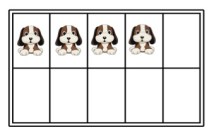
I know there are 5 spaces in each row, so I can see this 4 in relation to 5. 4 is one less than 5.
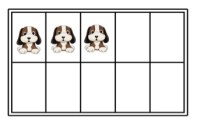
Perceptual subitising – instantly recognising a small group of objects, usually up to 5 or 6.
How many Digit Dogs can you see?
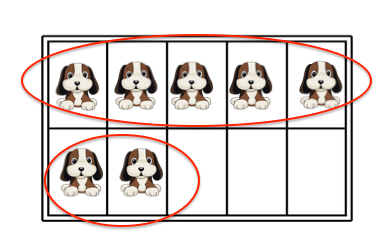
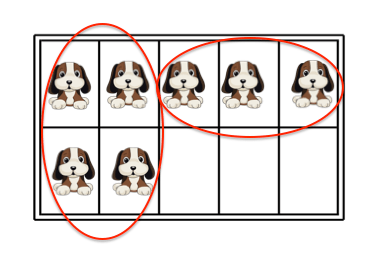
Conceptual subitising – seeing smaller groups of objects within a larger group to say how many there are without counting in ones. We do this when there are more than 5 or 6 objects.
I know there are 7 because I see 5 and 2 more.
I know there are 7 because I can see 4 and 3 more.
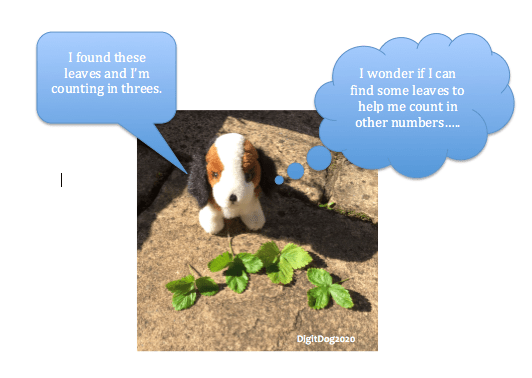
Digit Dog is out in the garden again. This time he is counting leaves.
See if you can find some leaves that are arranged in threes.
Put the leaves in front of you, counting in threes as you go. Now take them away and count back in threes. Write the numbers you are saying. Find the numbers on digit cards or on a number line.
Digit Dog has 4 groups of 3 leaves. He has 12 leaves altogether.
What if he had 6 groups of 3 leaves? How many leaves would he have then?
What if he had 15 leaves altogether? How many groups of 3 would he have?
Make up some questions like this to ask someone about your set of leaves.
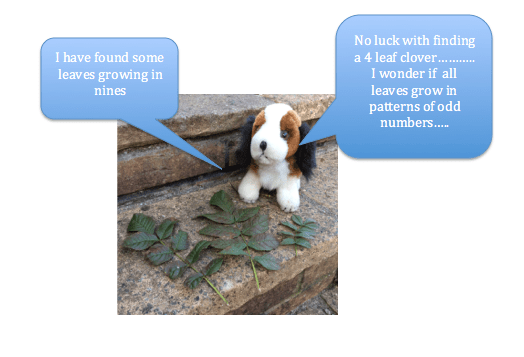
What about finding leaves that are arranged in different numbers?
An important part of learning mathematics is using and understanding mathematical vocabulary. Children need this vocabulary to talk about their work, to ask questions and to explain their thinking.
Target boards are grids with numbers or pictures that can be used to practise using mathematical language.
Counting and recognising numbers with Target Board 4
Print Target Board 4.Point at any box on the target board and ask children to say the number. Point to a number and ask children to say the number of tens and number of ones in that number.
Ask children to:
Find the number 12, or 50 or……….
Put the numbers in the first row in order. Which number is the smallest? Which number is the largest?
Find the largest number on the board.
Find the number that is one more than 35, one more than 11………
Find the number that is two more than 22, two more than 43………
Find the number that is one less than 12, one less than 28……….
Find the number that is two less than 38, two less than 10………
Find all the odd numbers. Find all the even numbers.
Does every column have an even number?
Does every column have an odd number?
Find the number that is ten more than 14, ten more than 40…….. What do you notice?
Find the number that is ten less than 55, ten less than 37…….. What do you notice?
Point at, or put counters on, two numbers. Count from the smallest number to the biggest number and back again.
Choose a number. Count from that number in 2s up to 60 or beyond. Now count back in 2s to your number.
Choose a number. Count in tens from your number. How far can you count?
Now get children to ask their own questions so that they learn to use the correct vocabulary.
An important part of learning mathematics is using and understanding mathematical vocabulary. Children need this vocabulary to talk about their work, to ask questions and to explain their thinking.
Target boards are grids with numbers or pictures that can be used to practise using mathematical language.
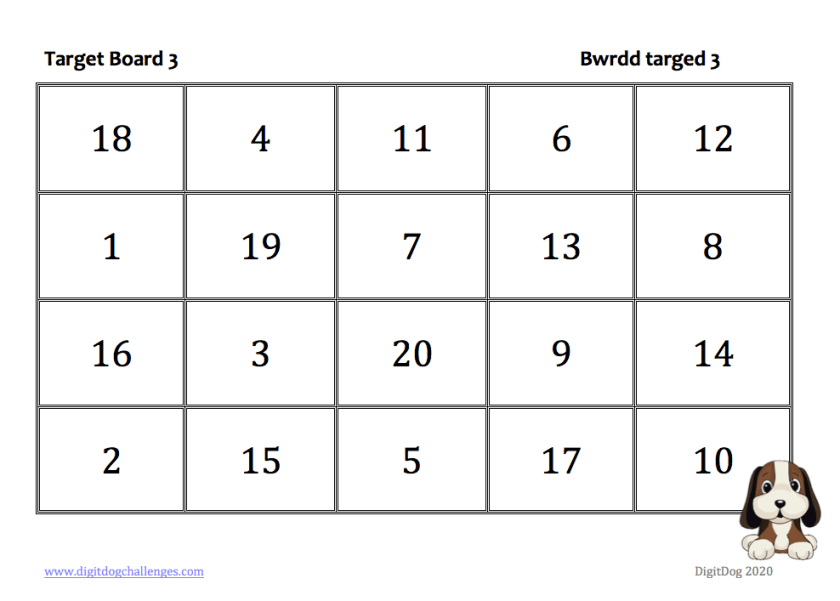
Counting and recognising numbers with Target Board 3
Print Target Board 3. Point at any box on the target board and ask children to say the number. Point to a number and ask children to collect that number of objects. Put sets of objects more than 10 into groups of 10 and some more, e.g. 17 objects will be organised into one group of 10 and 7 more. Put the objects onto 10 frames to support this idea of a group 10 and some more.
Ask children to:
Find the number 12, or 16 or……….
Put the numbers in the first row in order. Which number is the smallest? Which number is the largest?
Find the number that is one more than 13, one more than 8……….
Find the number that is two more than 16, two more than 7………
Find the number that is one less than 15, one less than 19……….
Find the number that is two less than 20, two less than 5………
Find an odd number. Find an even number.
Does every column have an even number?
Does every column have an odd number?
Find the number that is ten more than 6, ten more than 5…….. What do you notice?
Find the number that is ten less than 16, ten less than 15…….. What do you notice?
Now get children to ask their own questions so that they learn to use the correct vocabulary.
Play Bingo.
You need a board each, sets of digit cards 1 – 20 (you will need one set per player) and objects to cover the numbers on the board (use buttons, counters, milk bottle tops, small toys.
Shuffle the digit cards and place in a pile face down. Take turns to turn over the top card, say the number and cover it on your board. The first to cover the board is the winner.
Variations
The winner is the first to complete a row or a column.
Play Ten More / Ten Less Bingo. Use digit cards 0 – 20. Take turns to turn over the top card, but say the number that is either 10 more or 10 less than the number on the card and find the new number on your board.
An important part of learning mathematics is using and understanding mathematical vocabulary. Children need this vocabulary to talk about their work, to ask questions and to explain their thinking.
Target boards are grids with numbers or pictures that can be used to practise using mathematical language.
Counting and recognising numbers with Target Board 2
Print Target Board 2. Point at any box on the target board and ask children to say the number. Point to a number and ask children to hold up that number of fingers or do that number of claps, or jump that number of times or collect that number of objects.
Ask children to:
Find the number 2, or 6 or……….
Find a number that is more than 4. Now find a number that is less than 8.
Find the largest number. Find the smallest number.
Put the numbers in the first row in order. Which number is the smallest? Which number is the largest?
Find the number that is one more than 5, one more than 9……….
Find the number that is two more than 3, two more than 7………
Find the number that is one less than 5, one less than 9……….
Find the number that is two less than 3, two less than 7………
Find an odd number. Find an even number.
Does every column have an even number?
Does every column have an odd number?
For numbers up to 20, try the same activities with Target Board 3.
Now get children to ask their own questions so that they learn to use the correct vocabulary.
Play Bingo.
You need a board each, sets of digit cards 1 – 20 (you will need one set per player) and objects to cover the numbers on the board (use buttons, counters, milk bottle tops, small toys.
Shuffle the digit cards and place in a pile face down. Take turns to turn over the top card, say the number and cover it on your board. The first to cover the board is the winner.
Variations
The winner is the first to complete a row or a column.
Play One More Bingo. Use digit cards 0 – 19. Take turns to turn over the top card, but say the number that is one more than the number on the card and find the new number on your board.
Play One Less Bingo. Use digit cards 1 – 21. Take turns to turn over the top card, but say the number that is one less than the number on the card and find the new number on your board.
An important part of learning mathematics is using and understanding mathematical vocabulary. Children need this vocabulary to talk about their work, to ask questions and to explain their thinking.
Target boards are grids with numbers or pictures that can be used to practise using mathematical language.
Counting with Target Board 1
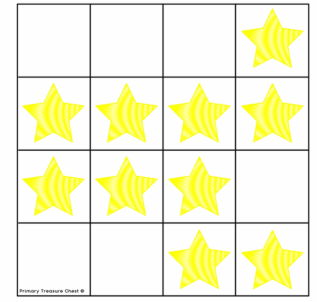
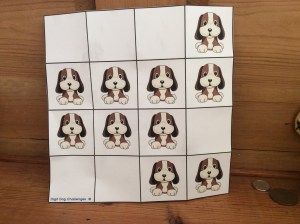
Print Target Board 1.Point at any box on the target board and ask:How many Digit Dogs can you see?Do children count the dogs in ones or do they recognise the arrangement and say the number without counting?
Ask children to:
Point at 2 dogs, 3 dogs, 1 dog ……….
Point at 4 dogs. Now point at more than 4 dogs. Now point at fewer than 4 dogs.
Point at 3 dogs. Now point at 1 more than 3 dogs. Now point at 1 fewer than 3 dogs.
Ask:
Which boxes have the most dogs? Which boxes have the fewest dogs?
Which row has most dogs? Which column has fewest dogs?
How many dogs are in the first row altogether? What about the second row? And the third?
Point to some dogs and ask children to hold up that number of fingers or do that number of claps, or jump that number of times.
Now get children to ask the questions and use the correct vocabulary.
Play Match the Dogs. Put 4 sets of the Digit Dog cards face down in a pile. Take turns to turn over the top card and find the matching picture on your board. How many dogs are on your card? The winner is the first to cover their board.
Play Bingo. Have a board each, roll a dice, say the number rolled and cover that number of dogs with a milk-bottle top/ button/ counter. The winner is the first to cover their board.
Put 4 sets of digit cards 1 – 5 in a pile face down. Take turns to turn over the top card and match the number to the dogs on your board. First to cover their board wins.
Play One More Bingo. Put 4 sets of digit cards 0 – 4 in a pile face down. Take turns to turn over the top card, say the number that is one more than the number on the card and match that number to the dogs on your board. First to cover their board wins.
Try using the flik-flaks to practise and use multiplication facts.
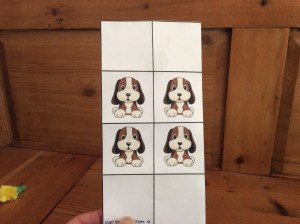
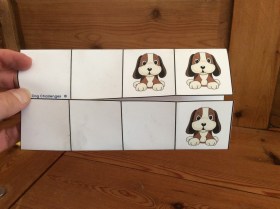
Practise counting in 2s by folding the Digit Dog flik-flak in half and asking:
How many dogs can you see?
How many eyes can you see?
How do you know? Tell me a number sentence.
Each dog has 2 eyes – 2, 4, 6, 8, 10
Five 2s equal 10, 5 lots of 2 equal 10, 5 groups of 2 equal 10, 2 five times equals 10, 5 x 2 = 10
1 dog has 2 eyes 1 x 2 = 2
2 dogs have 4 eyes 2 x 2 = 4
3 dogs have 6 eyes 3 x 2 = 6………..and so on
What patterns can you see? What do you notice about the number of eyes?
Repeat but this time count number of ears.
Challenge:
You can see 5 dogs but how many dogs are hidden? How many eyes are hidden? How did you work it out? Explain your thinking.
If I can see 12 eyes, how many dogs can I see?
Counting in steps of more than 2
You can practise counting in different steps by choosing different flik-flaks and repeating these activities. There are a range of flik-flaks available on www.primarytreasurechest.com
Subitising (recognising small amounts without counting)
Number bonds
Multiplication facts
Using mathematical language
Using reasoning skills
Number bonds
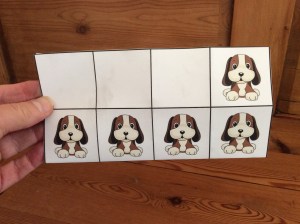
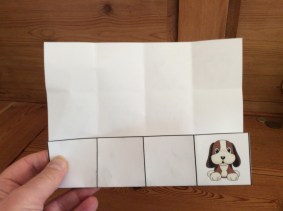
Look for patterns within numbers and help children understand that numbers are composed of smaller numbers e.g. fold the Digit Dog flik-flak in half as shown, ask How many dogs can you see? What else can you see? I can see 4 and 1, and 3 and 2……..Explain your thinking. Repeat by folding to show other numbers.
Use the flower flik-flak, fold it in half to show 6 flowers.
What do you notice? How many flowers can you see? How many purple? How many red? How many yellow? How many altogether?
Use the flik-flaks as a quick way to practise number bonds to 10 (the pairs of numbers that add togther to make 10).
Show children the flik-flak and ask:
“How many dogs can you see?” “How did you count them?”
Explore the numbers of dogs in each row and column. Ask questions such as “Which row has most dogs?” “Which row has the fewest dogs?” “Which row has one more than the bottom row?”
Explore the groups of dogs you can see. I can see 5 dogs on the top half and 5 dogs on the bottom, 5 + 5 = 10
Before continuing, make sure children are confident that there are 10 dogs altogether.
Fold the flik-flak:
Ask:
“How many dogs can you see now?”
“How many dogs are hidden?” “How many dogs can’t you see?” “How do you know?” “Explain your thinking”.
“How many dogs altogether?”
You want children to realise that they know there are 10 dogs altogether, that they can see 5 of them and need to work out how many of the dogs they can’t see. They might:
Count on from 5 to 10
Take away the 5 from 10
Use their knowledge that 5 and 5 equals 10
Expect children to explain their thinking.
Fold the flik-flak in a different way:
Ask the same questions.
“How many dogs can you see now?”
“How many dogs are hidden?” “How do you know?” “Explain your thinking”.
“How many dogs altogether?”
Keep folding the flik-flak to explore all the combinations of numbers to make 10.
I can see 1 dog. 9 dogs are hidden. 9 + 1 = 10I can see 3 dogs. I know 7 are hidden because 3 +7 = 10.I can see 7 dogs, so 3 dogs must be hidden because 3 + 7 = 10
Subitising (recognising small amounts without counting)
Number bonds
Multiplication facts
Using mathematical language
Using reasoning skills.
Counting
Hold up the Digit Dog flik-flak and ask how many dogs can you see? You can fold the flik-flak along the black lines to show all the numbers from 0 to 10. This allows children to practise counting sets of objects up to 10.
Give children their own flik-flak and ask them to:
Show a single digit number – 1, 2, 3, 4 ……etc.
Show the numbers 0 – 10 in order. How many ways can you show each number?
Show the same number of dogs as you are showing.
Show one less / one more e.g. show me one less than 3, one more than 5….etc. How did you work it out? Can you do it without counting?
More/fewer than I am showing. Explain your answer. e.g. How many dogs am I showing? Can you show me more dogs? Can you show me fewer dogs?
Subitising
Once children can confidently count the dogs by pointing at each one and not making mistakes, encourage them to subitise i.e. to recognise amounts without counting. When they see 3 dogs, they can say it is 3 without counting 1, 2, 3. They should be able to do this with numbers up to 5.
Counting in 2s
Use the flik-flaks as a quick way to practise counting in 2s.
Show children the flik-flak and ask:
How many dogs can you see? How many eyes can you see? How many ears can you see? How did you count them?
Fold the flik-flak:
Ask:
How many eyes can you see now? How did you count them? Did you count in 2s? Did you say “3 lots of 2”?
Challenge:
I can see 10 eyes. Show me 10 eyes with your flik-flak. How many dogs are there if there are 10 eyes?
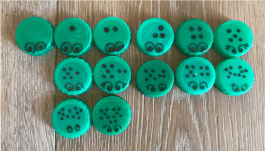
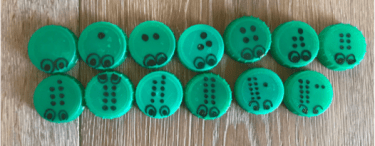
Digit Dog and Calculating Cat are playing with the bottle top bugs (make them with milk bottle tops).
Put your bottle top bugs in a feely bag or a box or under a tea towel. Each player takes one bug out, puts it in front of them and says how many spots there are. The player with more spots captures the bugs. Keep playing until you have used all the bugs. The winner is the one to have captured most bugs.
Who has more spots? How many more?
Who has fewer spots? How many fewer?
Say how many spots there are without counting in ones. Calculating Cat knows she has 11 spots because she counted 5 + 5 + 1.
What if…….
…….the player with fewer spots wins?
…….players take out two bugs, add the number of spots and compare the totals? The player with the greater total captures the bugs.










 Digit Dog Challenges