Posted in Calculating, Making totals, Number sense

Using Numicon® to explore equivalences

equivalent shapes

The idea of equal value is fundamental to mathematical understanding. Children need to understand that the “=” symbol means “equal value” and not “here is the answer”.

Ask:

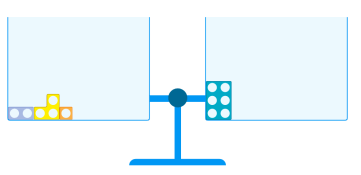
How can you make the scales balance?

Which Numicon® shape could go in the pan balance?

Screenshot 2019-11-11 10.43.28

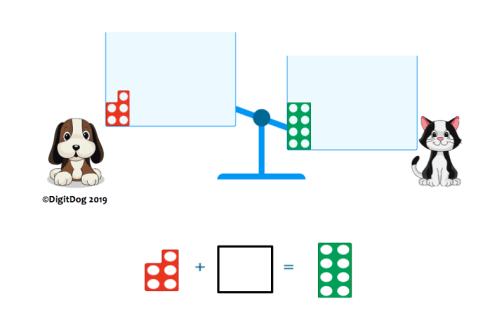
What about this one?

How are you going to solve it? Explain your thinking.

What if ………..you changed the shapes?


Now using numerals.

Screenshot 2019-11-13 11.41.26

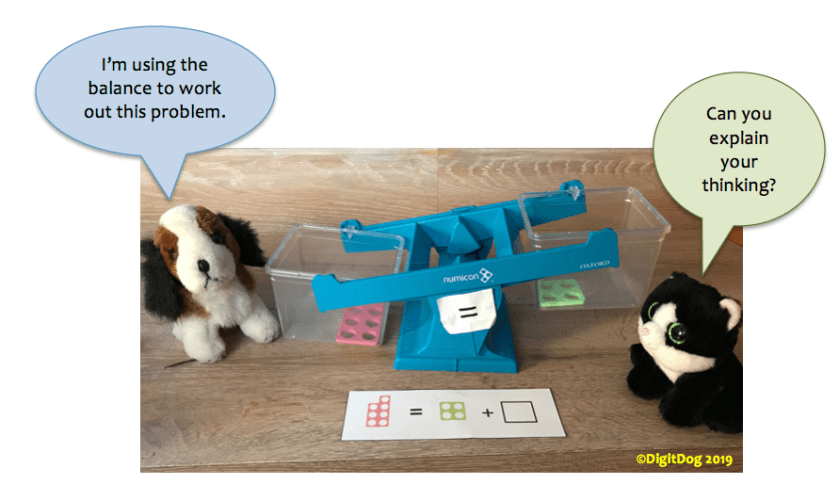
Can you model this with the pan balance and Numicon® shapes?

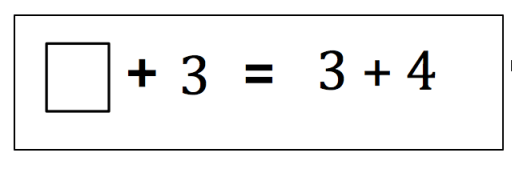
What’s the missing number? Explain how you know. Record the sentence.

Make up some of your own.

Make sets of problems like this to put with a pan balance in your enhanced provision.

Posted in Calculating, Making totals, Numicon

Using Numicon® to find pairs that make 10…..again

Balancing 10

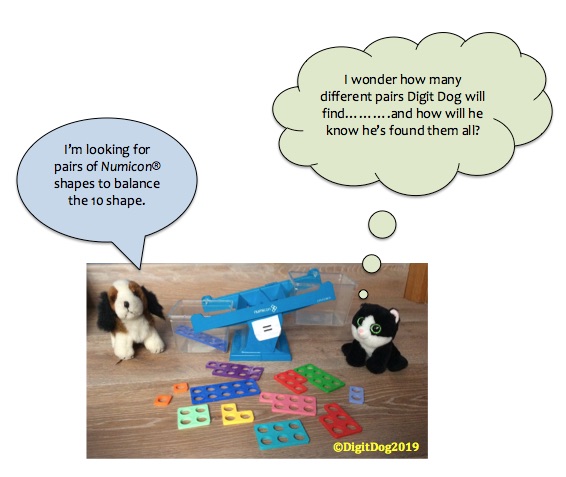
Numicon® shapes are weighted and so are the perfect resource for exploring equivalences. Make sure that learners have had the opportunity to play with the scales and the shapes before doing the challenge.

Ask:

How are you going to record what you have found?

Learners might:

  1. Use the shapes and an equals sign (download here) as a record. Ask children to explain what they have done. Ask:

Are all the pairs different?

How do you know that your pair of shapes are equal to 10?

Screenshot 2019-10-17 18.09.55


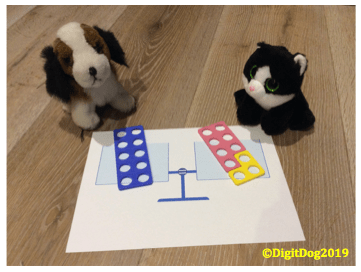
2. Use a pan balance working board (download here) to record the shapes on.

Screenshot 2019-10-17 18.10.54

3. Select a written number sentence (download here) that matches their shapes.

Screenshot 2019-10-17 18.33.40

4. Record in their own way.

5. Record number sentences.

Posted in Making totals, Numicon

Using Numicon® to find pairs that make 10

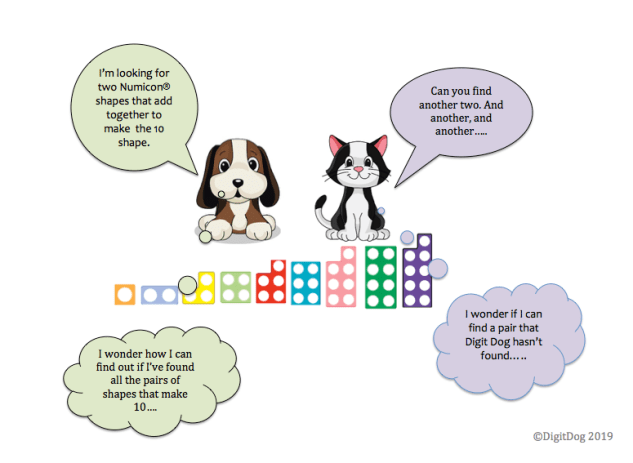
Digit Dog is looking for two Numicon® shapes that are equal to the 10 shape. Calculating Cat is challenging him to find another two shapes, and then another two, and then another two.

Making 10 with Numicon


Find one example, then another, then another, then one your friend hasn’t found is a good strategy to encourage learners to use their reasoning skills. Once they have found one pair of shapes challenge them to find another pair, ask:

Is this pair different?

How will you know when you have found all the pairs?

How are you going to record your work?

Look at the pairs that your friend has found. Are they the same? Different?

Are there any shapes you haven’t used? Why?

Encourage learners to check their pairs by putting them on the 10 shape.

Screenshot 2019-09-26 17.48.19Screenshot 2019-09-26 17.48.11

Can you put your pairs of shapes in order?

Why can’t you use the 5 shape?

What if……….

You choose three shapes to total 10? How many ways can you do it?


Posted in Making totals

Find a pair of cards that make 10, and another, and another……..

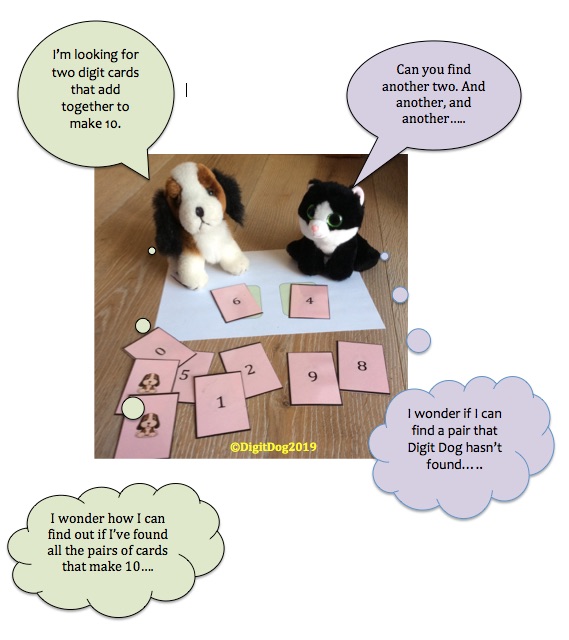
Digit Dog and Calculating Cat are finding pairs of digit cards that make 10.

Digit Dog has found two cards that total 10. Calculating Cat is challenging him to find another two cards, and then another two, and then another two.

Making 10


Find one example, then another, then another, then one your friend hasn’t found is a good strategy to encourage learners to use their reasoning skills. Once they have found one pair of cards challenge them to find another pair, ask:

Is this pair different?

How will you know when you have found all the pairs?

How are you going to record your work?

Look at the pairs that your friend has found. Are they the same? Different?

Look for learners who:

  • are systematic when looking for all the pairs that make 10.
  • can explain how they know they have found all the pairs.
  • are looking for patterns.
  • can organise their work.

What if……….

You choose three digit cards to total 10? How many ways can you do it?

Download a set of Digit Dog’s 0 – 9 cards here  Print double-sided to have DIgit Dog on the back!

Download a baseboard here

Posted in combinations, Easter, Making totals, Money

Coin combinations

Buying an egg

Screenshot 2019-04-08 16.30.42

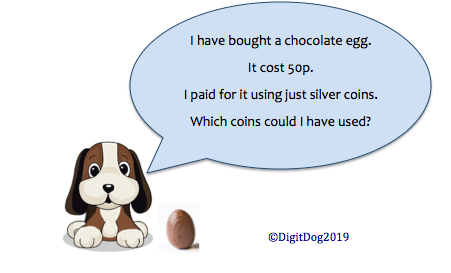
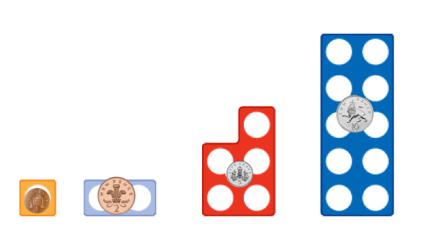
Digit Dog has bought a chocolate egg for 50p. He paid for it using silver coins. Which coins do you think he used? Which coins did he definitely not use? Why?

How many different ways do you think he could pay? Convince me that you have found all the different ways. Explain your thinking.

What is the least number of coins he could use? What is the most?

What if…………..

……..Digit Dog bought something for 50p, 75p, £1……..any amount you like?

……..he could use any coins? How many ways to pay would there be then?

Make up some questions like this for your friends.


Posted in Calculating, Chinese New Year, Making totals

2019 is the Chinese Year of the Pig

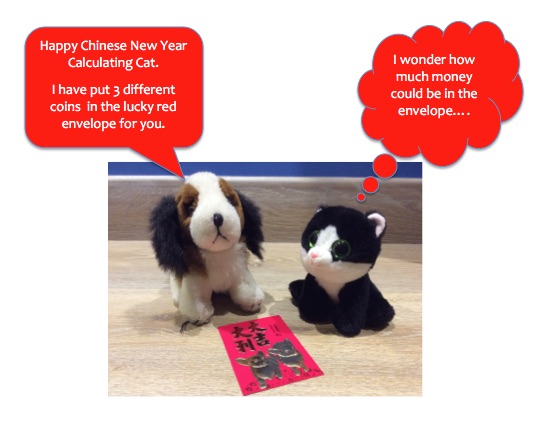
Digit Dog is getting ready to celebrate Chinese New Year which begins on February 5th and ends on February 19th.

He has given Calculating Cat a lucky red envelope with some coins in it. See if you can work out how much money could be in the envelope.

red envelope

Extend the challenge with ideas in the latest challenge card – click here or download from www.primarytreasurechest.com

Posted in Christmas, Making totals

Christmas challenge – day 15

How many in the box?

Screenshot 2018-12-12 18.09.58.png

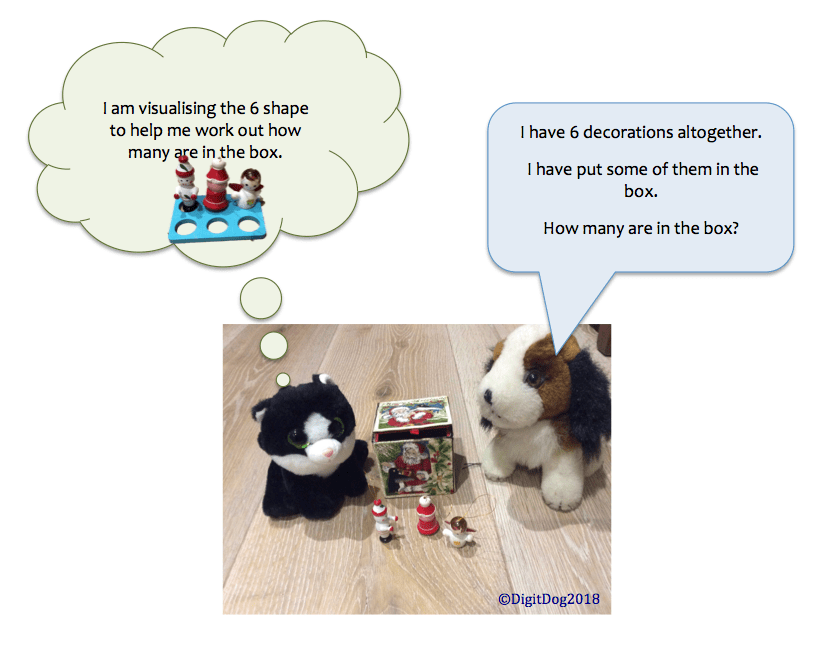
Digit Dog is playing a game with Calculating Cat. He has 6 tree decorations and has hidden some of them in his box. Calculating Cat has to work out how many he has hidden.

Calculating Cat is thinking about the Numicon® shape to help her work out how many are in the box.

  • She knows the whole is 6 – that’s the number of decorations Digit Dog had to start with.
  • She knows one of the parts is 3 – that’s the number of decorations not in the box.
  • Now she can work out the unknown part – that’s the number of decorations in the box – by thinking about the spaces in the Numicon® shape.

Screenshot 2018-12-12 18.18.47.png

She could have solved the problem by using number bonds. If she knows 3 + 3 = 6, she can work out the missing number.

What if………

……….Digit Dog put a different number of decorations in the box?

………..he had more decorations to start with? Fewer decorations?

Try out the game for yourself. One person hides objects in a box, their partner works out how many are hidden. Remember to explain how you work it out.

Posted in Christmas, combinations, Making totals, Money

Christmas challenge – Day 7

7p to spend – combinations of coins

Screenshot 2018-12-05 12.02.42

Digit Dog has bought a chocolate coin for 7p. He paid for it exactly, so which coins did he use?

How many different ways do you think he could do it? Convince me that you have found all the ways.

What is the least number of coins he could use? What is the most?

Which coins do you think he used? Which coins did he definitely not use? Why?

You might want to use your Numicon® purse to help you. Which coins are you going to use?


Screenshot 2018-12-03 17.50.40

Screenshot 2018-12-03 17.51.18
The chocolate coin cost 7p


What if…………..

……..Digit Dog bought something for 8p, 9p, 10p………..any amount you like?

…….he didn’t have the exact money but only had a 10p coin. How much change would he have? Which coins might he be given?

………you used larger amounts?

presentVary the amounts and the coins you can use.

Screenshot 2018-12-03 18.01.40

Posted in Christmas, combinations, Making totals

Christmas challenge – Day 5

5 Christmas stars – investigating 5

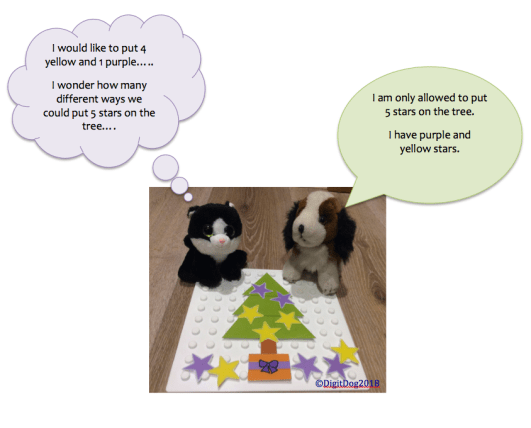
stars on treeAn activity to explore numbers that total 5.

Digit Dog and Calculating Cat have some yellow and purple stars to put on their tree. They can only put 5 stars on the tree and have to decide how many of each colour they use. How many different ways can they do it?

Download tree and stars

Ask:

Look at the picture. What do you notice?

What has Digit Dog done? What is Calculating Cat thinking?

How many different ways do you think they can put the stars on the tree? Why do you think that?

How are you going to record your different ways? How will you remember what you have done?

How do you know you have found all the different ways? Convince me.

Have you found any patterns?

Look for children who are starting to organise their work and systematically look for all the combinations. The activity is about exploring the combinations and reasoning about choices and patterns.

Ways to record

Provide enough stars and trees so that each combination can be kept and checked. Children can then look at all the trees and say what is the same and what is different. Ask them to put the trees in order and look for a pattern.

Have number sentences on card and ask children to match the number sentence to the trees.

Screenshot 2018-12-03 08.32.20

What does the 5 represent? – it is the 5 yellow stars. The 0? – there are no purple stars.

Write number sentences for each tree on separate post-it notes. These can then be sorted and put in order.

Use Numicon shapes to represent the number pairs.

What if…………

There was a different number of stars on the tree? Explore any number.

There were more than two colours of stars?


Posted in Calculating, Making totals, Numicon

Total 6

An extension of Investigating totals

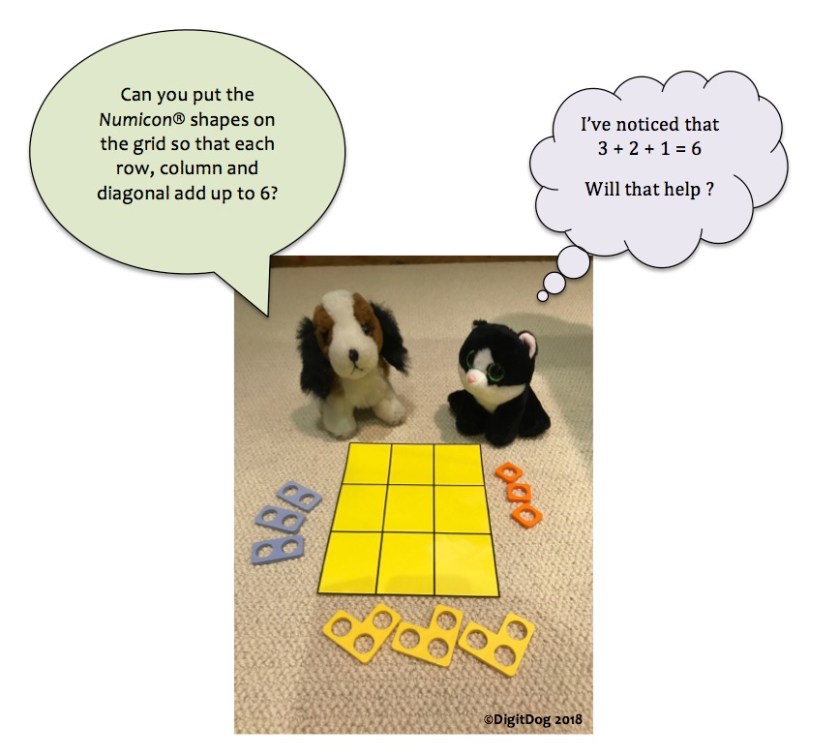
Put the shapes on the grid but this time each row, column and diagonal has to have the same total.

6 grid

You might want to make the task simpler:

  1. Make each row total 6
  2. Make each column total 6
  3. Make the rows and columns total 6
  4. Include the diagonals.

Which shapes are you using in each row / column? Why?

Is there more than one way of completing the grid?

Look at your partner’s grid. What is the same and what is different?

Make the task more challenging:

  1. Use digit cards instead of the shapes.
  2. Don’t give the total – Can you put the Numicon shapes on the grid so that each row, column and diagonal add to the same total?

What do you think the total might be? Why?

How are you going to start? What are you going to try first?

What if.……..you used three different consecutive shapes?

3 twos, 3 threes and 3 fours                                 3 threes, 3 fours and 3 fives

Screenshot 2018-09-26 14.28.32or   Screenshot 2018-09-26 14.28.43

What will the totals of each row be now?

Screenshot 2018-09-26 15.51.01

Posted in Calculating, Making totals, Numicon

Investigating totals

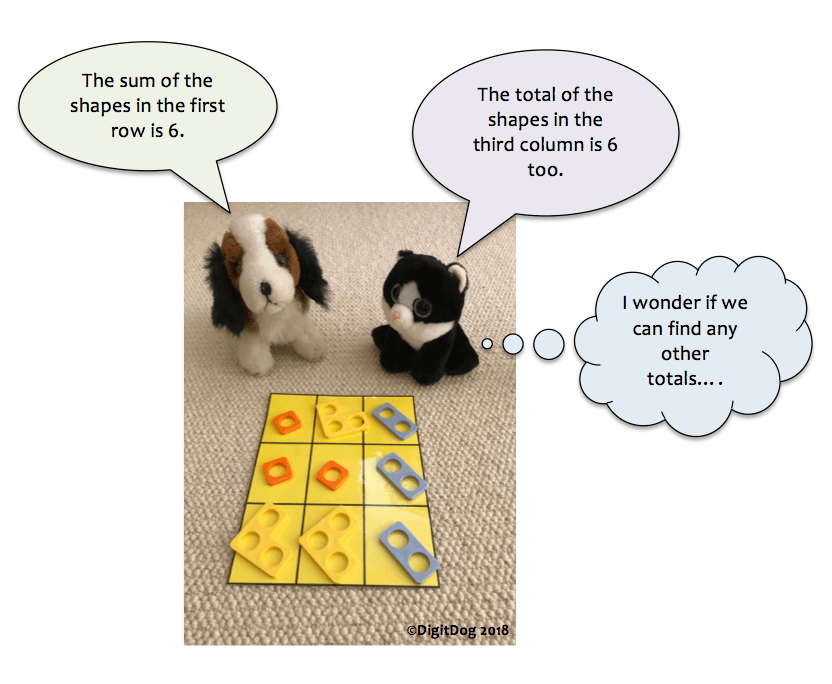
Digit Dog has got a 3 x 3 grid and 9 Numicon shapes – 3 one shapes, 3 two shapes and 3 three shapes. He is going to put the shapes on the grid and investigate the totals he can make.
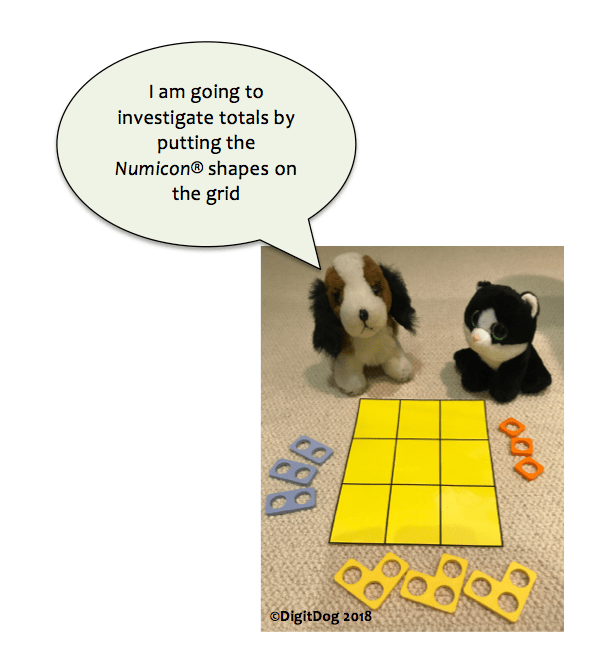
Screenshot 2018-09-23 15.50.21

This is what he does first:

Screenshot 2018-09-23 15.50.32

Copy what Digit Dog has done.

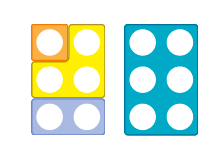
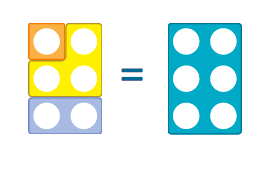
Digit Dog says that the sum of the shapes in the first row is 6. Do you agree with Digit Dog? Why or why not? Are you sure?

Expecting learners to explain their thinking helps develop their reasoning skills.

If you agree, convince me that Digit Dog is correct. If you don’t agree, explain why you think he is wrong.

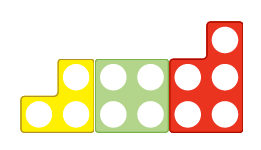
Encourage learners to explain why the total of the first row is 6. Use the Numicon shapes to show that the 3 shapes in the first row are equivalent to a six-shape. Explanations are much easier when you use concrete apparatus.
Screenshot 2018-09-23 18.01.53     Screenshot 2018-09-23 18.01.40

Screenshot 2018-09-23 18.07.13

Use the pan balance to explain.

Calculating Cat says that the total of the shapes in the third column is 6 too. Is she right? How do you know?

What is the same and what is different about Digit Dog’s row and Calculating Cat’s column?

Can you find any other rows or columns that total 6? Are there any that total more than 6? What about less than 6?

Can you find a row or column that totals 1 more than 6? What about 1 less than 6?

What else do you notice?

How are you going to record the totals you have found?

Now arrange the shapes on the grid in any way you want and investigate the totals that you make. What do you notice? What is the largest total you can make? The smallest total?

Look at a grid your friend has done. What is the same? What is different?

What if you used other shapes?

Posted in Making totals, What do you notice?, What's the same / different?

What do you notice?

Screenshot 2018-06-20 11.59.22

What’s the same and what is different about the pairs of bugs?

What has Calculating Cat noticed about the spots?

What patterns can you see?

Look at each pair: which bug has more spots? which bug has fewer spots? How many spots do they have altogether?

What if you were making 6 spots with just one bug? What patterns would you see then?

What if you made other numbers of spots?