Posted in Logical reasoning, Patterns

Making patterns 2

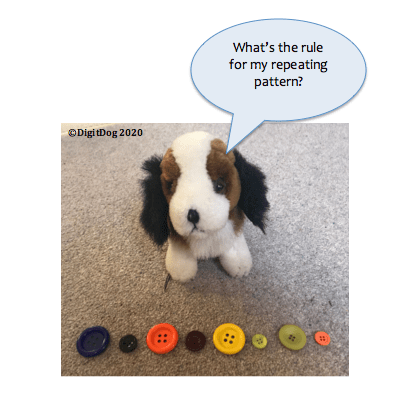
Digit Dog has made another AB pattern using buttons.

buttons AB

Can you work out the rule?

What sort of button would come next?

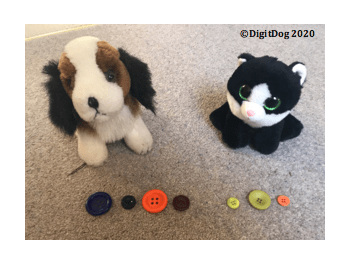
Play What’s missing?

what's missing buttons

What sort of button needs to go in the gap?

Make your own repeating pattern, take one object away and ask someone to work out what is missing.

You can use anything to make a pattern………..

Screenshot 2020-06-01 12.24.47Screenshot 2020-06-01 12.24.41

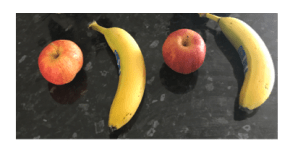
Look at Calculating Cat’s pattern.

Screenshot 2020-06-01 12.28.50

What is the rule?

Why is it different from the previous patterns?

This pattern has 3 objects in the repeat.

Orange, blue, pink, orange, blue, pink ………..

ABC, ABC………….

What colour button comes next?

Posted in Logical reasoning, Patterns

Making patterns

Pattern is an important part of mathematics. Recognising that a sequence of objects makes a pattern, being able to copy, extend and explain the pattern is an important step towards understanding number patterns.

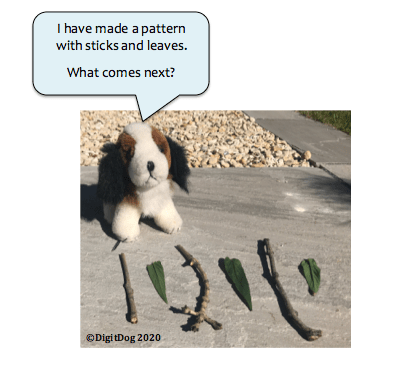
Digit Dog has been making a repeating pattern – a sequence that is governed by a rule. What is Digit Dog’s rule?

outdoor AB pattern DD

Can you copy Digit Dog’s pattern?

Can you continue the pattern?

Calculating Cat has also made a repeating pattern.

outdoor AB pattern CC

Look at both patterns.

What is the same? What is different?

These are both AB patterns. Two objects form the repeating unit.

Digit Dog has used a stick and a leaf:

Stick, leaf, stick, leaf, stick, leaf…………..

A, B, A, B, A, B……………..

Calculating Cat has used different objects but there are still two objects repeating over and over:

A, B, A, B, A, B……………..

Leaf, stone, leaf, stone, leaf, stone ………….

Can you make an AB pattern?

Start a pattern and see if someone else can continue it.


Posted in Counting, Games, Money

Collect the Coins – variations

Here are some variations for Digit Dog’s Collect the Coins game

Screenshot 2020-05-21 10.27.13

A game for two players

You need:

  • A counter for each player to move round the board.
  • A dice.
  • Coins to put in the bank (put them on the star).

To play the original game:

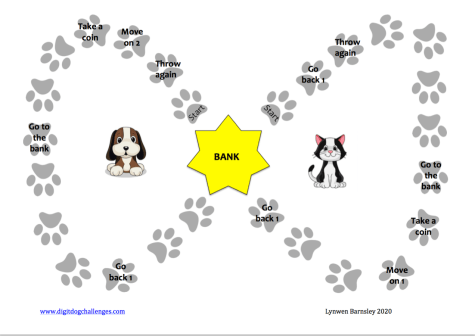
  • Each player choose a track and put your counter on start.
  • Take turns to throw the dice and move along the track.
  • Keep going round your track. If you land on the bank, collect two coins. If you pass through the bank, collect one coin.
  • The winner is the first to collect 5 coins.

Variations

Play the game until all the coins have gone from the bank. The winner is the person with the most coins. Count the coins then name the coins.

Put coins of different value in the bank. Play until all the coins have gone. The winner is the one with the largest amount of money.

Put coins of the same value in the bank e.g. all 5p coins to practise counting in 5s when the coins are totalled at the end of the game.

Decide on an amount to collect e.g. 10p. The winner is the first player to collect that amount exactly.

Posted in Counting, Games, Money

Collect the Coins

Play Digit Dog’s Collect the Coins game

Screenshot 2020-05-21 10.27.13

A game for two players

You need:

  • A counter for each player to move round the board
  • A dice
  • Ten coins to put in the bank (put them on the star)

To play:

  • Each player choose a track and put your counter on start.
  • Take turns to throw the dice and move along the track.
  • Keep going round your track. If you land on the bank, collect two coins. If you pass through the bank, collect one coin.
  • The winner is the first to collect 5 coins.
Posted in Calculating, Logical reasoning, Money

Toss the coin – nasty version

Toss the coin

Here’s a variation on the Toss the coin game.

You need:

A board for each player,

Two coins to toss,

A pile of coins to choose from (at least 32 for 2 players)

To play:

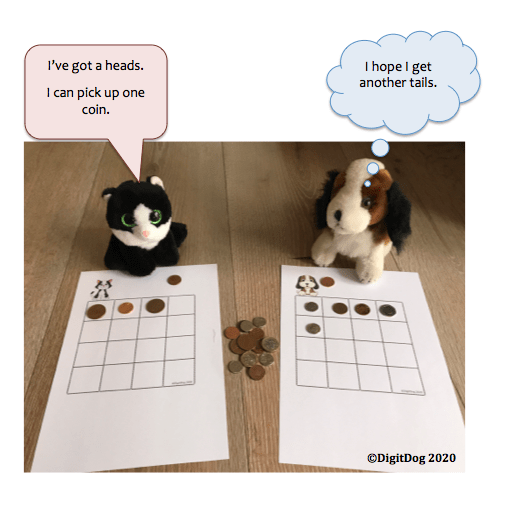
Take turns to toss your two coins:

  • One head and one tail – pick up two coins from the pile.
  • Two tails – take a coin from the other player’s grid.
  • Two heads – give one of the coins from your grid to the other player.


Put the coins on your grid, one on each square.

The game ends when one grid is full.

The winner is the player with the most money.

Which coins will you take from the other player? Which ones will you give away? Why?


Posted in Calculating, Fluency, Money

Toss the coin

Digit Dog has got a new game.

Toss the coin

To play the game you will need:

  • A board for each player (download boards here),
  • A coin for each player to toss,
  • A pile of assorted coins to choose from (at least 32 for 2 players).

To play:

Take turns to toss your coin. If it’s heads, choose one coin from the pile. If it’s tails, choose two coins.

Put the coin(s) on your grid, one on each square.

The first player to cover their grid wins.

At the end of the game count how much money you have altogether on your grid.

Variations

Use this board which has a smaller grid.

Screenshot 2020-05-19 12.17.46

Select the coins that go in the centre according to the needs of the child:

  • just use one pence coins for a simple counting game.
  • use coins up to 10p to make calculating easier.
  • use 5p, 10p and 20p to practise countng in 5s and 10s.

Change the rules:

The game ends when the first person fills their grid but the winner is the player with the most money on the board. If this is the rule, which coins are you going to try and pick up? 

The game ends when the first person fills their grid but the winner is the player with the least money on the board. How does changing the rule change the way you choose coins? Which coins do you want to pick up now?

Posted in Calculating, Logical reasoning, Money, Problem solving

How much is in the purse?

5 coins

Calculating Cat has 5 coins in her purse.

Think about which coins they could be. Get some coins and work out the possibilities.

What is the largest amount that could be in the purse? Which coins would that be?

What is the smallest amount that could be in the purse? Which coins would that be?

Digit Dog thinks that Calculating Cat might have 6p in her purse. Which coins is he thinking of? What about 10p?

Explore which coins could be in the purse. How many different amounts could there be?

Record the different amounts you have found.

Organise your answers so that you can be systematic and work out all the possible amounts.

What if there were fewer coins in the purse? Try it with just 2 or 3 coins.

What if the coins in the purse were silver coins?

What if there were only 1p, 2p, 5p and 10p coins in the purse?

What if no coin was worth more than 20p?


Posted in Counting, Fluency, Mathematical language

Counting leaves

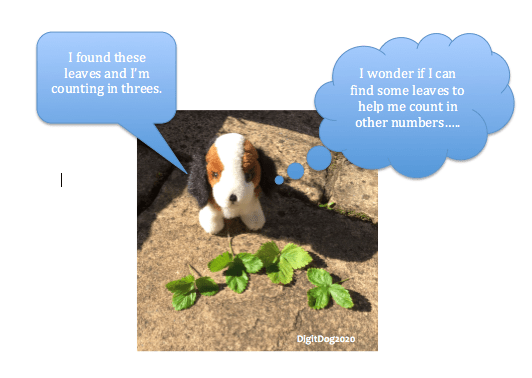
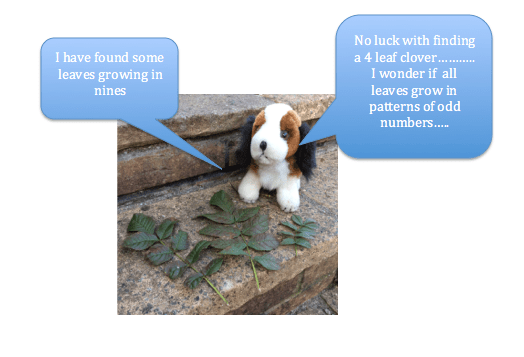
Digit Dog is out in the garden again. This time he is counting leaves.

counting in threes

See if you can find some leaves that are arranged in threes.

Put the leaves in front of you, counting in threes as you go. Now take them away and count back in threes. Write the numbers you are saying. Find the numbers on digit cards or on a number line.

Digit Dog has 4 groups of 3 leaves. He has 12 leaves altogether.

What if he had 6 groups of 3 leaves? How many leaves would he have then?

What if he had 15 leaves altogether? How many groups of 3 would he have?

Make up some questions like this to ask someone about your set of leaves.

What about finding leaves that are arranged in different numbers?

leaves in nines

What do you think?

Posted in Length, Mathematical language

Sticks in order

The sun is shining and Digit Dog has been in the garden collecting sticks.

sticks in order

sticks in order W

He noticed that his sticks were different lengths and put them in order.

See if you can find some sticks and put them in order.

Talk about your sticks:

Say how many you have found.

Choose two sticks and say “This one is longer than this one”.  “This one is shorter than this one”.

Choose more than two sticks and say which is the shortest and which is the longest.

Make a set of sticks that are all the same length.

Choose one stick and look for other objects that are longer than it, shorter than it and the same length as it.

Make some pictures using your sticks. Have a look at this idea on www.creativestarlearning.co.uk


Posted in Additive relationships, Calculating, Fluency, Problem solving

Counting and calculating with target boards – numbers to 100

Develop fluency with the target boards. Use the target boards to:

  • recall and remember useful number facts;
  • use number facts to calculate mentally;
  • explain thinking and methods of calculating.
  • use mathematical language correctly

Target board 4

Print Target Board 4

  • Say each number out loud.
  • Say the numbers in order – from smallest to largest and back again.
  • Point at a number – how many tens and how many ones make that number?
  • Point at a number – what is 10 more than that number?
  • Point at a number and count in 10s from that number. How far can you count?

Look at the target board and:

Find two numbers that total / add up to 30 / 40 / 50.

Find more than two numbers that make those totals.

Choose your own totals to make.

Record your work.

  • How do you know you are correct?
  • How did you work it out? Explain your thinking.

Find two numbers with a difference of 10, a difference of 12………… What other differences can you find?


Find the column with the highest total. Which column is easiest to add up? Why?

Find the number that is double 14, double 7, double 20………..

Find the number that is half of 80, half of 36………

Find the answer to 5 x 2, 9 x 5, 3 x 4…………..make up some questions of your own.


Find numbers that are multiples of 5 (are in the 5 times table), multiples of 2, multiples of 10……..


Posted in Additive relationships, Calculating, Fluency, Problem solving

Calculating with target boards (4)

Develop fluency with the target boards. Use the target boards to:

  • recall and remember useful number facts;
  • use number facts to calculate mentally;
  • explain thinking and methods of calculating.
  • use mathematical language correctly.


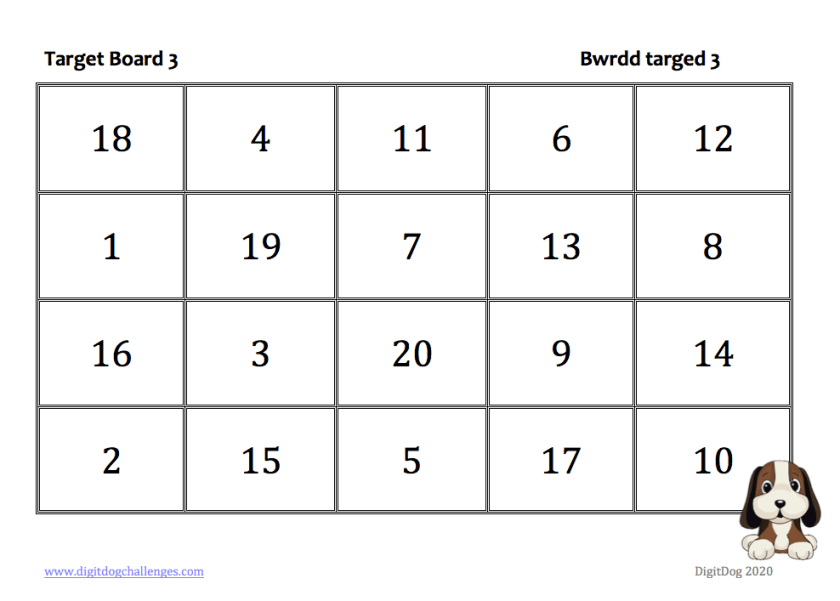
Target board 3

Print Target Board 3

  • Say each number out loud.
  • Say the numbers in order.
  • Point at a number and then find that number of objects.
  • Point at a number – what is 10 more than that number?

Ask children to look at the target board and:

Find two numbers that total / add up to 20.

  • How do you know you are correct?
  • How did you work it out? Explain your thinking.
  • How many pairs of numbers can you find?
  • Make a list of the pairs you find.
  • Make up a number story to go with your pairs of numbers e.g. 13 + 7 = 20 There were 13 ladybirds sitting on a leaf, 7 more came along and now there are 20.

Find more than two numbers that total 20?

Find numbers that make other totals.


Find the total of the numbers in the first column. How did you work it out? Which numbers did you add first? What did you notice? Did you notice that 18 + 2 = 20? How does this help?

Find the sum of the numbers in the bottom row.  How did you do that? Which numbers did you add first? What did you notice? What is the easiest way to add up the numbers?

Find the column with the highest total. Which column is easiest to add up? Why?

Find the number that is double 1, double 2, double 3………..

Find the number that is half of 10, half of 12………


Find two numbers with a difference of 2, a difference of 4…………

Make a list of your numbers. Put them in order. What do you notice? Can you find any patterns?

Problem solving with the target board

My total is 16 – find two numbers that you can add together to make my total.  Can you find three numbers to make my total?

One of my numbers is 7. When I add it to another number, my total is 13. What is my second number?

I am thinking of a number and when I count on 5, I say 14. Find the number I started with.

I am thinking of a number and when I count back 3, I say 8.  Find the number I started with. 

I am thinking of a number. I doubled it to make 16. What is my number?

My difference is 5 – find two numbers on the target board that have a difference of 5.

I am thinking of two numbers. When I take away the smaller from the larger my answer is 4. What numbers could I be thinking of? How many pairs of numbers can you find? How do you know you have found them all?

One of my numbers is 15. When I subtract another number, I am left with 9. What is my second number?

Make up some of your own problems like this.


Posted in Additive relationships, Calculating, Fluency

Calculating with target boards 3

Use the target boards to develop fluency.  Use them to:

  • recall and remember useful number facts;
  • use number facts to calculate mentally;
  • explain thinking and methods of calculating.
  • use mathematical language correctly.

Target board 2

Print Target Board 2

  • Say each number out loud.
  • Put objects on each number – check that you have the correct amount.
  • Say the numbers in order.

Subtraction and the target board.

Ask children to:

Choose a number and take away 1. Write a number sentence to show what you have done e.g. 4 – 1 = 3. Use objects to help if you need to. Try taking away other numbers.

Choose two numbers and take the smallest number away from the largest. Write a number sentence to show what you have done.

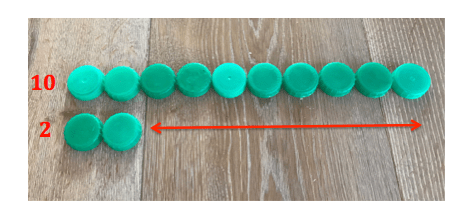
Choose two numbers and find the difference between the numbers e.g. the difference between 10 and 2 is 8. Use bottle tops to help work this out.

difference between

Or use the number line.

number line difference
The difference between 2 and 5 is 3.

Find two numbers on the board with a difference of 1. 

How do you know you are correct?

How did you work it out? Explain your thinking.

How many pairs of numbers with a difference of 1 can you find? Make a list of the pairs you find.

Practise counting back. Choose two numbers and count back from the larger to the smaller e.g. if you choose 4 and 9, you start at 9 and say 9, 8, 7, 6, 5, 4.

Use a number line to count back. Choose a number on the target board, count back 2, what number are you on now?

number line -2
I chose 10:  10 count back 2 is 8; 10, then 2 less is 8;  10 – 2 = 8

Make up a number story to go with your pairs of numbers, e.g. if you choose 4 and 6 you might say:

“Digit Dog had 6 bones in his dish. He ate 4 of them. How many does he have left?” 

“Calculating Cat had 6p in her purse and she spent 4p. How much does she have left?”

“Digit Dog has 6 bones and Calculating Cat has 4. How many more bones does Digit Dog have?”

Make up some problems for someone else to solve.


Problem solving with the target board

My difference is 3 – find two numbers on the target board that have a difference of 3.

I am thinking of two numbers. When I take away the smaller from the larger I am left with 2. What numbers could I be thinking of?

One of my numbers is 7. When I subtract another number, I am left with 5. What is my second number?

I am thinking of a number. I count back 3 and get to 4. What number did I start with?