Try using the flik-flaks to practise and use multiplication facts.
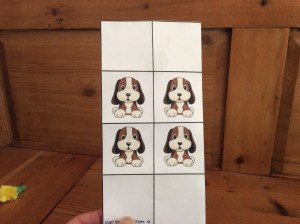
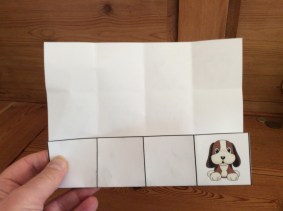
Practise counting in 2s by folding the Digit Dog flik-flak in half and asking:
How many dogs can you see?
How many eyes can you see?
How do you know? Tell me a number sentence.
Each dog has 2 eyes – 2, 4, 6, 8, 10
Five 2s equal 10, 5 lots of 2 equal 10, 5 groups of 2 equal 10, 2 five times equals 10, 5 x 2 = 10
1 dog has 2 eyes 1 x 2 = 2
2 dogs have 4 eyes 2 x 2 = 4
3 dogs have 6 eyes 3 x 2 = 6………..and so on
What patterns can you see? What do you notice about the number of eyes?
Repeat but this time count number of ears.
Challenge:
You can see 5 dogs but how many dogs are hidden? How many eyes are hidden? How did you work it out? Explain your thinking.
If I can see 12 eyes, how many dogs can I see?
Counting in steps of more than 2
You can practise counting in different steps by choosing different flik-flaks and repeating these activities. There are a range of flik-flaks available on www.primarytreasurechest.com
Subitising (recognising small amounts without counting)
Number bonds
Multiplication facts
Using mathematical language
Using reasoning skills
Number bonds
Look for patterns within numbers and help children understand that numbers are composed of smaller numbers e.g. fold the Digit Dog flik-flak in half as shown, ask How many dogs can you see? What else can you see? I can see 4 and 1, and 3 and 2……..Explain your thinking. Repeat by folding to show other numbers.
Use the flower flik-flak, fold it in half to show 6 flowers.
What do you notice? How many flowers can you see? How many purple? How many red? How many yellow? How many altogether?
Use the flik-flaks as a quick way to practise number bonds to 10 (the pairs of numbers that add togther to make 10).
Show children the flik-flak and ask:
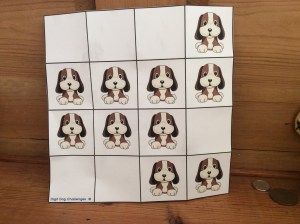
“How many dogs can you see?” “How did you count them?”
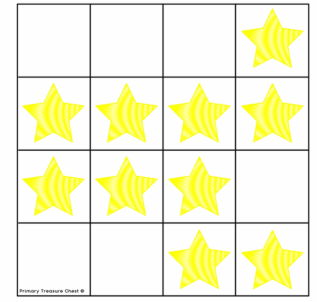
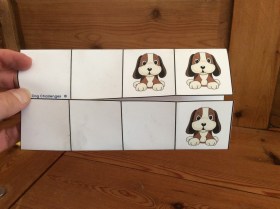
Explore the numbers of dogs in each row and column. Ask questions such as “Which row has most dogs?” “Which row has the fewest dogs?” “Which row has one more than the bottom row?”
Explore the groups of dogs you can see. I can see 5 dogs on the top half and 5 dogs on the bottom, 5 + 5 = 10
Before continuing, make sure children are confident that there are 10 dogs altogether.
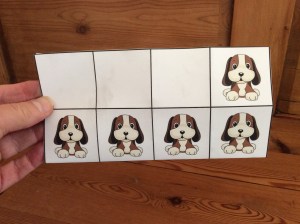
Fold the flik-flak:
Ask:
“How many dogs can you see now?”
“How many dogs are hidden?” “How many dogs can’t you see?” “How do you know?” “Explain your thinking”.
“How many dogs altogether?”
You want children to realise that they know there are 10 dogs altogether, that they can see 5 of them and need to work out how many of the dogs they can’t see. They might:
Count on from 5 to 10
Take away the 5 from 10
Use their knowledge that 5 and 5 equals 10
Expect children to explain their thinking.
Fold the flik-flak in a different way:
Ask the same questions.
“How many dogs can you see now?”
“How many dogs are hidden?” “How do you know?” “Explain your thinking”.
“How many dogs altogether?”
Keep folding the flik-flak to explore all the combinations of numbers to make 10.
I can see 1 dog. 9 dogs are hidden. 9 + 1 = 10I can see 3 dogs. I know 7 are hidden because 3 +7 = 10.I can see 7 dogs, so 3 dogs must be hidden because 3 + 7 = 10
Subitising (recognising small amounts without counting)
Number bonds
Multiplication facts
Using mathematical language
Using reasoning skills.
Counting
Hold up the Digit Dog flik-flak and ask how many dogs can you see? You can fold the flik-flak along the black lines to show all the numbers from 0 to 10. This allows children to practise counting sets of objects up to 10.
Give children their own flik-flak and ask them to:
Show a single digit number – 1, 2, 3, 4 ……etc.
Show the numbers 0 – 10 in order. How many ways can you show each number?
Show the same number of dogs as you are showing.
Show one less / one more e.g. show me one less than 3, one more than 5….etc. How did you work it out? Can you do it without counting?
More/fewer than I am showing. Explain your answer. e.g. How many dogs am I showing? Can you show me more dogs? Can you show me fewer dogs?
Subitising
Once children can confidently count the dogs by pointing at each one and not making mistakes, encourage them to subitise i.e. to recognise amounts without counting. When they see 3 dogs, they can say it is 3 without counting 1, 2, 3. They should be able to do this with numbers up to 5.
Counting in 2s
Use the flik-flaks as a quick way to practise counting in 2s.
Show children the flik-flak and ask:
How many dogs can you see? How many eyes can you see? How many ears can you see? How did you count them?
Fold the flik-flak:
Ask:
How many eyes can you see now? How did you count them? Did you count in 2s? Did you say “3 lots of 2”?
Challenge:
I can see 10 eyes. Show me 10 eyes with your flik-flak. How many dogs are there if there are 10 eyes?
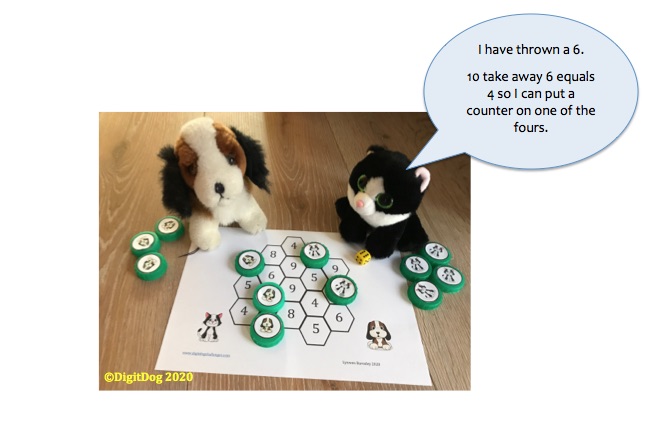
Subtract the dice number from 10, find the answer on the board and place a counter on it.
If you cannot place a counter, do nothing. You cannot put a counter on a number that already has a counter on it.
When all the hexagons have been covered, the winner is the player who has placed more counters.
Use full sentences and correct mathematical language as you play the game.
I have thrown a 2. 10 subtract 2 is 8.
I have thrown a 2. 10 take away 2 equals 8.
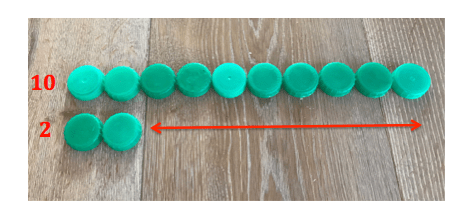
Subtraction is not just take away. Learners find the concept of subtraction as difference between more difficult than take away, so play the game using the language of difference:
I have thrown a 2. The difference between 10 and 2 is 8.
Use bottle tops to illustrate this.
The difference between 10 and 2 is 8.
Also explore subtraction as counting back. Use jumps on a number line to show this.
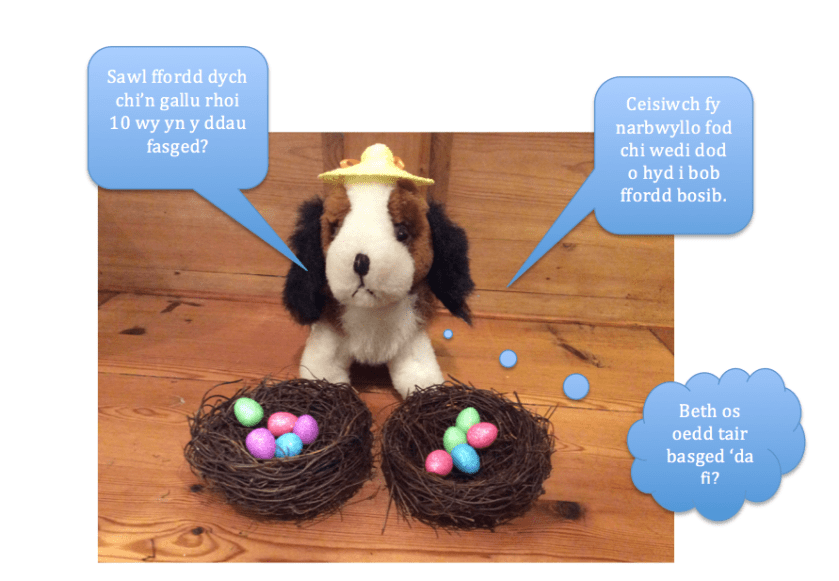
Digit Dog has got 10 mini Easter eggs and two baskets. He puts some eggs in one basket and the rest in the other. He’s trying to find out how many ways he can do this.
Try this yourself – if you don’t have eggs and baskets you can use any objects and containers you can find.
Let children try out some different ways of organising the eggs. Say:
I have ……..eggs in one basket and ……..eggs in the other. I have 10 eggs altogether.
…….. plus ……… is equal to 10.
Ask:
How can you record what you have done? Children might take photos, draw pictures or write a number sentence.
How will you know you have found all the different ways? Can you explain how you know?
Do you notice any patterns?
What if………….
……….you put the eggs in the two baskets, then one person closes their eyes and another person takes away some eggs? Person 1 opens their eyes and works out how many eggs are missing. How did you work out how many were missing? Explain your thinking.
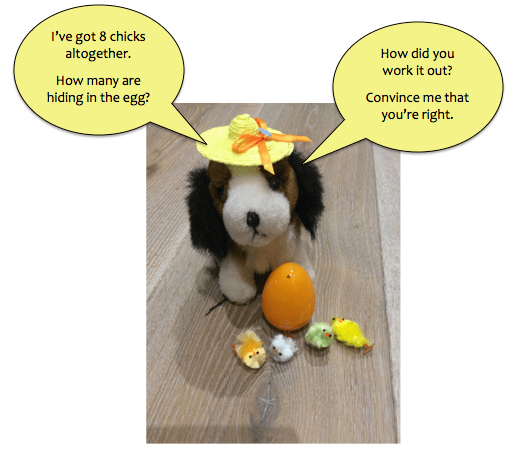
Digit Dog is using a hollow plastic egg and some fluffy chicks to create some number problems. This type of word problem requires more thinking than the problems such as “There are 4 chicks in my egg and 4 chicks on the floor. How many chicks are there altogether?”, where the end result is unknown.
The aim is to encourage learners to think and talk mathematically – to have a mathematical conversation and use their knowledge of additive relationships and the link between addition and subtraction.
Ask learners to:
Explain what the problem is about in their own words.
Explain what information they know and what they are trying to find out. How many chicks are not in the egg? What number of chicks cannot be in the egg?
FInd a way to work out how many chicks are in the egg.
Describe the strategy they have used. They might:
act it out – using children themselves (with chick masks)
act it out – using toy chicks
use counters to represent the chicks
draw pictures of the chicks
use an eight Numicon shape to lace the chicks on
use number bonds
Convince everyone that their answer is correct. Use sentence starters such as:
I know the answer is 4 because ….
First of all I…………then I………
I know that …….. so…………
Write a number sentence
Change the number of chicks in the egg.
Think about a What if………?
What if there were more than 8 chicks altogether?
What if the story wasn’t about chicks?
Can learners transfer their thinking to a new problem?
Make up some of your own problems like this one for your friend.
The five proficiences
Learners will use:
strategic competence to make sense of the problem, work out what is known and what needs to be found out and to decide on a way of solving it.
logical reasoning to explain their thinking, to make sense of the problem and to use what they know to work it out.
conceptual understanding of, and fluency with, number bonds for 8 in order to use them to solve the problem and to be efficient and accurate with the basic calculations.
communication using symbols and correct mathematical vocabulary to write number sentences and explain their thinking .
Learners will need to be competent in all five proficiencies in order to create their own problems.
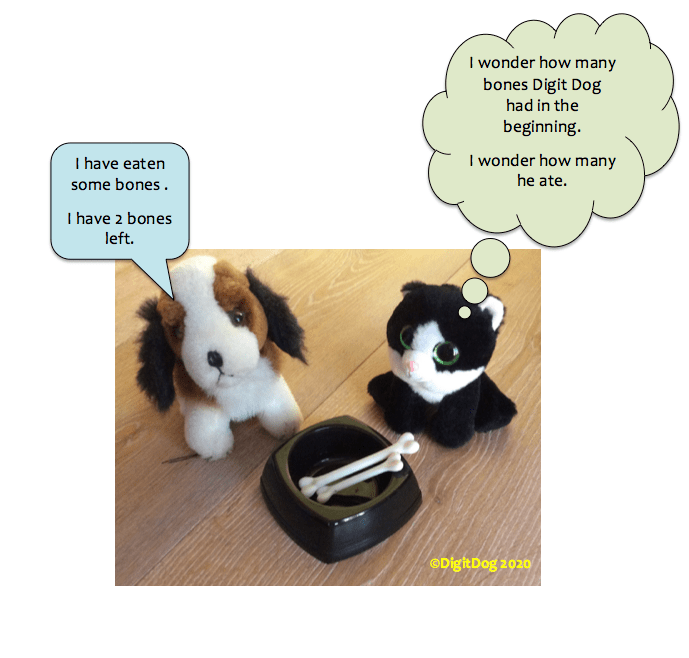
The aim of the activity is to encourage learners to think and talk mathematically – to have a mathematical conversation and use their knowledge of additive relationships. This structure of problem is more difficult than the usual “I had 2 bones and then ate 2 more, how many did I eat altogether?”
Ask:
What has Digit Dog been doing? Can you tell me in your own words? What is Calculating Cat wondering?
How many bones could Digit Dog have had in the beginning? How many could he not have had? Explain your thinking.
Take suggestions for numbers of bones.
Is there just one answer?
Use one number as an example.
If Digit Dog started with 3 bones, how many bones did he eat?
Explain how you can find out.You might want to use bones, drawings, Numicon shapes, cubes to help.
Can you write a number sentence? 3 – ? = 2
Try some other numbers of bones. Record your answers. Can you put your answers in order? What do you notice?
Use this speaking frame to explain your work:
Digit Dog started with ______ bones, he ate _____ bones, now he has 2 bones left.
What if……….
He had a different number of bones left?
Make up your own problem like this about Calculating Cat and some fish.
The five proficiences
Learners will use:
strategic competence to make sense of the problem, work out what is known and what needs to be found out and to decide on a way of solving it.
logical reasoning to explain their thinking and work systematically to find possible numbers.
conceptual understanding of, and fluency with, number bonds to recognise that they need numbers with a difference of 2 or to see this pattern as they try out numbers, to see that 1 or 2 are not possible numbers to start with and to be efficient and accurate with the basic calculations.
communication using symbols and correct mathematical vocabulary to show and explain their thinking .
Learners will need to be competent in all five proficiencies to make up their own problems.
Digit Dog is using a hollow plastic egg and some fluffy chicks to create some number problems. This type of word problem requires more thinking than the problems such as “There are 4 chicks in my egg and 4 chicks on the floor. How many chicks are there altogether?”, where the end result is unknown.
The aim is to encourage learners to think and talk mathematically – to have a mathematical conversation and use their knowledge of additive relationships and the link between addition and subtraction.
Ask learners to:
Explain what the problem is about in their own words.
Explain what information they know and what they are trying to find out. How many chicks are not in the egg? What number of chicks cannot be in the egg?
FInd a way to work out how many chicks are in the egg.
Describe the strategy they have used. They might:
act it out – using children themselves (with chick masks)
act it out – using toy chicks
use counters to represent the chicks
draw pictures of the chicks
use an eight Numicon shape to lace the chicks on
use number bonds
Convince everyone that their answer is correct. Use sentence starters such as:
I know the answer is 4 because ….
First of all I…………then I………
I know that …….. so…………
Write a number sentence
Change the number of chicks in the egg.
Think about a What if………?
What if there were more than 8 chicks altogether?
What if the story wasn’t about chicks?
Can learners transfer their thinking to a new problem?
Make up some of your own problems like this one for your friend.
The five proficiences
Learners will use:
strategic competence to make sense of the problem, work out what is known and what needs to be found out and to decide on a way of solving it.
logical reasoning to explain their thinking, to make sense of the problem and to use what they know to work it out.
conceptual understanding of, and fluency with, number bonds for 8 in order to use them to solve the problem and to be efficient and accurate with the basic calculations.
communication using symbols and correct mathematical vocabulary to write number sentences and explain their thinking .
Learners will need to be competent in all five proficiencies in order to create their own problems.








 Digit Dog Challenges