Posted in Calculating, Fluency, Games

Playing with cards 2

Break the Bank at 27

A game for 2 – 5 players

You need:

A pack of playing cards – picture cards worth 10, Ace worth 1

To play

Deal out the whole pack of cards to players. Players put cards face down in a pile in front of them.

The first player turns over the top card and puts it in the centre. The next player puts their top card in the centre and adds the value of the two cards. Play continues like this, each player placing their card on the centre pile and adding the value to the total. When the total reaches 27 or more, that player takes the cards from the centre and puts them in their pile.
Screenshot 2020-06-08 10.44.23

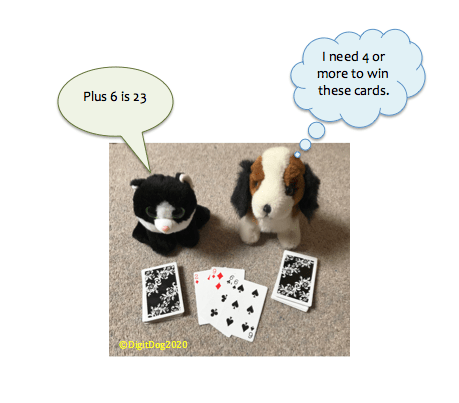
For example, in this game:

Digit Dog put down 2 and said “2”.

Calculating Cat put down 9, added it to the 2 and said “11”

Digit Dog put down 6, added it to 11 and said “17”.

Calculating Cat put down 6, added it to 17 and said “23”.

Digit Dog is now hoping to turn over a 4 or more so that he can take the cards.

The game continues for an agreed time or until one player has no cards.

The winner is the player with most cards.

Variations

Give the Ace and picture cards different values e.g. A = 11, J = 12, Q = 13, K = 14.

Change the number that breaks the bank – make it more or less than 27.

Posted in Calculating, Fluency, Games

Playing with cards

Quick addition

Two players

You need:

A pack of playing cards – picture cards are worth 10, aces are worth 1

To play:

Deal out all the cards to the two players and place in a pile, face down.

Players take turns to say 1, 2, 3 GO! and both players turn over their top card.

Players add the two numbers on the cards and the first one to say “the total is…..” (correctly) wins the two cards.

Play until all cards have been used, then each player counts how many cards they have won.

The winner is the player with most cards.


Screenshot 2020-06-08 09.23.29

Variations

Play quick subtraction where players subtract the smaller number from the larger.

Play quick multiplication where players multiply the two numbers and say “the product is…..”

To make the game easier:

  • Remove the picture cards
  • Just use cards Ace to 5.
  • Play with digit cards – make several sets of 0 – 5 cards.

To make the game more challenging:

  • Give the picture cards different values: J = 10, Q = 11, K = 12
  • Have 3 or 4 players and add all the numbers.
Posted in Counting, Games, Money

Collect the Coins – variations

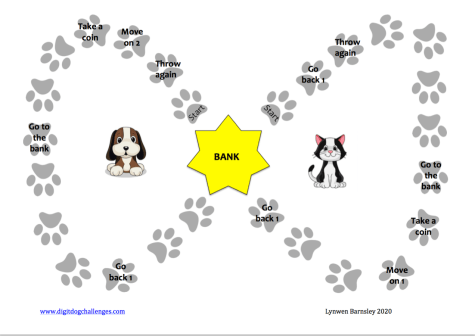
Here are some variations for Digit Dog’s Collect the Coins game

Screenshot 2020-05-21 10.27.13

A game for two players

You need:

  • A counter for each player to move round the board.
  • A dice.
  • Coins to put in the bank (put them on the star).

To play the original game:

  • Each player choose a track and put your counter on start.
  • Take turns to throw the dice and move along the track.
  • Keep going round your track. If you land on the bank, collect two coins. If you pass through the bank, collect one coin.
  • The winner is the first to collect 5 coins.

Variations

Play the game until all the coins have gone from the bank. The winner is the person with the most coins. Count the coins then name the coins.

Put coins of different value in the bank. Play until all the coins have gone. The winner is the one with the largest amount of money.

Put coins of the same value in the bank e.g. all 5p coins to practise counting in 5s when the coins are totalled at the end of the game.

Decide on an amount to collect e.g. 10p. The winner is the first player to collect that amount exactly.

Posted in Counting, Games, Money

Collect the Coins

Play Digit Dog’s Collect the Coins game

Screenshot 2020-05-21 10.27.13

A game for two players

You need:

  • A counter for each player to move round the board
  • A dice
  • Ten coins to put in the bank (put them on the star)

To play:

  • Each player choose a track and put your counter on start.
  • Take turns to throw the dice and move along the track.
  • Keep going round your track. If you land on the bank, collect two coins. If you pass through the bank, collect one coin.
  • The winner is the first to collect 5 coins.
Posted in Conceptual understanding, Counting, Games

Target board 4 – counting and recognising numbers

An important part of learning mathematics is using and understanding mathematical vocabulary. Children need this vocabulary to talk about their work, to ask questions and to explain their thinking.

Target boards are grids with numbers or pictures that can be used to practise using mathematical language.

Target board 4


Counting and recognising numbers with Target Board 4

Print Target Board 4. Point at any box on the target board and ask children to say the number. Point to a number and ask children to say the number of tens and number of ones in that number.

Ask children to:

Find the number 12, or 50 or……….

Put the numbers in the first row in order. Which number is the smallest? Which number is the largest?

Find the largest number on the board.

Find the number that is one more than 35, one more than 11………

Find the number that is two more than 22, two more than 43………

Find the number that is one less than 12, one less than 28……….

Find the number that is two less than 38, two less than 10………

Find all the odd numbers. Find all the even numbers.

Does every column have an even number?

Does every column have an odd number?

Find the number that is ten more than 14, ten more than 40…….. What do you notice?

Find the number that is ten less than 55, ten less than 37…….. What do you notice?

Point at, or put counters on, two numbers. Count from the smallest number to the biggest number and back again.

Choose a number. Count from that number in 2s up to 60 or beyond. Now count back in 2s  to your number.

Choose a number. Count in tens from your number. How far can you count?


Now get children to ask their own questions so that they learn to use the correct vocabulary.

Make your own target board.


Posted in Conceptual understanding, Counting, Games

Target board 3 – counting and recognising numbers

An important part of learning mathematics is using and understanding mathematical vocabulary. Children need this vocabulary to talk about their work, to ask questions and to explain their thinking.

Target boards are grids with numbers or pictures that can be used to practise using mathematical language.

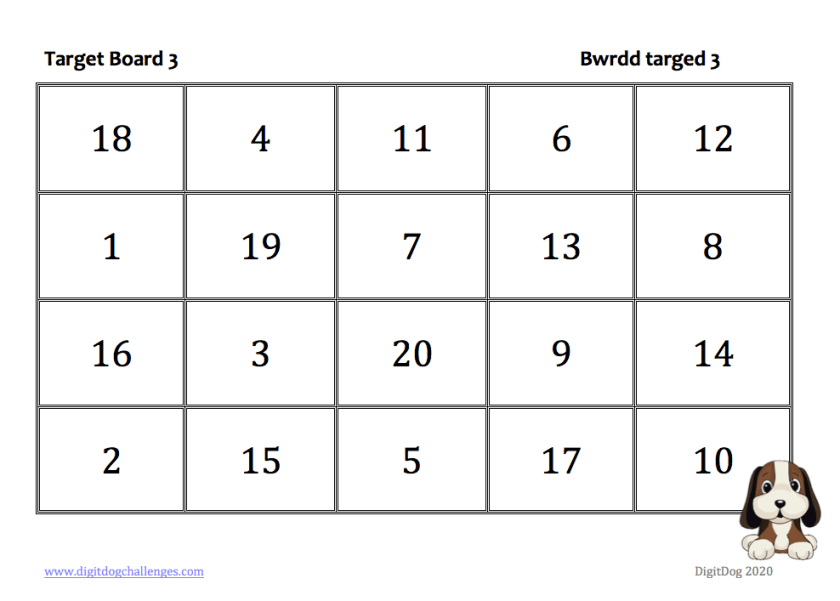
Target board 3


Counting and recognising numbers with Target Board 3

Print Target Board 3. Point at any box on the target board and ask children to say the number. Point to a number and ask children to collect that number of objects. Put sets of objects more than 10 into groups of 10 and some more, e.g. 17 objects will be organised into one group of 10 and 7 more. Put the objects onto 10 frames to support this idea of a group 10 and some more.

Ask children to:

Find the number 12, or 16 or……….

Put the numbers in the first row in order. Which number is the smallest? Which number is the largest?

Find the number that is one more than 13, one more than 8……….

Find the number that is two more than 16, two more than 7………

Find the number that is one less than 15, one less than 19……….

Find the number that is two less than 20, two less than 5………

Find an odd number. Find an even number.

Does every column have an even number?

Does every column have an odd number?

Find the number that is ten more than 6, ten more than 5…….. What do you notice?

Find the number that is ten less than 16, ten less than 15…….. What do you notice?


Now get children to ask their own questions so that they learn to use the correct vocabulary.

Play Bingo.

You need a board each, sets of digit cards 1 – 20 (you will need one set per player) and objects to cover the numbers on the board (use buttons, counters, milk bottle tops, small toys.

Shuffle the digit cards and place in a pile face down. Take turns to turn over the top card, say the number and cover it on your board. The first to cover the board is the winner.

Variations

The winner is the first to complete a row or a column.

Play Ten More / Ten Less Bingo. Use digit cards 0 – 20. Take turns to turn over the top card, but say the number that is either 10 more or 10 less than the number on the card and find the new number on your board.


Posted in Conceptual understanding, Counting, Games

Target board 2 – counting and recognising numbers

An important part of learning mathematics is using and understanding mathematical vocabulary. Children need this vocabulary to talk about their work, to ask questions and to explain their thinking.

Target boards are grids with numbers or pictures that can be used to practise using mathematical language.

Target board 2


Counting and recognising numbers with Target Board 2

Print Target Board 2. Point at any box on the target board and ask children to say the number. Point to a number and ask children to hold up that number of fingers or do that number of claps, or jump that number of times or collect that number of objects.

Ask children to:

Find the number 2, or 6 or……….

Find a number that is more than 4. Now find a number that is less than 8.

Find the largest number. Find the smallest number.

Put the numbers in the first row in order. Which number is the smallest? Which number is the largest?

Find the number that is one more than 5, one more than 9……….

Find the number that is two more than 3, two more than 7………

Find the number that is one less than 5, one less than 9……….

Find the number that is two less than 3, two less than 7………

Find an odd number. Find an even number.

Does every column have an even number?

Does every column have an odd number?

For numbers up to 20, try the same activities with Target Board 3.


Now get children to ask their own questions so that they learn to use the correct vocabulary.

Play Bingo.

You need a board each, sets of digit cards 1 – 20 (you will need one set per player) and objects to cover the numbers on the board (use buttons, counters, milk bottle tops, small toys.

Shuffle the digit cards and place in a pile face down. Take turns to turn over the top card, say the number and cover it on your board. The first to cover the board is the winner.

Variations

The winner is the first to complete a row or a column.

Play One More Bingo. Use digit cards 0 – 19. Take turns to turn over the top card, but say the number that is one more than the number on the card and find the new number  on your board.

Play One Less Bingo. Use digit cards 1 – 21. Take turns to turn over the top card, but say the number that is one less than the number on the card and find the new number on your board.

What about two more and two less bingo?


Posted in Conceptual understanding, Counting, Games

Target board 1 – counting

An important part of learning mathematics is using and understanding mathematical vocabulary. Children need this vocabulary to talk about their work, to ask questions and to explain their thinking.

Target boards are grids with numbers or pictures that can be used to practise using mathematical language.


Target board 1

Counting with Target Board 1

Print Target Board 1. Point at any box on the target board and ask: How many Digit Dogs can you see?  Do children count the dogs in ones or do they recognise the arrangement and say the number without counting?

Ask children to:

Point at 2 dogs, 3 dogs, 1 dog ……….

Point at 4 dogs. Now point at more than 4 dogs. Now point at fewer than 4 dogs.

Point at 3 dogs. Now point at 1 more than 3 dogs. Now point at 1 fewer than 3 dogs.

Ask:

Which boxes have the most dogs? Which boxes have the fewest dogs?

Which row has most dogs? Which column has fewest dogs?

How many dogs are in the first row altogether? What about the second row? And the third?

Point to some dogs and ask children to hold up that number of fingers or do that number of claps, or jump that number of times.

Now get children to ask the questions and use the correct vocabulary.

Play Match the Dogs. Put 4 sets of the Digit Dog cards face down in a pile. Take turns to turn over the top card and find the matching picture on your board. How many dogs are on your card? The winner is the first to cover their board.

Play Bingo. Have a board each, roll a dice, say the number rolled and cover that number of dogs with a milk-bottle top/ button/ counter. The winner is the first to cover their board.

Put 4 sets of digit cards 1 – 5 in a pile face down. Take turns to turn over the top card and match the number to the dogs on your board. First to cover their board wins.

Play One More Bingo. Put 4 sets of digit cards 0 – 4 in a pile face down. Take turns to turn over the top card, say the number that is one more than the number on the card and match that number to the dogs on your board. First to cover their board wins.


Posted in Calculating, Counting, Games, Subitising

Who has more?

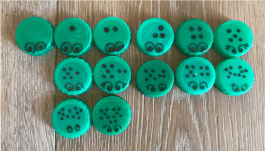
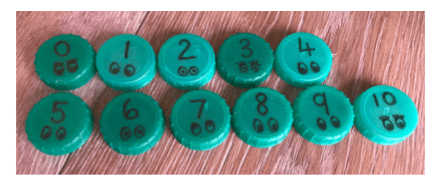
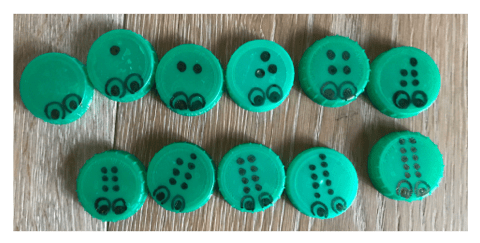
Digit Dog and Calculating Cat are playing with the bottle top bugs (make them with milk bottle tops).

bugs 1-12 fives   bugs 1 - 12 numicon

Who has more?

Put your bottle top bugs in a feely bag or a box or under a tea towel. Each player takes one bug out, puts it in front of them and says how many spots there are. The player with more spots captures the bugs. Keep playing until you have used all the bugs. The winner is the one to have captured most bugs.

Who has more spots? How many more?

Who has fewer spots? How many fewer?

Say how many spots there are without counting in ones. Calculating Cat knows she has 11 spots because she counted 5 + 5 + 1.

What if…….

…….the player with fewer spots wins?

…….players take out two bugs, add the number of spots and compare the totals? The player with the greater total captures the bugs.


Posted in Calculating, Games

Collect the bugs

Collect the bugs

collect the bugs

A game for two players.

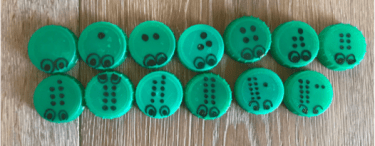
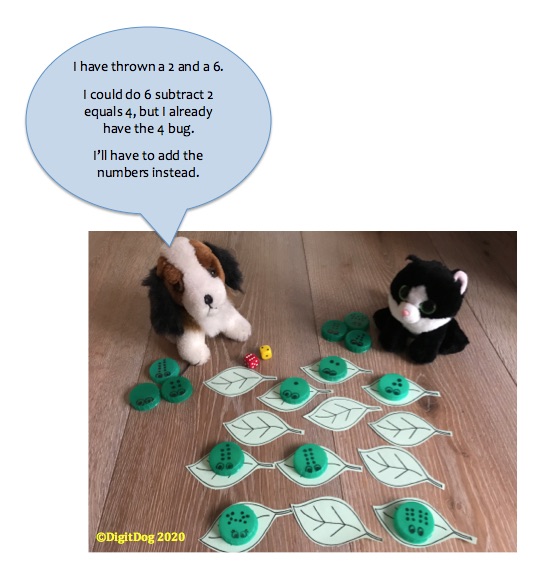
You need two dice and a set of bottle top bugs (you can make these by drawing on old milk bottle tops. Either use spots or numerals). You can print these leaves to put the bugs on, if you wish.

Screenshot 2020-03-26 19.07.06

Screenshot 2020-03-26 19.07.14

Take turns to roll both dice and use either addition or subtraction to capture a bug e.g. if you throw a 5 and a 3 you can either add the numbers together, 5 + 3 = 8, and capture the 8 bug, or you can subtract the numbers, 5 – 3 = 2, and capture the 2 bug.

When all the bugs have been captured, the player who has most bugs is the winner.

Which bugs are easiest to capture? Why do you think that?

Which bugs are more difficult to capture?

What if………

…… you could multiply the two numbers?

……you could also divide the numbers?


Posted in Games

Odd and even race

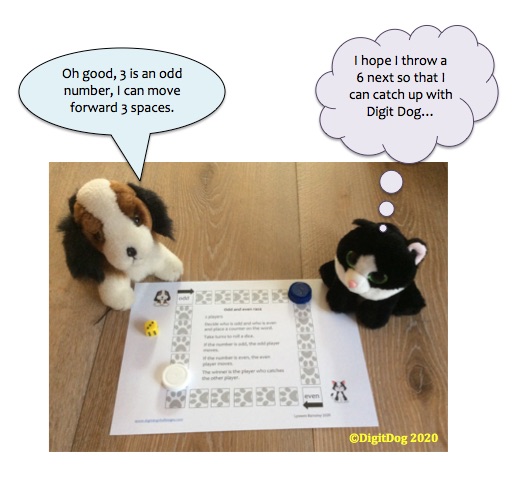
Digit Dog and Calculating Cat are playing another game.

odd and even

Odd and even race

This is a game for 2 players.

You need:

A game board (download here), a counter for each player, a dice.

To play:

Decide who is going to be odd and who is going to be even and place a counter on the word.

Take turns to roll a dice.

If the number is odd, the odd player moves that number of spaces.

If the number is even, the even player moves that number of spaces.

The winner is the player who catches the other player.

Posted in Games, Logical reasoning

Strategy game

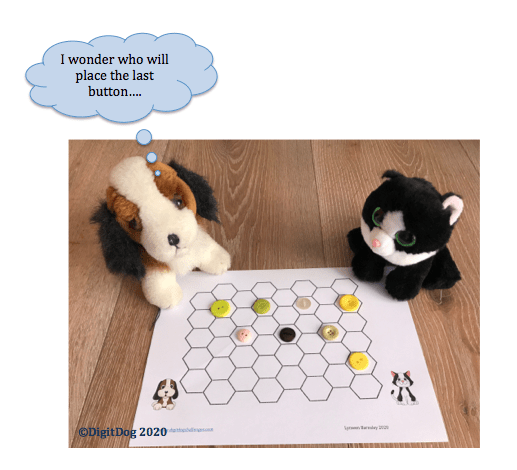
Have a go at Digit Dog’s strategy game.

strategy game

You need:

A game board (download here)

A pile of counters / buttons/ pebbles

To play:

Take turns to place counters on the any of the hexagons.

A counter cannot be put on a hexagon which touches another hexagon already holding a counter.

The last player who is able to put a counter on the board wins.

Play a few times and see if you can find a winning strategy.

Is there a good place on the board to start?

Does it matter who starts? Does the player who goes first always win?