Posts

Posted in Additive relationships, Calculating, Fluency, Problem solving

Calculating with target boards 2

Develop fluency with the target boards. Use the target boards to:

  • recall and remember useful number facts;
  • use number facts to calculate mentally;
  • explain thinking and methods of calculating.
  • use mathematical language correctly.

Target board 2

Print Target Board 2

  • Say each number out loud.
  • Put objects on each number – check that you have the correct amount.
  • Say the numbers in order.

Practise addition with the target board.

Ask children to:

Find two numbers that total 5.

  • How do you know you are correct?
  • How did you work it out? Explain your thinking.
  • How many pairs of numbers can you find?
  • Make a list of the pairs you find.

Find numbers that total 10.

  • How do you know you are correct?
  • How did you work it out? Explain your thinking.
  • How many pairs of numbers can you find?
  • Make a list of the pairs you find.

Make up a number story to go with your pairs of numbers, e.g. 3 + 2 = 5 Digit Dog ate 3 bones for breakfast and 2 bones for dinner. He ate 5 bones altogether. How many different stories can you make?

Find other totals and make up stories to go with them.


Find the total of the numbers in the first column. How did you work it out?

Find the sum of the numbers in the bottom row.  How did you do that?

Find the column with the highest total. Which column is easiest to add up? Why?

Find the number that is double 1, double 2, double 3………..


Point at a number and say what double that number is e.g. point at 5 and say “double 5 is 10”

Problem solving with the target board

My total is 8 – find two numbers that you can add together to make my total.  Can you find three numbers to make my total?

One of my numbers is 5. When I add it to another number, my total is 7. What is my second number?

I am thinking of a number. I count on 3 and get to 8. What number did I start with?

I am thinking of a number. I doubled it to make 8. What is my number?


Posted in Patterns, Problem solving

Patterns with bunting

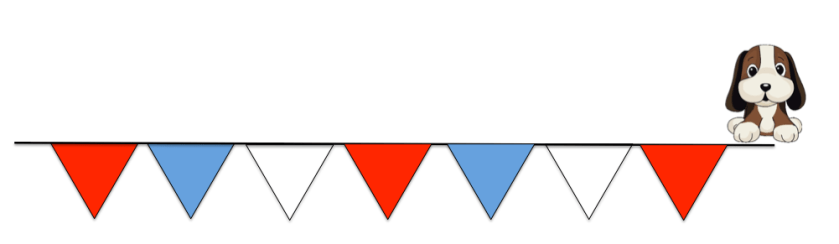
Digit Dog is making some bunting ready for the VE Day celebrations.

DD bunting

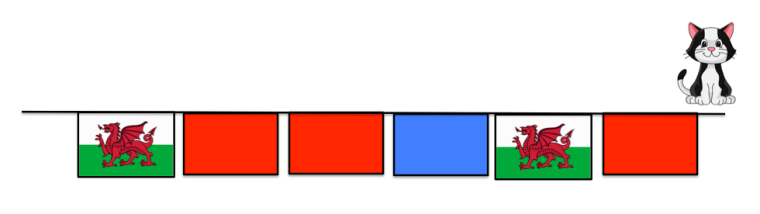
He has made a pattern with his flags.

Which colour flag will he put next? How do you know?

What colour will the 10th flag be? What about the 16th flag? How did you work it out?

If he uses 30 flags, what colour will the last flag be?

Can you make a pattern like Digit Dog?


Calculating Cat has made a different pattern.

CC bunting

What do you notice about Calculating Cat’s pattern?

Which flag will she put next? How do you know?

What will the 12th flag be? What about the 17th? How did you work it out?

If she uses 28 flags, which flag will be last?


Look at both sets of flags.

What is the same about them? What is different?


Try making your own bunting. Make some flags and decide on a pattern. See if someone else can spot your pattern.


Posted in Additive relationships, Calculating, Fluency

Calculating with target boards

Develop fluency with the target boards. Use the target boards to:

  • recall and remember useful number facts;
  • use number facts to calculate mentally;
  • explain thinking and methods of calculating.
  • use mathematical language correctly.

Target board 1

Print Target Board 1 and a set of dog cards.

Match the dog cards to your target board.

Find two groups of dogs that make 5 altogether.

How do you know you are correct? How did you work it out? Explain your thinking. Can you find a different way of making 5?

Use the cards to record your pairs.

dog cards

What do you think? Will Calculating Cat be able to find more pairs of cards that total 5?

Write a number sentence for each of your pairs.

dog cards sentences

Can you put your pairs of cards in order? What patterns can you see?

Look at the target board again. Can you make some other totals? Can you use more than 2 groups of dogs to make some totals?

Posted in Conceptual understanding, Counting, Games

Target board 4 – counting and recognising numbers

An important part of learning mathematics is using and understanding mathematical vocabulary. Children need this vocabulary to talk about their work, to ask questions and to explain their thinking.

Target boards are grids with numbers or pictures that can be used to practise using mathematical language.

Target board 4


Counting and recognising numbers with Target Board 4

Print Target Board 4. Point at any box on the target board and ask children to say the number. Point to a number and ask children to say the number of tens and number of ones in that number.

Ask children to:

Find the number 12, or 50 or……….

Put the numbers in the first row in order. Which number is the smallest? Which number is the largest?

Find the largest number on the board.

Find the number that is one more than 35, one more than 11………

Find the number that is two more than 22, two more than 43………

Find the number that is one less than 12, one less than 28……….

Find the number that is two less than 38, two less than 10………

Find all the odd numbers. Find all the even numbers.

Does every column have an even number?

Does every column have an odd number?

Find the number that is ten more than 14, ten more than 40…….. What do you notice?

Find the number that is ten less than 55, ten less than 37…….. What do you notice?

Point at, or put counters on, two numbers. Count from the smallest number to the biggest number and back again.

Choose a number. Count from that number in 2s up to 60 or beyond. Now count back in 2s  to your number.

Choose a number. Count in tens from your number. How far can you count?


Now get children to ask their own questions so that they learn to use the correct vocabulary.

Make your own target board.


Posted in Conceptual understanding, Counting, Games

Target board 3 – counting and recognising numbers

An important part of learning mathematics is using and understanding mathematical vocabulary. Children need this vocabulary to talk about their work, to ask questions and to explain their thinking.

Target boards are grids with numbers or pictures that can be used to practise using mathematical language.

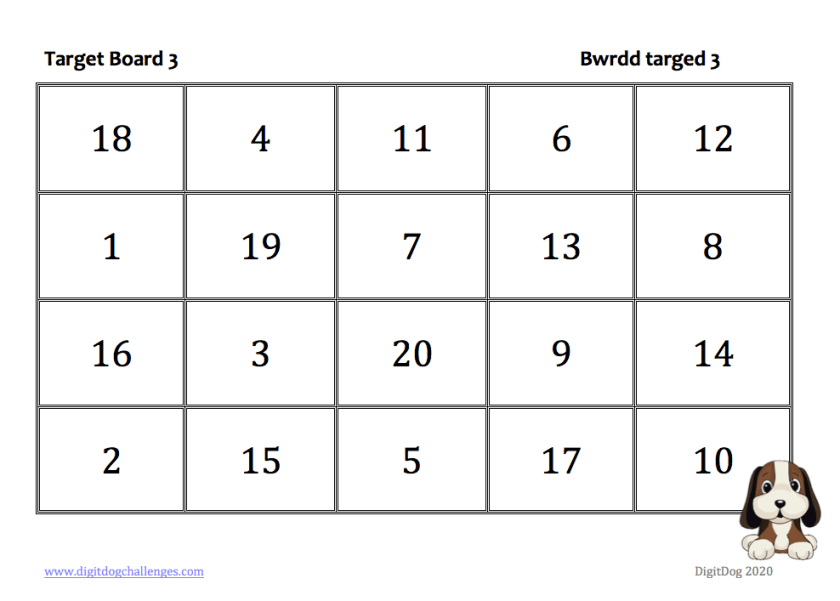
Target board 3


Counting and recognising numbers with Target Board 3

Print Target Board 3. Point at any box on the target board and ask children to say the number. Point to a number and ask children to collect that number of objects. Put sets of objects more than 10 into groups of 10 and some more, e.g. 17 objects will be organised into one group of 10 and 7 more. Put the objects onto 10 frames to support this idea of a group 10 and some more.

Ask children to:

Find the number 12, or 16 or……….

Put the numbers in the first row in order. Which number is the smallest? Which number is the largest?

Find the number that is one more than 13, one more than 8……….

Find the number that is two more than 16, two more than 7………

Find the number that is one less than 15, one less than 19……….

Find the number that is two less than 20, two less than 5………

Find an odd number. Find an even number.

Does every column have an even number?

Does every column have an odd number?

Find the number that is ten more than 6, ten more than 5…….. What do you notice?

Find the number that is ten less than 16, ten less than 15…….. What do you notice?


Now get children to ask their own questions so that they learn to use the correct vocabulary.

Play Bingo.

You need a board each, sets of digit cards 1 – 20 (you will need one set per player) and objects to cover the numbers on the board (use buttons, counters, milk bottle tops, small toys.

Shuffle the digit cards and place in a pile face down. Take turns to turn over the top card, say the number and cover it on your board. The first to cover the board is the winner.

Variations

The winner is the first to complete a row or a column.

Play Ten More / Ten Less Bingo. Use digit cards 0 – 20. Take turns to turn over the top card, but say the number that is either 10 more or 10 less than the number on the card and find the new number on your board.


Posted in Conceptual understanding, Counting, Games

Target board 2 – counting and recognising numbers

An important part of learning mathematics is using and understanding mathematical vocabulary. Children need this vocabulary to talk about their work, to ask questions and to explain their thinking.

Target boards are grids with numbers or pictures that can be used to practise using mathematical language.

Target board 2


Counting and recognising numbers with Target Board 2

Print Target Board 2. Point at any box on the target board and ask children to say the number. Point to a number and ask children to hold up that number of fingers or do that number of claps, or jump that number of times or collect that number of objects.

Ask children to:

Find the number 2, or 6 or……….

Find a number that is more than 4. Now find a number that is less than 8.

Find the largest number. Find the smallest number.

Put the numbers in the first row in order. Which number is the smallest? Which number is the largest?

Find the number that is one more than 5, one more than 9……….

Find the number that is two more than 3, two more than 7………

Find the number that is one less than 5, one less than 9……….

Find the number that is two less than 3, two less than 7………

Find an odd number. Find an even number.

Does every column have an even number?

Does every column have an odd number?

For numbers up to 20, try the same activities with Target Board 3.


Now get children to ask their own questions so that they learn to use the correct vocabulary.

Play Bingo.

You need a board each, sets of digit cards 1 – 20 (you will need one set per player) and objects to cover the numbers on the board (use buttons, counters, milk bottle tops, small toys.

Shuffle the digit cards and place in a pile face down. Take turns to turn over the top card, say the number and cover it on your board. The first to cover the board is the winner.

Variations

The winner is the first to complete a row or a column.

Play One More Bingo. Use digit cards 0 – 19. Take turns to turn over the top card, but say the number that is one more than the number on the card and find the new number  on your board.

Play One Less Bingo. Use digit cards 1 – 21. Take turns to turn over the top card, but say the number that is one less than the number on the card and find the new number on your board.

What about two more and two less bingo?


Posted in Conceptual understanding, Counting, Games

Target board 1 – counting

An important part of learning mathematics is using and understanding mathematical vocabulary. Children need this vocabulary to talk about their work, to ask questions and to explain their thinking.

Target boards are grids with numbers or pictures that can be used to practise using mathematical language.


Target board 1

Counting with Target Board 1

Print Target Board 1. Point at any box on the target board and ask: How many Digit Dogs can you see?  Do children count the dogs in ones or do they recognise the arrangement and say the number without counting?

Ask children to:

Point at 2 dogs, 3 dogs, 1 dog ……….

Point at 4 dogs. Now point at more than 4 dogs. Now point at fewer than 4 dogs.

Point at 3 dogs. Now point at 1 more than 3 dogs. Now point at 1 fewer than 3 dogs.

Ask:

Which boxes have the most dogs? Which boxes have the fewest dogs?

Which row has most dogs? Which column has fewest dogs?

How many dogs are in the first row altogether? What about the second row? And the third?

Point to some dogs and ask children to hold up that number of fingers or do that number of claps, or jump that number of times.

Now get children to ask the questions and use the correct vocabulary.

Play Match the Dogs. Put 4 sets of the Digit Dog cards face down in a pile. Take turns to turn over the top card and find the matching picture on your board. How many dogs are on your card? The winner is the first to cover their board.

Play Bingo. Have a board each, roll a dice, say the number rolled and cover that number of dogs with a milk-bottle top/ button/ counter. The winner is the first to cover their board.

Put 4 sets of digit cards 1 – 5 in a pile face down. Take turns to turn over the top card and match the number to the dogs on your board. First to cover their board wins.

Play One More Bingo. Put 4 sets of digit cards 0 – 4 in a pile face down. Take turns to turn over the top card, say the number that is one more than the number on the card and match that number to the dogs on your board. First to cover their board wins.


Posted in Logical reasoning, What's the same / different?

Buttons

Helping children to notice similarities and differences helps them to spot patterns and to use their reasoning skills. Spotting patterns and logical reasoning are key when learning mathematics.

Ask children “What is the same?” “What is different?”

Then ask them to explain what they notice, this improves their language and thinking.

two sets of buttons 3

two sets of buttons 2

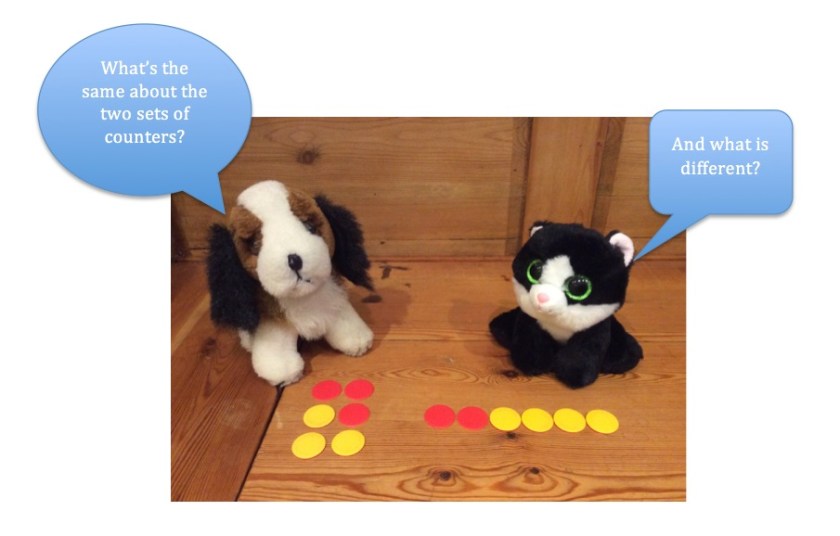
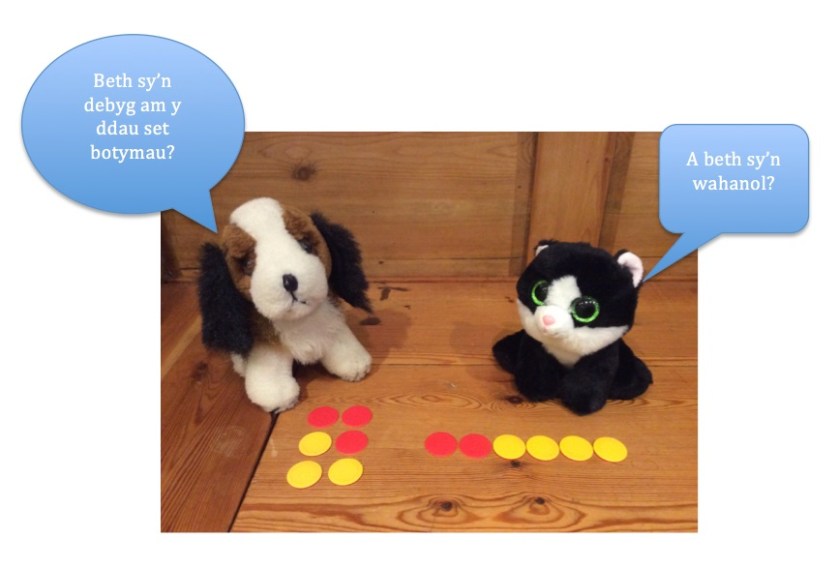
Look at the two sets of buttons. Find things that are the same about the two sets, for example, both sets have different coloured buttons in them. How many similarities can you find?

Now look for differences. Find things that are different about the two sets, for example, there are a different number of buttons in each set. How many differences can you find?

Make your own sets of objects and look for similarities and differences.

Posted in Calculating, Conceptual understanding, Counting, Fluency

Yet more flik-flaks: counting in steps of more than 1

Try using the flik-flaks to practise and use multiplication facts.

Practise counting in 2s by folding the Digit Dog flik-flak in half and asking:

  • How many dogs can you see?
  • How many eyes can you see?
  • How do you know? Tell me a number sentence.

Each dog has 2 eyes – 2, 4, 6, 8, 10

Five 2s equal 10,  5 lots of 2 equal 10, 5 groups of 2 equal 10, 2 five times equals 10,           5 x 2 = 10

1 dog has 2 eyes  1 x 2 = 2

2 dogs have 4 eyes  2 x 2 = 4

3 dogs have 6 eyes 3 x 2 = 6………..and so on

What patterns can you see? What do you notice about the number of eyes?


Repeat but this time count number of ears.

Challenge:

You can see 5 dogs but how many dogs are hidden? How many eyes are hidden? How did you work it out? Explain your thinking.

If I can see 12 eyes, how many dogs can I see?

Counting in steps of more than 2

You can practise counting in different steps by choosing different flik-flaks and repeating these activities. There are a range of flik-flaks available on www.primarytreasurechest.com

Use the star flik-flak to count in 5s.

Screenshot 2020-04-23 11.54.17

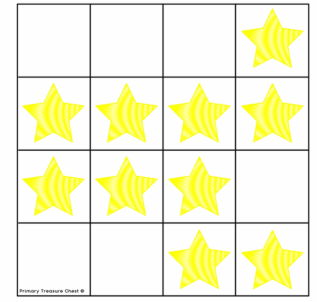
How many stars can you see? How many points? How did you work it out? What is the multiplication sentence?

If I can see 30 points, how many stars can I see?

Or the 10p coin flik-flak to count in 10s.

Screenshot 2020-04-23 11.58.51

How many coins? How many pence? How did you work it out? What is the multiplication sentence?


Posted in Additive relationships, Calculating, Conceptual understanding, Counting, Fluency

More flik-flaks: number bonds

What do children need to practise daily?

In order for children to develop fluency they need to have a daily routine where they practise:

  • Counting;
  • Remembered facts;
  • Using number relationships to do calculations.

Children need the opportunity to:

  • Talk mathematically;
  • Discuss and solve problems;
  • Be creative;
  • Use reasoning skills.

Follow Digit Dog for ideas to engage children in mathematical conversations.

Using flik-flaks

Print your own flik – flaks from www.primarytreasurechest.com

Flik-flaks available to download from www.primarytreasurechest.com

Use flik-flaks to practise:

  • Counting
  • Subitising (recognising small amounts without counting)
  • Number bonds
  • Multiplication facts
  • Using mathematical language
  • Using reasoning skills

Number bonds

Look for patterns within numbers and help children understand that numbers are composed of smaller numbers e.g. fold the Digit Dog flik-flak in half as shown, ask How many dogs can you see? What else can you see? I can see 4 and 1, and 3 and 2……..Explain your thinking. Repeat by folding to show other numbers.


Use the flower flik-flak, fold it in half to show 6 flowers.

What do you notice? How many flowers can you see? How many purple? How many red? How many yellow? How many altogether?

Repeat by folding to show other numbers.

Download flower flik-flak here

Use the flik-flaks as a quick way to practise number bonds to 10 (the pairs of numbers that add togther to make 10).


Show children the flik-flak and ask:

“How many dogs can you see?” “How did you count them?”

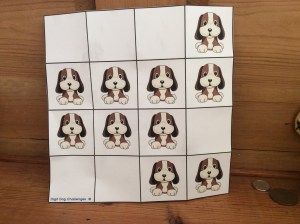
Explore the numbers of dogs in each row and column. Ask questions such as “Which row has most dogs?” “Which row has the fewest dogs?” “Which row has one more than the bottom row?”

Explore the groups of dogs you can see. I can see 5 dogs on the top half and 5 dogs on the bottom, 5 + 5 = 10

Before continuing, make sure children are confident that there are 10 dogs altogether.

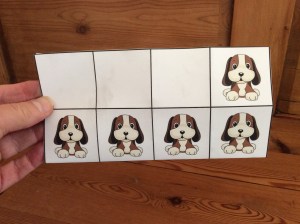
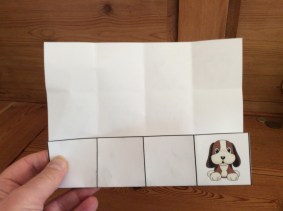
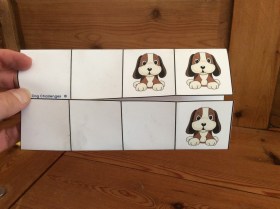
Fold the flik-flak:


Ask:

“How many dogs can you see now?”

“How many dogs are hidden?” “How many dogs can’t you see?” “How do you know?” “Explain your thinking”.

“How many dogs altogether?”

You want children to realise that they know there are 10 dogs altogether, that they can see 5 of them and need to work out how many of the dogs they can’t see. They might:

  • Count on from 5 to 10
  • Take away the 5 from 10
  • Use their knowledge that  5 and 5 equals 10

Expect children to explain their thinking.

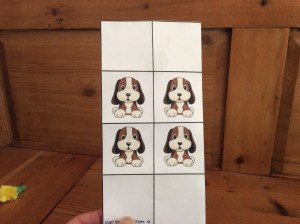
Fold the flik-flak in a different way:

Ask the same questions.

How many dogs can you see now?”

“How many dogs are hidden?” “How do you know?” “Explain your thinking”.

“How many dogs altogether?”


Keep folding the flik-flak to explore all the combinations of numbers to make 10.

I can see 1 dog. 9 dogs are hidden. 9 + 1 = 10
I can see 3 dogs. I know 7 are hidden because 3 +7 = 10.
I can see 7 dogs, so 3 dogs must be hidden because 3 + 7 = 10


Posted in Conceptual understanding, Counting, Fluency, Subitising

Practising maths with Digit Dog

What do children need to practise daily?

In order for children to develop fluency they need to have a daily routine where they practise:

  • Counting;
  • Remembered facts;
  • Using number relationships to do calculations.

Children need the opportunity to:

  • Talk mathematically;
  • Discuss and solve problems;
  • Be creative;
  • Use reasoning skills.

Follow Digit Dog for ideas to engage children in mathematical conversations.

Using flik-flaks

Print your own flik – flaks from www.primarytreasurechest.com

Flik-flaks available to download from www.primarytreasurechest.com

Use flik-flaks to practise:

  • Counting
  • Subitising (recognising small amounts without counting)
  • Number bonds
  • Multiplication facts
  • Using mathematical language
  • Using reasoning skills.

Counting

Hold up the Digit Dog flik-flak and ask how many dogs can you see? You can fold the flik-flak along the black lines to show all the numbers from 0 to 10. This allows children to practise counting sets of objects up to 10.

Give children their own flik-flak and ask them to:

  1. Show a single digit number – 1, 2, 3, 4 ……etc.
  2. Show the numbers 0 – 10 in order. How many ways can you show each number?
  3. Show the same number of dogs as you are showing.
  4. Show one less / one more e.g. show me one less than 3, one more than 5….etc. How did you work it out? Can you do it without counting?
  5. More/fewer than I am showing. Explain your answer. e.g. How many dogs am I showing? Can you show me more dogs? Can you show me fewer dogs?

Subitising

Once children can confidently count the dogs by pointing at each one and not making mistakes, encourage them to subitise i.e. to recognise amounts without counting. When they see 3 dogs, they can say it is 3 without counting 1, 2, 3. They should be able to do this with numbers up to 5.

Counting in 2s

Use the flik-flaks as a quick way to practise counting in 2s.


Show children the flik-flak and ask:

How many dogs can you see?  How many eyes can you see?  How many ears can you see?  How did you count them?

Fold the flik-flak:


Ask:

How many eyes can you see now? How did you count them? Did you count in 2s? Did you say “3 lots of 2”?

Challenge:

I can see 10 eyes. Show me 10 eyes with your flik-flak. How many dogs are there if there are 10 eyes?