Posts

Posted in Calculating, Logical reasoning, Money

How much money?

Calculating Cat has set Digit Dog a challenge. She has put five coins in her purse and is asking Digit Dog to work out how much money she might have.

5 coins

Use coins to investigate which coins could be in the purse.

Write down the different ways you have found.

Digit Dog thinks there could be 6p in the purse. Which 5 coins would you need to make 6p?

Can you work systematically so that you know you have found all the different combinations?

What if……..

………there was a different number of coins in the purse? What amounts could you make then?


Posted in Additive relationships, Calculating, Fluency

Under the leaf

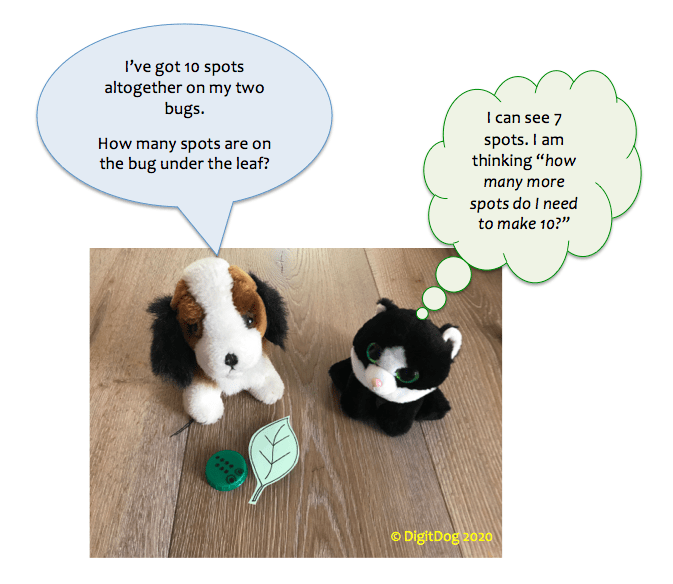
How many spots are under the leaf?bug under the leaf


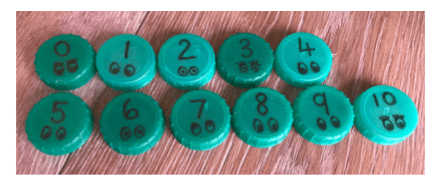
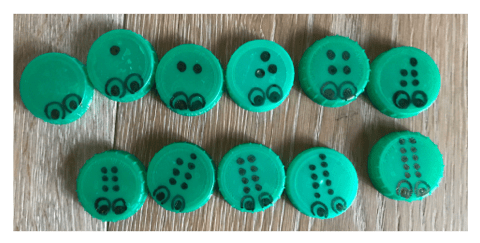
Digit Dog is using the bottle top bugs and leaves to create some number problems.

This type of problem encourages learners to think and talk mathematically and use the  link between addition and subtraction.

Ask children to:

  • Explain what the problem is about in their own words.
  • Explain what information they know and what they are trying to find out. How many spots are on the bug they can see? What number of spots cannot be under the leaf?
  • Find a way to work out how many spots are on the bug under the leaf.
  • Describe the strategy they have used. They might:
    • use counters to represent the spots and work out how many more they need to make 10
    • draw pictures of the bugs
    • use number bonds – the numbers that add together to make 10.
    • I know that 7 + 3 = 10 so there must be a 3-spot bug under the leaf.
    • I know that 10 – 7 = 3 so there must be a 3-spot bug under the leaf.
  • Convince everyone that their answer is correct. Use sentence starters such as:
    • I know the answer is 3 because ….
    • First of all I…………then I………
    • I know that …….. so…………
  • Write a number sentence
  • Change the bugs – choose two different bugs, work out the total number of spots and then hide one under a leaf.

What if……….

……..you tried it with 3 bugs? Work out the total and then hide one bug under a leaf.

……..you tried multiplying the numbers? Hide one bug under a leaf but this time say “the product of my numbers is…..”


Posted in Calculating, Counting, Games, Subitising

Who has more?

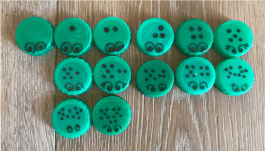
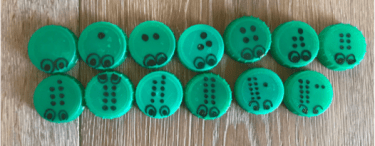
Digit Dog and Calculating Cat are playing with the bottle top bugs (make them with milk bottle tops).

bugs 1-12 fives   bugs 1 - 12 numicon

Who has more?

Put your bottle top bugs in a feely bag or a box or under a tea towel. Each player takes one bug out, puts it in front of them and says how many spots there are. The player with more spots captures the bugs. Keep playing until you have used all the bugs. The winner is the one to have captured most bugs.

Who has more spots? How many more?

Who has fewer spots? How many fewer?

Say how many spots there are without counting in ones. Calculating Cat knows she has 11 spots because she counted 5 + 5 + 1.

What if…….

…….the player with fewer spots wins?

…….players take out two bugs, add the number of spots and compare the totals? The player with the greater total captures the bugs.


Posted in Calculating, Games

Collect the bugs

Collect the bugs

collect the bugs

A game for two players.

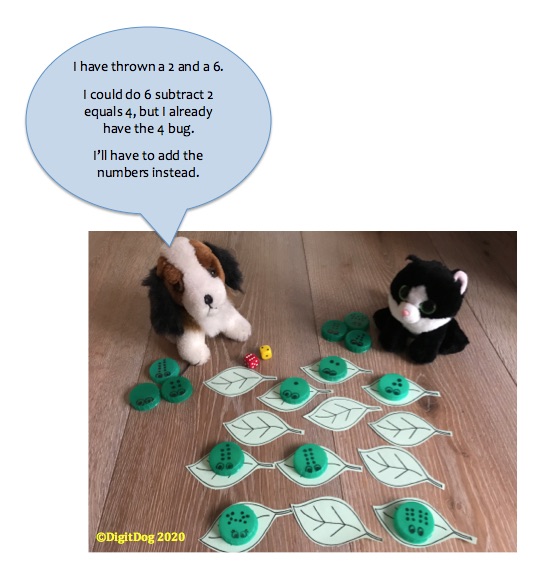
You need two dice and a set of bottle top bugs (you can make these by drawing on old milk bottle tops. Either use spots or numerals). You can print these leaves to put the bugs on, if you wish.

Screenshot 2020-03-26 19.07.06

Screenshot 2020-03-26 19.07.14

Take turns to roll both dice and use either addition or subtraction to capture a bug e.g. if you throw a 5 and a 3 you can either add the numbers together, 5 + 3 = 8, and capture the 8 bug, or you can subtract the numbers, 5 – 3 = 2, and capture the 2 bug.

When all the bugs have been captured, the player who has most bugs is the winner.

Which bugs are easiest to capture? Why do you think that?

Which bugs are more difficult to capture?

What if………

…… you could multiply the two numbers?

……you could also divide the numbers?


Posted in Games

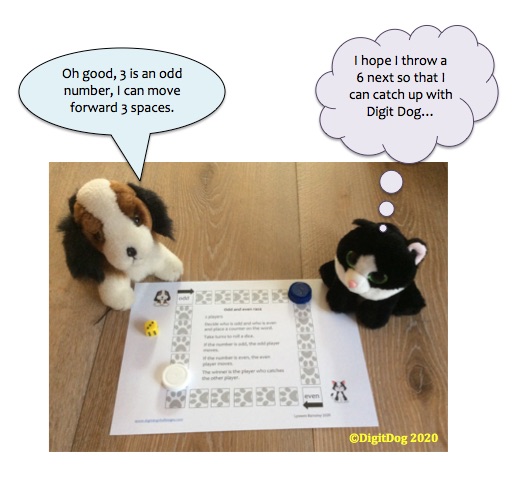
Odd and even race

Digit Dog and Calculating Cat are playing another game.

odd and even

Odd and even race

This is a game for 2 players.

You need:

A game board (download here), a counter for each player, a dice.

To play:

Decide who is going to be odd and who is going to be even and place a counter on the word.

Take turns to roll a dice.

If the number is odd, the odd player moves that number of spaces.

If the number is even, the even player moves that number of spaces.

The winner is the player who catches the other player.

Posted in Games, Logical reasoning

Strategy game

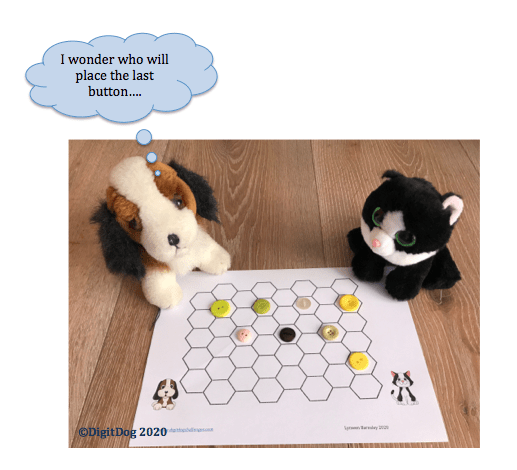
Have a go at Digit Dog’s strategy game.

strategy game

You need:

A game board (download here)

A pile of counters / buttons/ pebbles

To play:

Take turns to place counters on the any of the hexagons.

A counter cannot be put on a hexagon which touches another hexagon already holding a counter.

The last player who is able to put a counter on the board wins.

Play a few times and see if you can find a winning strategy.

Is there a good place on the board to start?

Does it matter who starts? Does the player who goes first always win?


Posted in Calculating, Conceptual understanding, Games, Strategic competence

Subtract from 10

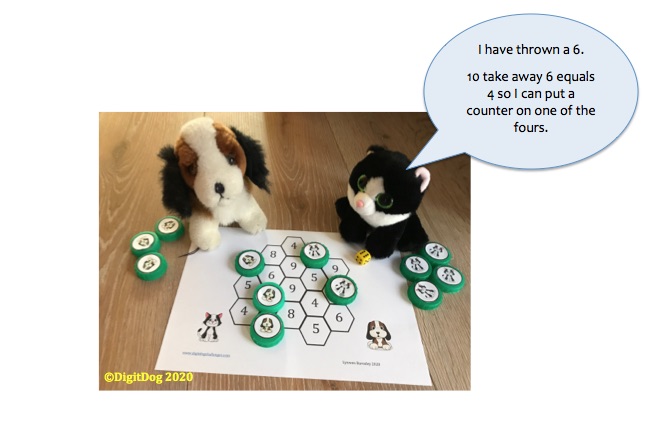
Here’s a game to practise subtracting numbers from 10.

subtraction game

You need:

  • A game board (download here)
  • Counters for each person (we made some with pictures stuck on milk bottle tops)
  • A dice or pile of digit cards 1 – 6

Take turns to:

  1. Throw the dice;
  2. Subtract the dice number from 10, find the answer on the board and place a counter on it.

If you cannot place a counter, do nothing. You cannot put a counter on a number that already has a counter on it.

When all the hexagons have been covered, the winner is the player who has placed more counters.

Use full sentences and correct mathematical language as you play the game.

I have thrown a 2.  10 subtract 2 is 8.

I have thrown a 2. 10 take away 2 equals 8.

Subtraction is not just take away. Learners find the concept of subtraction as difference between more difficult than take away, so play the game using the language of difference:

I have thrown a 2. The difference between 10 and 2 is 8.

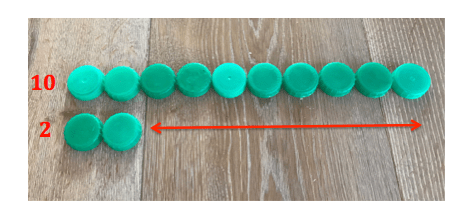
Use bottle tops to illustrate this.

difference between
The difference between 10 and 2 is 8.

Also explore subtraction as counting back. Use jumps on a number line to show this.

number line -2
I threw a 2.  10 count back 2 equals 8.
Posted in Easter, Games

Race to the eggs

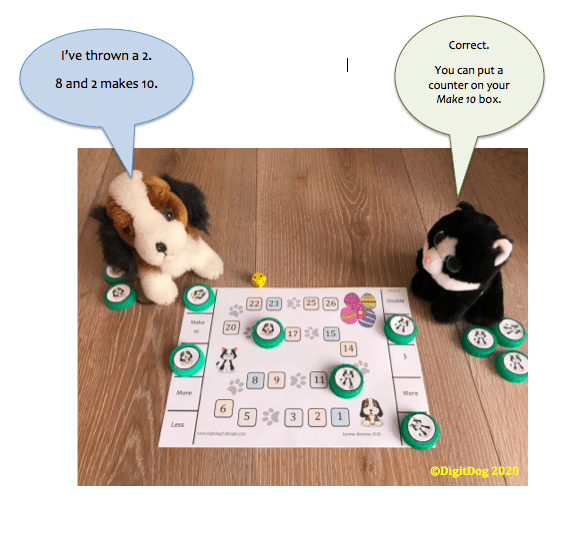
Digit Dog and Calculating Cat are playing a game. Why don’t you try it?

Easter game

Race to the eggs – a game for two players

You will need:

The game board (download here), a dice (or a pile of 1 – 6 digit cards) and 6 counters for each player. We made counters from milk bottle tops.

To play:

Take turns to throw the dice, say the number thrown and move a counter along the track.

If you land on a paw print, say the number that should be there.

Once you have moved your counter, choose one of the boxes on the side of the board. If you choose:

  • Double – double the number on the dice.
  • Make 10 – say the number that goes with the number on the dice to make 10.
  • 3 – think of 3 ways to make the number on the dice e.g. if you threw a 4 you could say 3 + 1 = 4, 5 – 1 = 4, 2 + 2 = 4.
  • More – say a number that is more than the number on the dice.
  • Less – say a number that is less than the number on the dice.

If you get the answer correct you can put one of your counters on the rectangle.

The game continues until one player gets to the eggs but you cannot be the winner until you also have a counter on each of your 5 boxes.

Posted in Calculating, Conceptual understanding, Easter, Logical reasoning, Problem solving

Two eggs left

Digit Dog has been eating his Easter mini eggs.

He has 2 eggs left.

Calculating Cat is wondering how many eggs he could have had to start with and how many he could have eaten to be left with 2.

two eggs left

How many eggs could he have had at the start? What if it was 6? How many would he have eaten to be left with 2?

What other numbers could he have started with?

What number do you know he couldn’t have had at the start?

How many different solutions can you find?

How did you work it out? Explain your reasoning.

Can you record your solutions?

Can you put your solutions in order?

What if………..

……………he had a different number of eggs left?

………….he was eating bones not eggs?

………..you made up a problem like this about your Easter eggs?

Posted in Easter, Logical reasoning, What's the same / different?

Compare the Easter eggs

Helping children to notice similarities and differences in everyday life helps them to spot patterns and to use their reasoning skills. Spotting patterns and logical reasoning are key when learning mathematics.

Ask children “What is the same?” “What is different?”

Then ask them to explain what they notice, this improves their language and thinking.

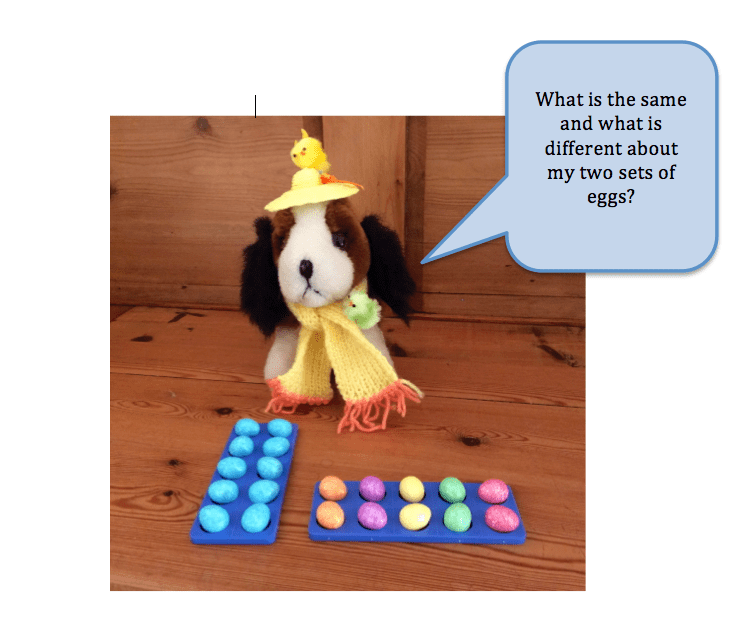
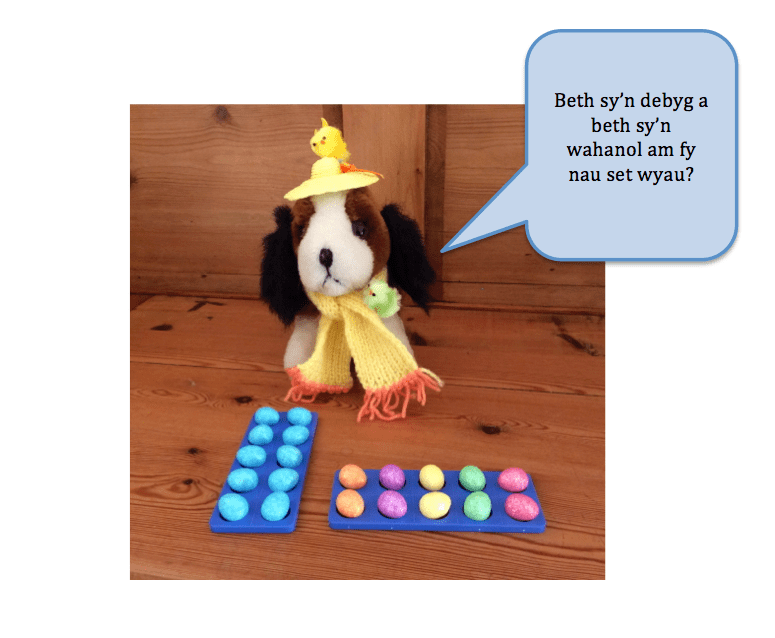
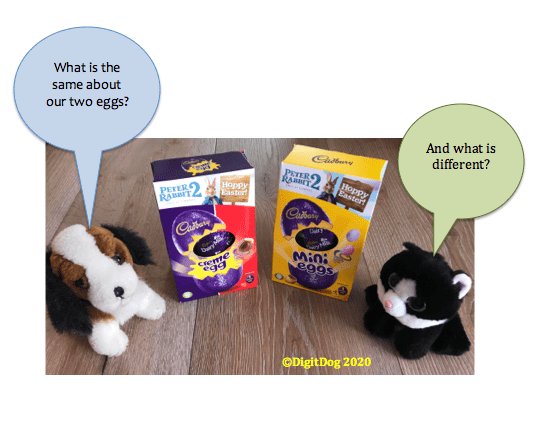
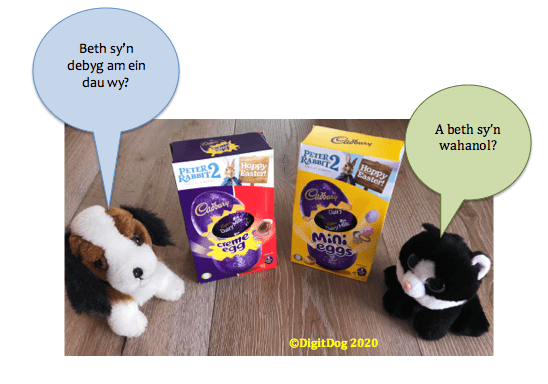
Digit Dog and Calculating Cat are playing “what’s the same and what’s different?” with their Easter eggs.
same different eggs

same different eggs W

Look at the two eggs and find similarities and differences. Any answer is acceptable. Encourage children to keep looking for more. Make a list that can be added to.

What can you say about the two eggs? What do you notice?

Can you think of anything that is the same?

I can see that both eggs have Peter Rabbit on them.

Encourage and model the use of full sentences.

Anything else?

Both eggs are made of chocolate.

Both eggs are in a box.

Can you think of more things that are the same?

What about the differences? What is different about the two eggs?

I can see that one egg has creme eggs in it and the other has mini eggs.

Any other differences?

The boxes are different colours.

Use your own Easter eggs to play this game.

Posted in Counting, Easter

Fill the egg

How many objects can you fit in the egg?

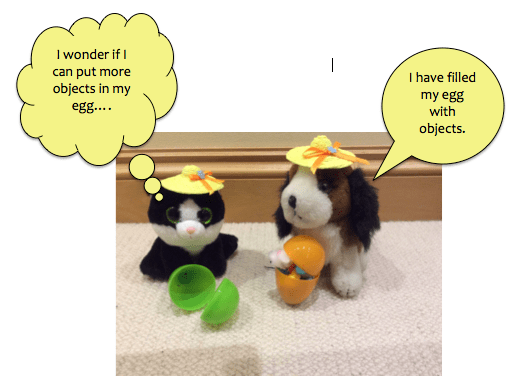
Digit Dog and Calculating Cat are trying to fill their plastic eggs with as many objects as they can.

Try this out for yourself – each person needs an empty plastic Easter egg or any small container to fill with as many objects as they can. The one who collects most objects is the winner.

fill the egg


Fill the egg Cy

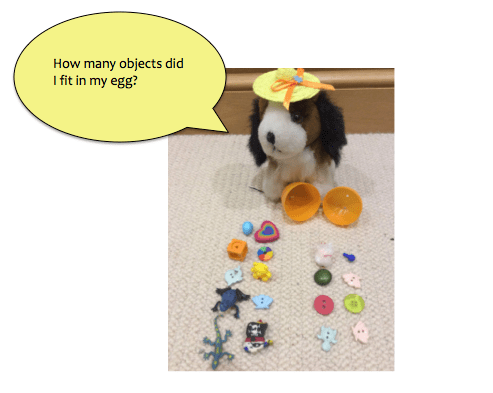
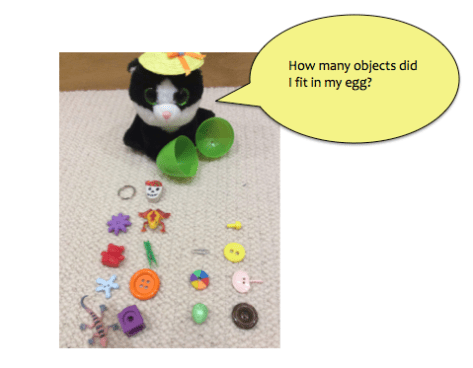
Count the objects to see who has the most. Organise your objects so that you can see how many there are without counting in ones.

Do this by:

  1.  Organising the objects into tens.  How many do you have?  “I have one ten and eight”.

Screenshot 2018-03-23 08.27.30

Screenshot 2018-03-23 08.27.39

How many objects does Digit Dog have? Don’t count in ones.

Does he have more or fewer objects than Calculating Cat? Explain how you know.

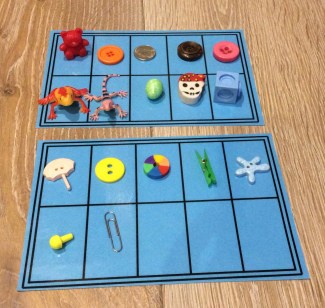
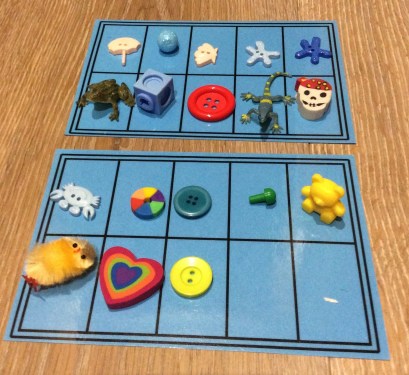
2. Putting the objects on a 10-frame (download here).

IMG_2476.jpg
Calculating Cat
IMG_2479
Digit Dog

Who collected the most objects? How do you know?

How many more objects does Calculating Cat need so that she has 20? How can you work it out by looking at the 10-frame?

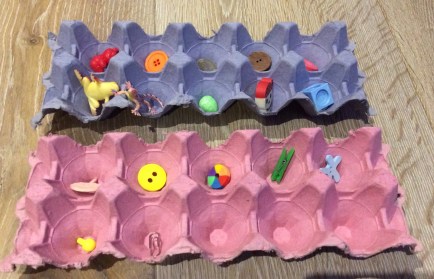
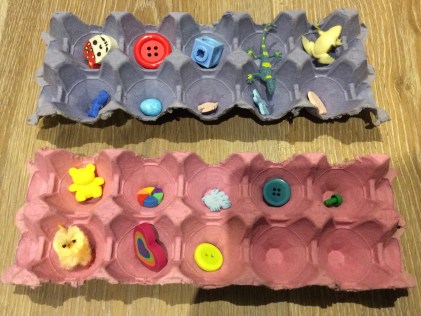
3. Putting the objects in egg boxes.

IMG_2477
Calculating Cat
IMG_2480
Digit Dog

Who was the winner? Who had more objects? Who had fewer objects? Can you quickly count the objects? Make a chart to show how many objects each person collected.