Posted in Christmas, Numicon, Problem solving

Cover the Christmas Tree

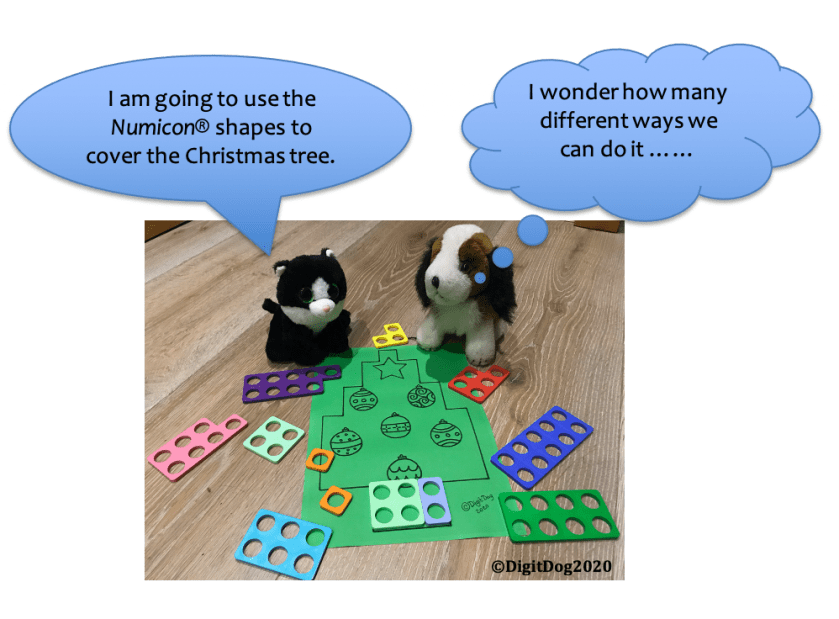
Can you use the Numicon shapes to cover the Christmas tree?

This is a variation on the popular Cover Santa’s Sleigh activity.

You will need a Christmas tree (download and print) and Numicon® shapes.
Screenshot 2020-11-26 at 18.54.03

Start with the blank Christmas tree and ask learners to use the Numicon shapes to cover it in any way they can.

Ask learners to explain how they covered the tree. Which shapes did they choose first and why? What did they notice? Are some shapes more useful than others?

How many different ways can you find to do it? Compare your tree with your friend’s. What’s the same and what’s different?

How many shapes have you used? Who has used most shapes? Who has used fewest?

Can you cover the tree using only odd shapes? Why or why not? What about even shapes?

Can you use one shape repeatedly to cover the tree? Which shapes will work? Which won’t? Why?

Can you cover the tree using each shape at least once?

Look for learners who:

  • can reason about which shapes to use,
  • can explain their thinking,
  • can work systematically,
  • can see patterns and discuss why they are choosing particular shapes,
  • can substitute shapes so that they have more or fewer, rather than starting from scratch each time,
  • can talk about similarities and differences.
Posted in Communication using symbols, Conceptual understanding, Fluency, Logical reasoning, Mathematical language, Strategic competence

Have you seen Digit Dog’s challenge card packs?

The challenge cards are extended versions of Digit Dog’s popular posts and are now available in packs of 5 with links to Curriculum for Wales 2022.

Each pack has 5 challenge cards, linked to a theme, concept or resource. There is also an overview of how Digit Dog Challenges address the five proficiencies, and links to the relevant Descriptions of Learning in the Mathematics and Numeracy Area of Learning and Experience.

There are currently two packs available.

The first pack has activities using my favourite resource – the Two-sided Beans

Packs can be purchased from Collective Learning

The second pack has activities that focus on solving non-routine problems that involve additive relationships. They are aimed at Progression Step 2 level descriptions:

Statement of What Matters 1

I have explored additive relationships, using a range of representations. I can add and subtract whole numbers, using a variety of written and mental methods.

Statement of What Matters 2

I can find missing numbers when number bonds are not complete.

Packs are available to purchase at Collective Learning

Posted in Additive relationships, Calculating, Conceptual understanding, Fluency, Number sense, Problem solving

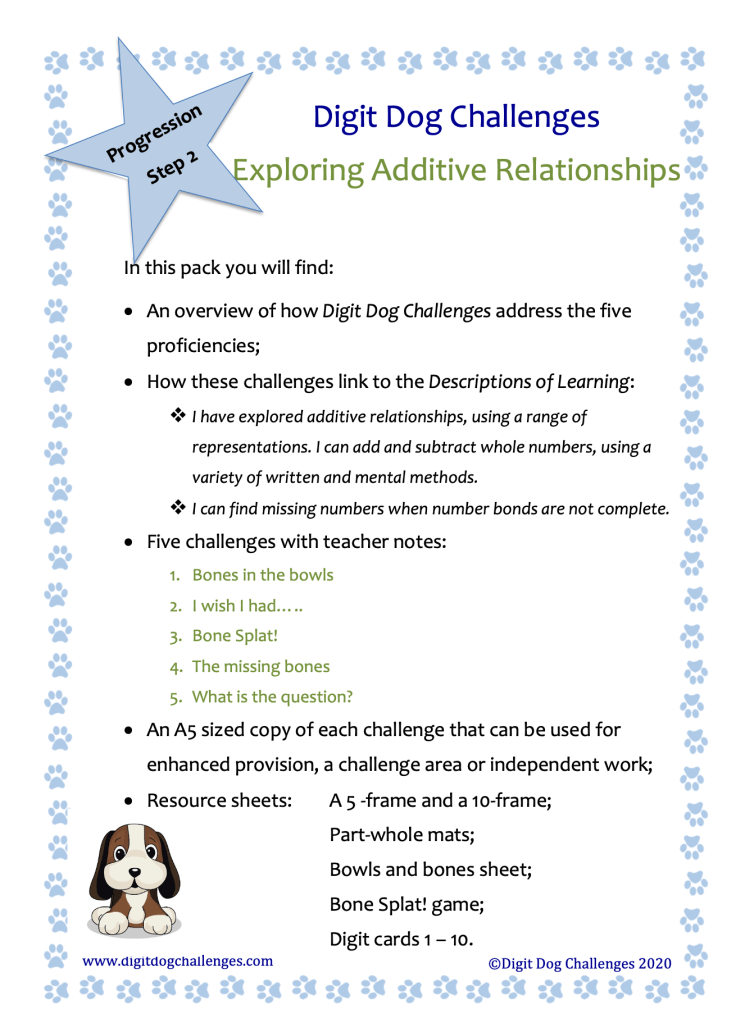
NEW! Challenge card pack – Exploring Additive Relationships

New from Digit Dog Challenges – the challenge cards are extended versions of Digit Dog’s popular posts and are now available in packs of 5 with links to Curriculum for Wales 2022.

Each pack has 5 challenge cards, linked to a theme, concept or resource. There is also an overview of how Digit Dog Challenges address the five proficiencies, and links to the relevant Descriptions of Learning in the Mathematics and Numeracy Area of Learning and Experience.

The latest pack contains activities that focus on solving problems that involve additive relationships. They are aimed at Progression Step 2 level descriptions:

Statement of What Matters 1

I have explored additive relationships, using a range of representations. I can add and subtract whole numbers, using a variety of written and mental methods.

Statement of What Matters 2

I can find missing numbers when number bonds are not complete.

Digit Dog and his bones are used as a context for exploring additive relationships and solving non-routine problems that focus on missing numbers.

Packs are available for purchase at https://www.collectivelearning.co.uk/product/digit-dog-challenges-exploring-additive-relationships-lynwen-barnsley/

Posted in What's the same / different?

Bottle Top Bugs – What’s the same? What’s different?

Noticing similarities and differences is key to spotting patterns and reasoning mathematically.

Choose 2 bottle top bugs and ask:  “What is the same?” “What is different?”

Explaining what you notice improves your mathematical language and thinking.

Bugs

Digit Dog and Calculating Cat have each made a set of 3 bugs.

Look at the two sets of bugs and find similarities and differences. Accept all answers. Encourage learners to keep looking for more. Make a list that can be added to during the day / week.
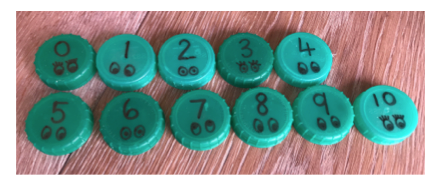
What can you say about the two sets of bugs? What do you notice? Say what you see.

Can you think of anything that is the same about the two sets?

I can see that each set has 3 bugs. Each set has the same number of bugs.

Encourage and model the use of full sentences. You might want to ask learners to start their sentences with I notice that………..

Anything else?

I notice that in each set, the bugs have different coloured eyes.

I notice that the number of spots on all the bugs in both sets is an even number.

I notice that if you add up the number of spots, in each set the total is more than 10 .

I notice that both sets have two bugs with a double.

Can you think of more things that are the same about the two sets?

What about the differences? What is different about the two sets?

I notice that one set has all green bugs and the other has different colours.

Any other differences?

I notice that the total number of spots in each set is different.

I notice that all the bugs in Calculating Cat’s set have more than 7 spots, Digit Dog’s bugs have less than 7.

The total number of spots is different. Digit Dog’s total is half Calculating Cat’s total.

Make up some sets with a partner and look for similarities and differences.
Posted in Calculating, Fluency, Making totals, Strategic competence

Bottle Top Bugs – Making tens

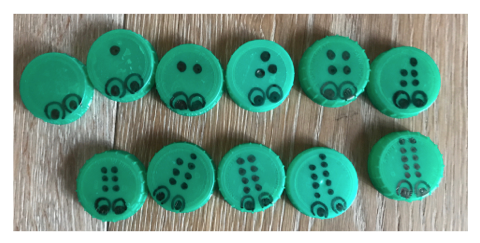
You need a set of Bottle Top Bugs 0 – 10 with spots or numerals

Screenshot 2020-03-26 19.07.14
Screenshot 2020-03-26 19.07.06

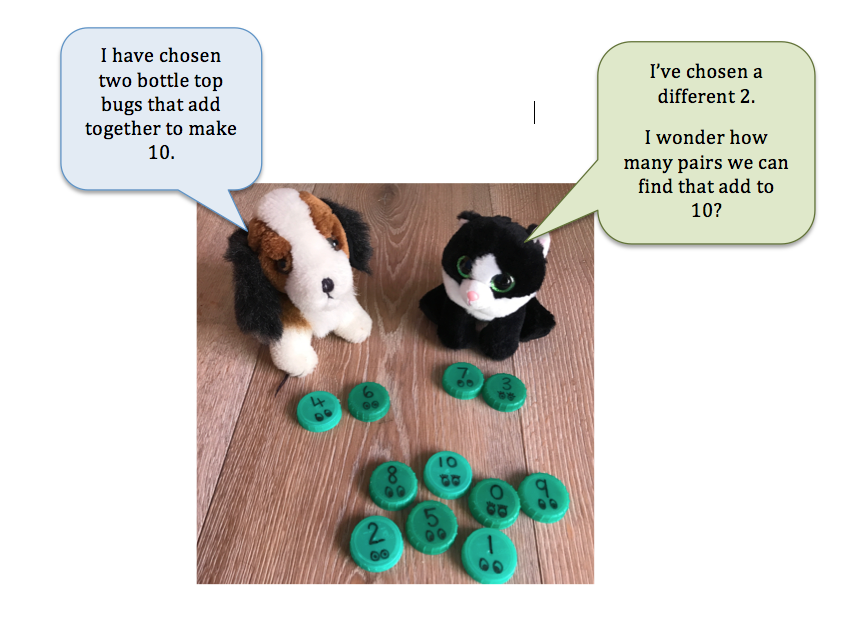
Take turns to choose two bugs so that the numbers on their backs add up to 10.

bottletop bugs add to 10

What do you think?

How many pairs of numbers can you find to make 10?

How do you know you have found all the pairs?

What if.…………

…….you looked for 3 numbers which, added together, make 10?

…….you looked for numbers with a difference of 1? What do you notice?

…….you made up some of your own questions?

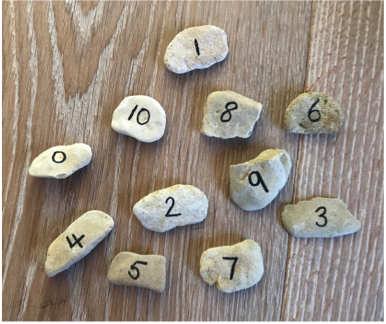
If you don’t have Bottle Top Bugs you can do the same activity with:

digit cards (download here)

numbers on pieces of paper

number pebbles like these.


number pebbles 2

Posted in Additive relationships, Calculating, Fluency

Bottle Top Bugs – Under the leaf

How many spots are under the leaf?bug under the leaf

Digit Dog is using the bottle top bugs and leaves to create some number problems.

This type of problem encourages learners to think and talk mathematically and use the  link between addition and subtraction.

Ask children to:

  • Explain what the problem is about in their own words.
  • Explain what information they know and what they are trying to find out. How many spots are on the bug they can see? What number of spots cannot be under the leaf?
  • Find a way to work out how many spots are on the bug under the leaf.
  • Describe the strategy they have used. They might:
    • use counters to represent the spots and work out how many more they need to make 10
    • draw pictures of the spots
    • use number bonds – the numbers that add together to make 10.
    • I know that 7 + 3 = 10 so there must be a 3-spot bug under the leaf.
    • I know that 10 – 7 = 3 so there must be a 3-spot bug under the leaf.
  • Convince everyone that their answer is correct. Use sentence starters such as:
    • I know the answer is 3 because ….
    • First of all I…………then I………
    • I know that …….. so…………
  • Write a number sentence
  • Change the bugs – choose two different bugs, work out the total number of spots and then hide one under a leaf.

What if……….

……..you tried it with 3 bugs? Work out the total and then hide one bug under a leaf.

……..you tried multiplying the numbers? Hide one bug under a leaf but this time say “the product of my numbers is…..”

Posted in Calculating, Games

Bottle Top Bugs – Collect the bugs

Collect the bugs

You need:

A set of bottle top bugs  (0 – 12)

A set of leaves to put the bugs on (optional)

2 dice

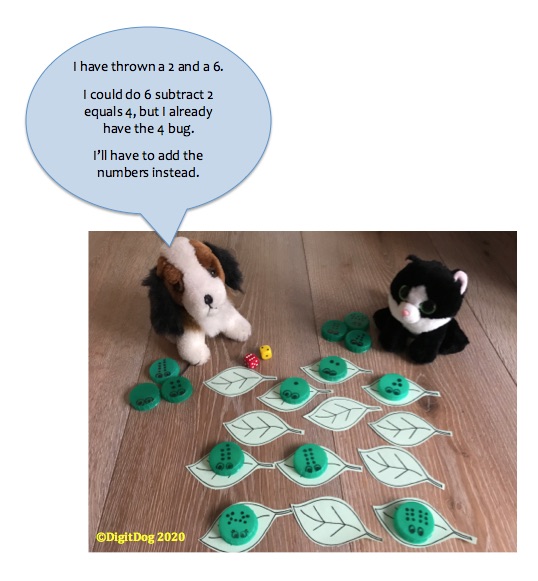
Set out the leaves with one bug on each leaf.  Take turns to roll both dice and use either addition or subtraction to capture a bug. For example, if you throw a 5 and a 3 you can either add the numbers together, 5 + 3 = 8, and capture the 8 bug, or you can subtract the numbers, 5 – 3 = 2, and capture the 2 bug.

collect the bugs

Explain your reasoning like Digit Dog.

When all the bugs have been captured, the player who has most bugs is the winner.

Which bugs are easiest to capture? Why do you think that?

Which bugs are more difficult to capture?

Posted in Calculating, Counting, Games, Subitising

Bottle Top Bugs – Who has more?

Who has more?

You need:

A set of Bottle Top Bugs

A feely bag / box or cloth

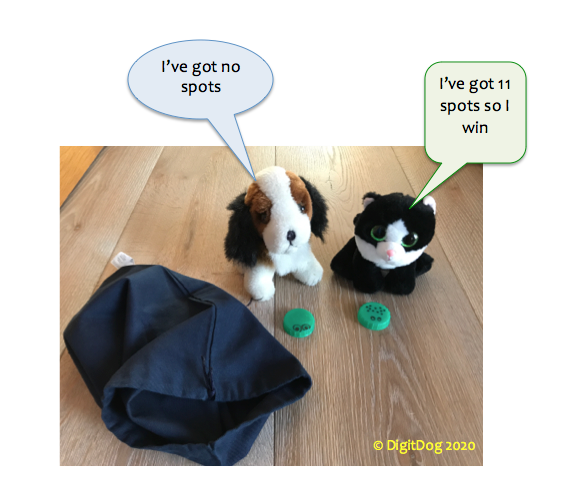
Put your bottle top bugs in a feely bag or a box or under a cloth. Each player takes one bug out, puts it in front of them and says how many spots there are. The player with more spots captures both bugs.

Who has more?

Keep playing until all the bugs have been used. The winner is the player who has  captured most bugs.

Ask:

Who has more spots? How many more?

Say:

I have ……. spots. I have ……. more spots than my friend.

Make sure that learners also practice using the word fewer.

Who has fewer spots? How many fewer?

I have …….. spots. I have …….. fewer spots than my friend.

Practise subitising (saying how many spots there are without counting in ones).

When you turn over a bug, say how many spots there are without counting in ones. How do you know how many spots there are? Calculating Cat knows she has 11 spots because she saw two groups of 5 plus 1.

Vary the game

Change the rules so that the player with fewer spots wins.

Players take two bugs and add the number of spots together. They then compare their totals. The player with the greater total captures all four bugs.

Players take two bugs and find the difference. They then compare their differences. The player with the greater / smaller difference captures the four bugs.

Posted in Logical reasoning, Mathematical language, What do you notice?

Bottle Top Bugs – What do you notice?


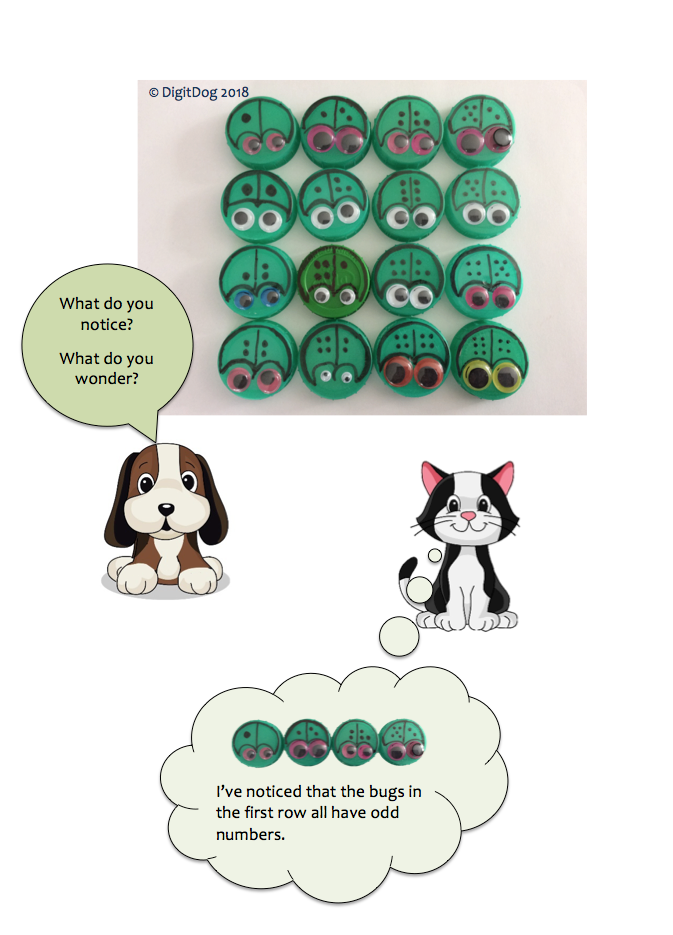
Digit Dog and Calculating Cat have arranged their bugs in 4 rows of 4.

What do you notice?

How many ways can you finish the sentence?

I notice that……….

Screenshot 2018-06-06 12.20.39

Is Calculating Cat correct? Or has she made a mistake? Convince me. Explain your thinking.

What can you say about:

  • the rows?
  • the columns?
  • the number of bugs?
  • patterns in the numbers on the bugs’ backs?
  • diagonal patterns?
  • odd ones out?
  • totals of spots?
  • their eyes?
  • anything else?

Digit Dog is also asking What do you wonder?

Look at the bugs and finish the sentence – I wonder…………..

How many ways can you finish the sentence? You might say things like:

I wonder what the total of each row is……

I wonder which row has the lowest total……..

I wonder if I can arrnage the bugs in order………

Collect the I wonder statements to use as challenges and activities.

Posted in Counting, Mathematical language, Subitising

Bottle Top Bugs

Wondering what to do with the tops of plastic milk bottles?

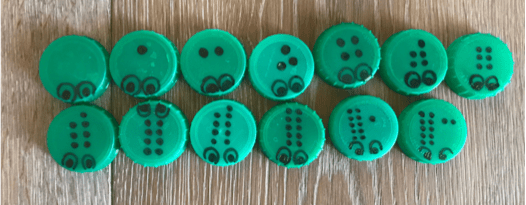
Make a set of Bottle Top Bugs.

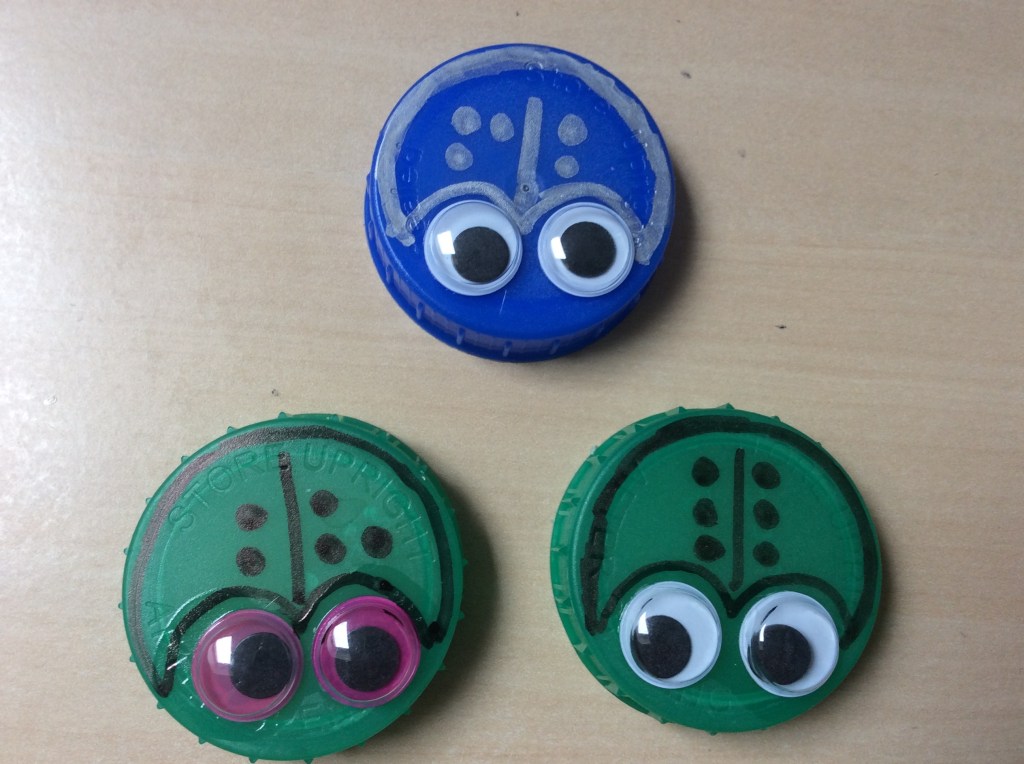
Draw eyes and spots. Think about the patterns of spots – this arrangement focuses on the pattern of 5. The numbers above 6 are arranged as “5 and some more”.
The spots on these bugs are arranged to match the Numicon shape patterns.
These bugs have “goggly eyes” and the spots are divided into two so that number bonds can be explored.

Look at your bugs.

Count the spots and put the bugs in order.

Try to say how many spots there are without counting in ones. Start to recognise patterns.

Find the Bug

Find the bug with 5 spots. Now find the one with one more than 5, one less than 5, two more/less than 5.

Find two bugs that have 8 spots altogether. Can you find another two with 8 spots? How many different pairs can you find? How do you know you have found them all?

COMING NEXT

More activities with Bottle Top Bugs.