Posted in Calculating, Fluency, Games

Double your number

Play Double your number

You need:

A game board.

A set of counters for each player. One colour for each player. You can download Digit Dog counters here – print on card and cut out or print on paper and stick them on milk bottle tops.

A dice.

Screenshot 2020-06-16 11.35.19

To play:

Take turns to throw a dice.

Double the number you throw, find the answer on the board and put your counter on it.

The winner is the first player to get three counters in a row.

Variation

Use a set of digit cards 1 – 19 and this board. Take turns to turn over a card, double the number and cover the answer on the board.


Posted in Calculating, Fluency, Games

Pass the Peas, Please

Digit Dog and Calculating Cat are playing Pass the Peas Please, a game they found on www.nrich.org
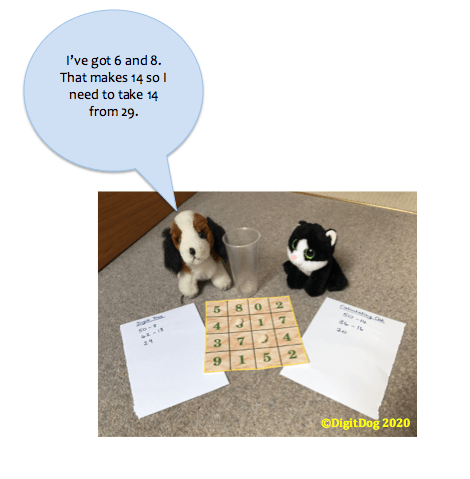
Screenshot 2020-06-16 10.20.55

A game for 2 or more players

You need:

A game board

2 dried peas (or beans or counters or sweets).

A plastic cup.

A piece of paper and pencil for each player.

To play:

Each player begins by writing 50 on their piece of paper.

Player 1 places two dried peas into the plastic cup and tosses them onto the game board.

They add the two numbers the peas land on and then take the total away from 50 and write the answer on their score sheet.

The next player takes a turn.

In the following turns, the players take the sum of the numbers away from the new remaining number.

The first player to reach zero wins.

Variations

Start with 0 on your score card and keep a running total of scores. The winner is the first to reach 50.

Use one pea instead of 2 and either subtract the number the pea lands on from 50 or keep a running total.

Use 3 peas to play the game.

Change the number you start with on your score card – make it higher or lower.

Each player takes a turn to throw two peas and add the numbers. The player with the highest total wins that round. Play 10 rounds.

Each player takes a turn to throw two peas and add the numbers. The player with the lowest total wins that round. Play 10 rounds.

Each player takes a turn to throw two peas and finds the difference between the numbers. The player with the highest difference wins that round. Play 10 rounds.

Use this board and start with 10 or 20 on your score cards.

Make your own boards. Choose the numbers you put on the board.

Posted in Calculating, Fluency, Games, Logical reasoning

Playing with cards 5

Memory addition

Screenshot 2020-06-11 09.14.09

Any number of players or teams of 2.

You need:

A pack of playing cards arranged in a 13 x 4 array, face down. Ace = 1, picture cards = 10.

To play:

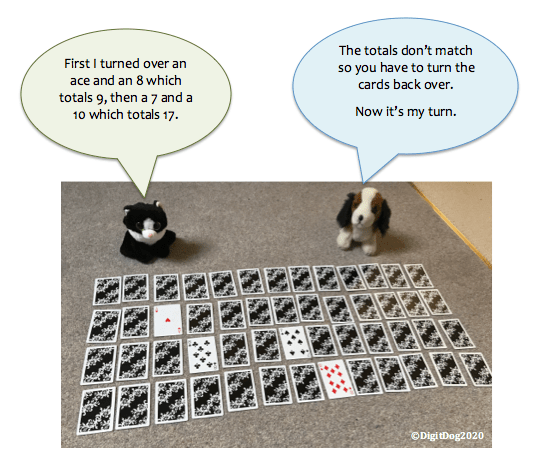
Player 1 turns over 2 cards and adds the values. Player 1 then turns over another two cards and adds the values. If the totals match, player 1 keeps the 4 cards and has another turn. If they do not match, the cards are turned face down again and it is player 2’s turn.

The game continues until no more matches can be made.

Can you remember where cards are? How will this help you? Watch carefully when other players are turning over cards.

Variations

  1. Play the same game but subtract the pairs of cards. If the answers match, keep the cards and have another turn. If they don’t, turn them face down again.
  2. On each turn, turn over two cards. If the numbers match, keep the cards and have another turn. If they don’t match turn the cards face down again.
  3. On each turn, turn over two cards. If the numbers and colours match, keep the cards and have another turn. If they don’t match turn the cards face down again.
  4. On each turn, turn over two cards. If both numbers are odd or both even, keep the cards and have another turn. If they don’t match turn the cards back face down.
  5. Make up your own rules!


Posted in Calculating, Fluency, Games

Playing with cards 4

Odd addition

2 – 5 players

You need:

Digit cards 1 – 10 (a set for each player) or playing cards with the picture cards removed.

To play:

Shuffle the cards and place in the centre.

Each player takes two cards from the pile, adds the cards together and tells everyone the total.

If the total is odd, the player keeps the cards. If the total is even, the cards are returned to the centre pile.

Play ten rounds or until there are no cards left.

The winner is the player with most cards.

Screenshot 2020-06-08 12.22.57

Variations

  • Leave the picture cards in and give them a value e.g. J = 11, Q = 12, K =13
  • Subtract the numbers on the cards instead of adding.
  • Deal 3 cards to each person.
  • Keep adding the totals of the cards you keep. First player to reach a total of 50 wins.


Posted in Conceptual understanding, Fluency, Games, Logical reasoning

Playing with cards 3

Largest number

2 – 4 players

You need:

Digit cards 1 – 9  (one set per player, shuffled) or a pack of playing cards, Ace to 9 only.

To play:

Deal 2 cards to each player.

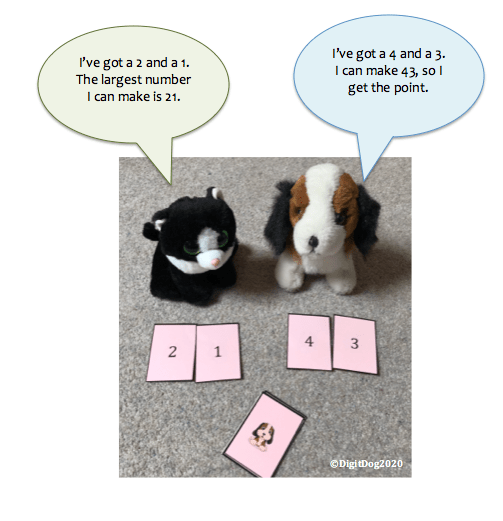
Players turn over their cards and make the largest 2-digit number they can with the cards they have been dealt.

The player with the largest number scores a point.

Play ten rounds. The winner is the player with most points.

Screenshot 2020-06-08 12.01.45

Variations

  • Deal 3 cards to each player and make 3-digit numbers.
  • Try 4 or 5- digit numbers.
  • Get a point for the smallest number rather than the largest.
  • Play more than 10 rounds.
Posted in Calculating, Fluency, Games

Playing with cards 2

Break the Bank at 27

A game for 2 – 5 players

You need:

A pack of playing cards – picture cards worth 10, Ace worth 1

To play

Deal out the whole pack of cards to players. Players put cards face down in a pile in front of them.

The first player turns over the top card and puts it in the centre. The next player puts their top card in the centre and adds the value of the two cards. Play continues like this, each player placing their card on the centre pile and adding the value to the total. When the total reaches 27 or more, that player takes the cards from the centre and puts them in their pile.

Screenshot 2020-06-08 10.44.23

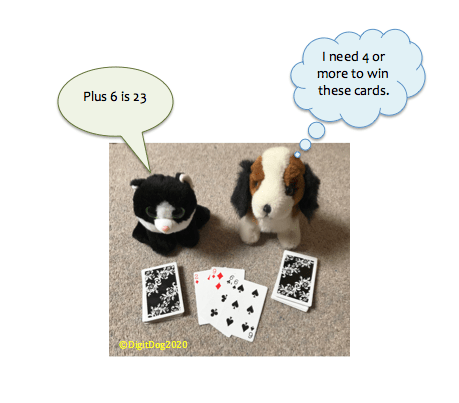
For example, in this game:

Digit Dog put down 2 and said “2”.

Calculating Cat put down 9, added it to the 2 and said “11”

Digit Dog put down 6, added it to 11 and said “17”.

Calculating Cat put down 6, added it to 17 and said “23”.

Digit Dog is now hoping to turn over a 4 or more so that he can take the cards.

The game continues for an agreed time or until one player has no cards.

The winner is the player with most cards.

Variations

Give the Ace and picture cards different values e.g. A = 11, J = 12, Q = 13, K = 14.

Change the number that breaks the bank – make it more or less than 27.

Posted in Calculating, Fluency, Games

Playing with cards

Quick addition

Two players

You need:

A pack of playing cards – picture cards are worth 10, aces are worth 1

To play:

Deal out all the cards to the two players and place in a pile, face down.

Players take turns to say 1, 2, 3 GO! and both players turn over their top card.

Players add the two numbers on the cards and the first one to say “the total is…..” (correctly) wins the two cards.

Play until all cards have been used, then each player counts how many cards they have won.

The winner is the player with most cards.


Screenshot 2020-06-08 09.23.29

Variations

Play quick subtraction where players subtract the smaller number from the larger.

Play quick multiplication where players multiply the two numbers and say “the product is…..”

To make the game easier:

  • Remove the picture cards
  • Just use cards Ace to 5.
  • Play with digit cards – make several sets of 0 – 5 cards.

To make the game more challenging:

  • Give the picture cards different values: J = 10, Q = 11, K = 12
  • Have 3 or 4 players and add all the numbers.
Posted in Calculating, Fluency, Money

Toss the coin

Digit Dog has got a new game.

Toss the coin

To play the game you will need:

  • A board for each player (download boards here),
  • A coin for each player to toss,
  • A pile of assorted coins to choose from (at least 32 for 2 players).

To play:

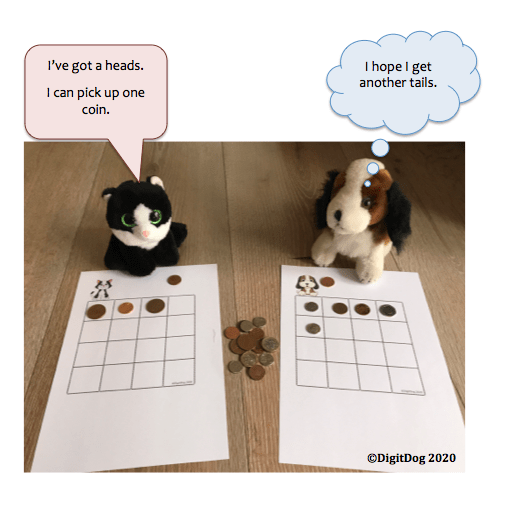
Take turns to toss your coin. If it’s heads, choose one coin from the pile. If it’s tails, choose two coins.

Put the coin(s) on your grid, one on each square.

The first player to cover their grid wins.

At the end of the game count how much money you have altogether on your grid.

Variations

Use this board which has a smaller grid.

Screenshot 2020-05-19 12.17.46

Select the coins that go in the centre according to the needs of the child:

  • just use one pence coins for a simple counting game.
  • use coins up to 10p to make calculating easier.
  • use 5p, 10p and 20p to practise countng in 5s and 10s.

Change the rules:

The game ends when the first person fills their grid but the winner is the player with the most money on the board. If this is the rule, which coins are you going to try and pick up? 

The game ends when the first person fills their grid but the winner is the player with the least money on the board. How does changing the rule change the way you choose coins? Which coins do you want to pick up now?

Posted in Counting, Fluency, Mathematical language

Counting leaves

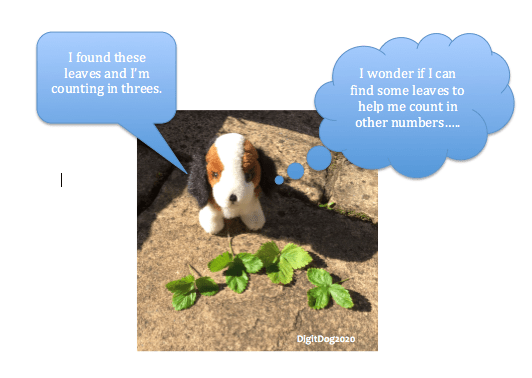
Digit Dog is out in the garden again. This time he is counting leaves.

counting in threes

See if you can find some leaves that are arranged in threes.

Put the leaves in front of you, counting in threes as you go. Now take them away and count back in threes. Write the numbers you are saying. Find the numbers on digit cards or on a number line.

Digit Dog has 4 groups of 3 leaves. He has 12 leaves altogether.

What if he had 6 groups of 3 leaves? How many leaves would he have then?

What if he had 15 leaves altogether? How many groups of 3 would he have?

Make up some questions like this to ask someone about your set of leaves.

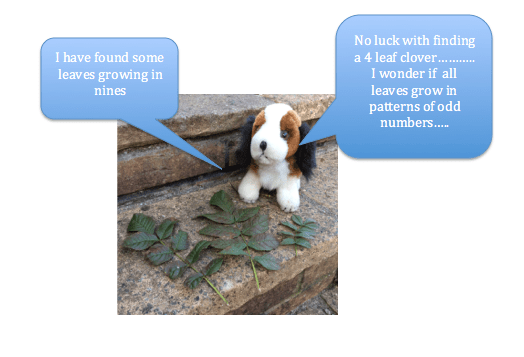
What about finding leaves that are arranged in different numbers?

leaves in nines

What do you think?

Posted in Additive relationships, Calculating, Fluency, Problem solving

Counting and calculating with target boards – numbers to 100

Develop fluency with the target boards. Use the target boards to:

  • recall and remember useful number facts;
  • use number facts to calculate mentally;
  • explain thinking and methods of calculating.
  • use mathematical language correctly

Target board 4

Print Target Board 4

  • Say each number out loud.
  • Say the numbers in order – from smallest to largest and back again.
  • Point at a number – how many tens and how many ones make that number?
  • Point at a number – what is 10 more than that number?
  • Point at a number and count in 10s from that number. How far can you count?

Look at the target board and:

Find two numbers that total / add up to 30 / 40 / 50.

Find more than two numbers that make those totals.

Choose your own totals to make.

Record your work.

  • How do you know you are correct?
  • How did you work it out? Explain your thinking.

Find two numbers with a difference of 10, a difference of 12………… What other differences can you find?


Find the column with the highest total. Which column is easiest to add up? Why?

Find the number that is double 14, double 7, double 20………..

Find the number that is half of 80, half of 36………

Find the answer to 5 x 2, 9 x 5, 3 x 4…………..make up some questions of your own.


Find numbers that are multiples of 5 (are in the 5 times table), multiples of 2, multiples of 10……..


Posted in Additive relationships, Calculating, Fluency, Problem solving

Calculating with target boards (4)

Develop fluency with the target boards. Use the target boards to:

  • recall and remember useful number facts;
  • use number facts to calculate mentally;
  • explain thinking and methods of calculating.
  • use mathematical language correctly.


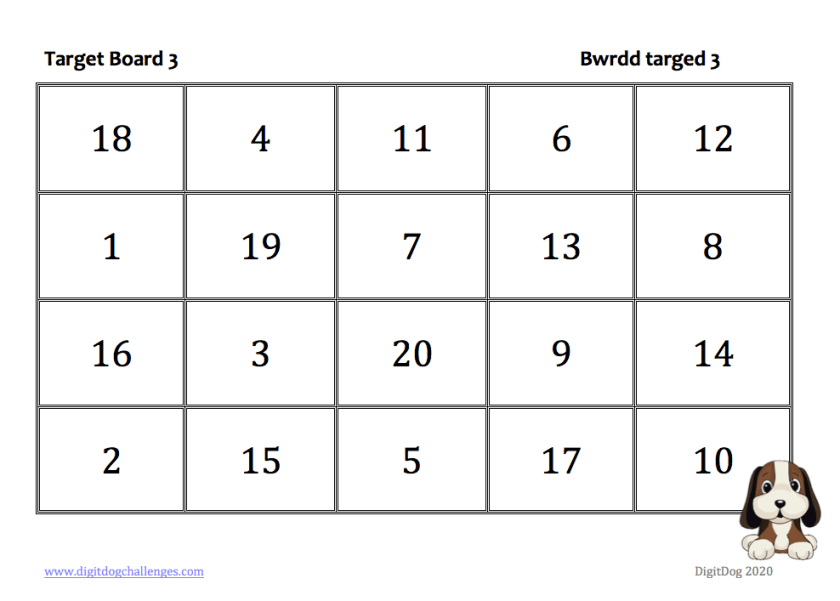
Target board 3

Print Target Board 3

  • Say each number out loud.
  • Say the numbers in order.
  • Point at a number and then find that number of objects.
  • Point at a number – what is 10 more than that number?

Ask children to look at the target board and:

Find two numbers that total / add up to 20.

  • How do you know you are correct?
  • How did you work it out? Explain your thinking.
  • How many pairs of numbers can you find?
  • Make a list of the pairs you find.
  • Make up a number story to go with your pairs of numbers e.g. 13 + 7 = 20 There were 13 ladybirds sitting on a leaf, 7 more came along and now there are 20.

Find more than two numbers that total 20?

Find numbers that make other totals.


Find the total of the numbers in the first column. How did you work it out? Which numbers did you add first? What did you notice? Did you notice that 18 + 2 = 20? How does this help?

Find the sum of the numbers in the bottom row.  How did you do that? Which numbers did you add first? What did you notice? What is the easiest way to add up the numbers?

Find the column with the highest total. Which column is easiest to add up? Why?

Find the number that is double 1, double 2, double 3………..

Find the number that is half of 10, half of 12………


Find two numbers with a difference of 2, a difference of 4…………

Make a list of your numbers. Put them in order. What do you notice? Can you find any patterns?

Problem solving with the target board

My total is 16 – find two numbers that you can add together to make my total.  Can you find three numbers to make my total?

One of my numbers is 7. When I add it to another number, my total is 13. What is my second number?

I am thinking of a number and when I count on 5, I say 14. Find the number I started with.

I am thinking of a number and when I count back 3, I say 8.  Find the number I started with. 

I am thinking of a number. I doubled it to make 16. What is my number?

My difference is 5 – find two numbers on the target board that have a difference of 5.

I am thinking of two numbers. When I take away the smaller from the larger my answer is 4. What numbers could I be thinking of? How many pairs of numbers can you find? How do you know you have found them all?

One of my numbers is 15. When I subtract another number, I am left with 9. What is my second number?

Make up some of your own problems like this.


Posted in Additive relationships, Calculating, Fluency

Calculating with target boards 3

Use the target boards to develop fluency.  Use them to:

  • recall and remember useful number facts;
  • use number facts to calculate mentally;
  • explain thinking and methods of calculating.
  • use mathematical language correctly.

Target board 2

Print Target Board 2

  • Say each number out loud.
  • Put objects on each number – check that you have the correct amount.
  • Say the numbers in order.

Subtraction and the target board.

Ask children to:

Choose a number and take away 1. Write a number sentence to show what you have done e.g. 4 – 1 = 3. Use objects to help if you need to. Try taking away other numbers.

Choose two numbers and take the smallest number away from the largest. Write a number sentence to show what you have done.

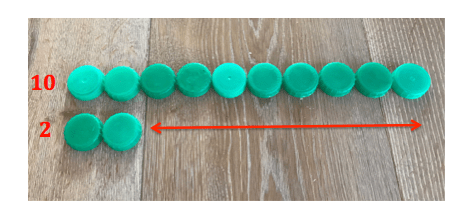
Choose two numbers and find the difference between the numbers e.g. the difference between 10 and 2 is 8. Use bottle tops to help work this out.

difference between

Or use the number line.

number line difference
The difference between 2 and 5 is 3.

Find two numbers on the board with a difference of 1. 

How do you know you are correct?

How did you work it out? Explain your thinking.

How many pairs of numbers with a difference of 1 can you find? Make a list of the pairs you find.

Practise counting back. Choose two numbers and count back from the larger to the smaller e.g. if you choose 4 and 9, you start at 9 and say 9, 8, 7, 6, 5, 4.

Use a number line to count back. Choose a number on the target board, count back 2, what number are you on now?

number line -2
I chose 10:  10 count back 2 is 8; 10, then 2 less is 8;  10 – 2 = 8

Make up a number story to go with your pairs of numbers, e.g. if you choose 4 and 6 you might say:

“Digit Dog had 6 bones in his dish. He ate 4 of them. How many does he have left?” 

“Calculating Cat had 6p in her purse and she spent 4p. How much does she have left?”

“Digit Dog has 6 bones and Calculating Cat has 4. How many more bones does Digit Dog have?”

Make up some problems for someone else to solve.


Problem solving with the target board

My difference is 3 – find two numbers on the target board that have a difference of 3.

I am thinking of two numbers. When I take away the smaller from the larger I am left with 2. What numbers could I be thinking of?

One of my numbers is 7. When I subtract another number, I am left with 5. What is my second number?

I am thinking of a number. I count back 3 and get to 4. What number did I start with?