Posted in Calculating, Making totals, Numicon

Total 6

Total 6 is an extension of Investigating totals

Put the shapes on the grid but this time each row, column and diagonal has to total 6.
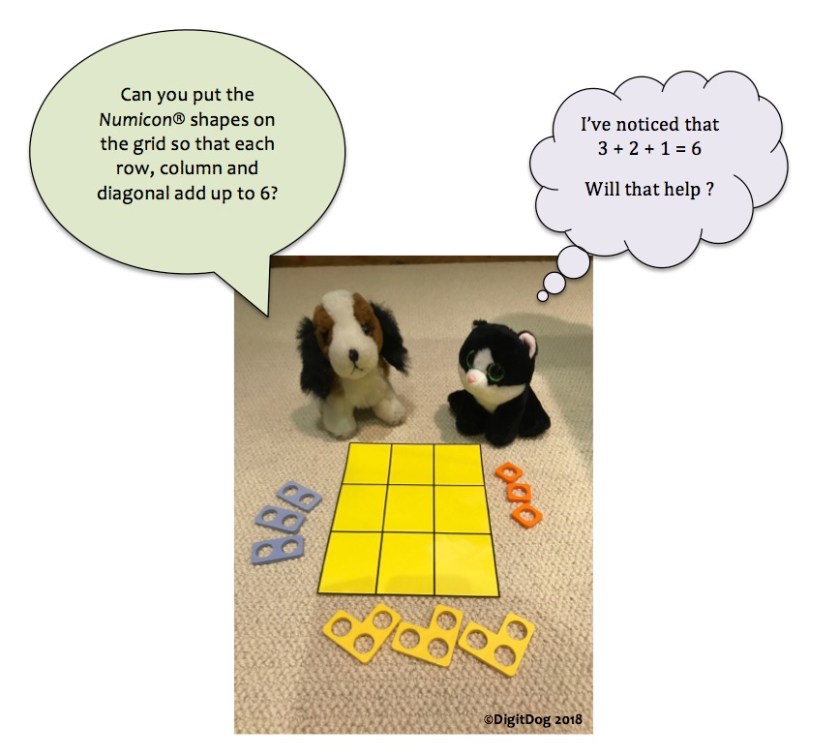
6 grid

You might want to start by:

  1. Just making each row total 6. Then try
  2. Just making each column total 6. Follow this by
  3. Making both the rows and columns total 6, and finally
  4. Include the diagonals too.

Which shapes are you using in each row / column? Why?

Is there more than one way of completing the grid?

Look at your partner’s grid. What is the same and what is different?

Make the task more challenging:

  1. Use digit cards instead of the shapes.
  2. Don’t give the total – Can you put the Numicon shapes on the grid so that each row, column and diagonal add to the same total?

What do you think the total might be? Why?

How are you going to start? What are you going to try first?

What if.……..you used three different consecutive shapes?

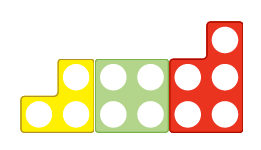
3 twos, 3 threes and 3 fours                                 3 threes, 3 fours and 3 fives

Screenshot 2018-09-26 14.28.32or   Screenshot 2018-09-26 14.28.43

What will the totals of each row be now?

Screenshot 2018-09-26 15.51.01

Posted in Calculating, Making totals, Numicon

Investigating totals

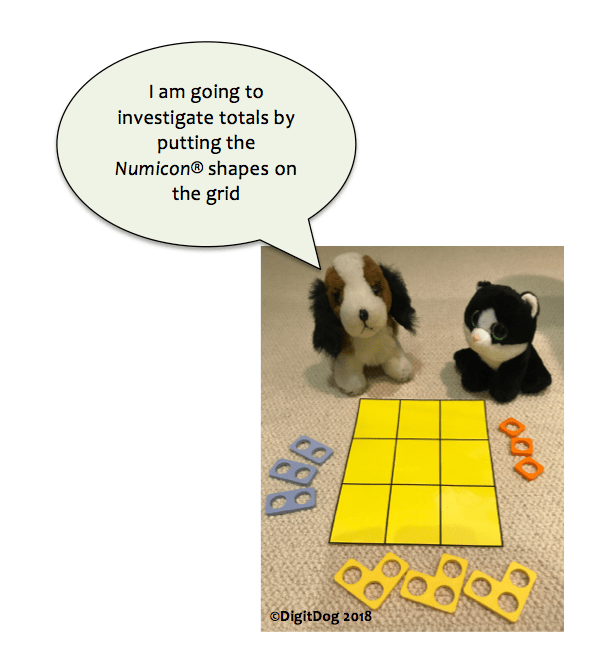
Digit Dog has got a 3 x 3 grid and 9 Numicon shapes – 3 one shapes, 3 two shapes and 3 three shapes. He is going to put the shapes on the grid and investigate the totals he can make.

Screenshot 2018-09-23 15.50.21

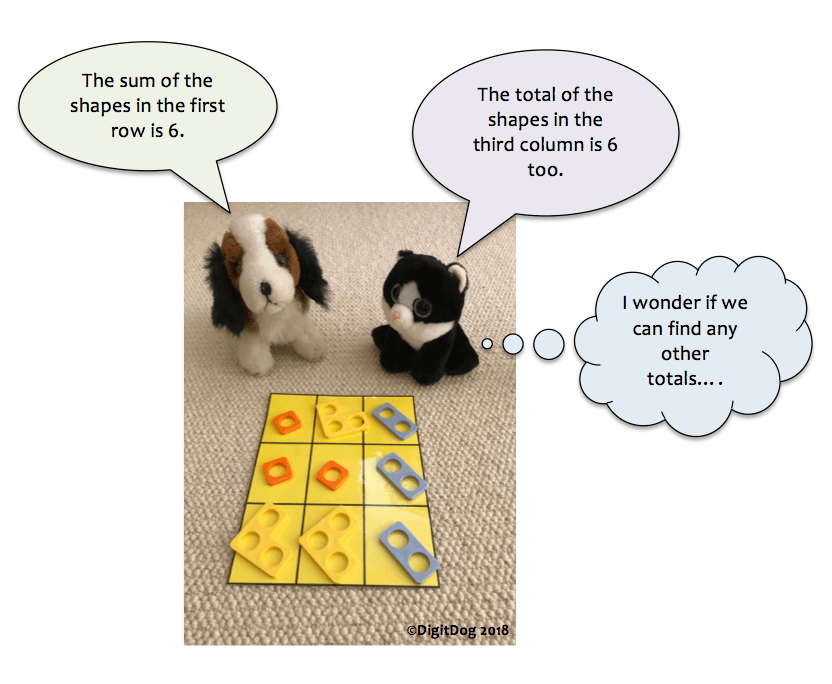
This is what he does first:

Screenshot 2018-09-23 15.50.32

Copy what Digit Dog has done.

Digit Dog says that the sum of the shapes in the first row is 6. Do you agree with Digit Dog? Why or why not? Are you sure?

Expecting learners to explain their thinking helps develop their reasoning skills.

If you agree, convince me that Digit Dog is correct. If you don’t agree, explain why you think he is wrong.

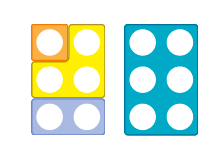
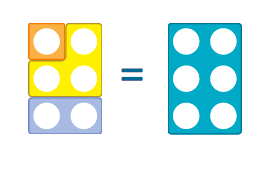
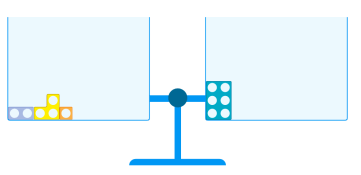
Encourage learners to explain why the total of the first row is 6. Use the Numicon shapes to show that the 3 shapes in the first row are equivalent to a six-shape. Explanations are much easier when you use concrete apparatus.

Screenshot 2018-09-23 18.01.53     Screenshot 2018-09-23 18.01.40

Screenshot 2018-09-23 18.07.13

Use the pan balance to explain.

Calculating Cat says that the total of the shapes in the third column is 6 too. Is she right? How do you know?

What is the same and what is different about Digit Dog’s row and Calculating Cat’s column?

Can you find any other rows or columns that total 6? Are there any that total more than 6? What about less than 6?

Can you find a row or column that totals 1 more than 6? What about 1 less than 6?

What else do you notice?

Find a way to record the totals you have found?

Now arrange the shapes on the grid in any way you want and investigate the totals that you make. What do you notice? What is the largest total you can make? The smallest total?

Look at a grid your friend has done. What is the same? What is different?

What if you used other shapes?

Posted in 2-sided beans, Conceptual understanding, Fluency

NEW! Challenge card packs

New from Digit Dog Challenges – the challenge cards are extended versions of Digit Dog’s popular posts and are now available in packs of 5 with links to Curriculum for Wales 2022.

Each pack has 5 challenge cards, linked to a theme, concept or resource. There is also an overview of how Digit Dog Challenges address the five proficiencies, and links to the relevant Descriptions of Learning in the Mathematics and Numeracy Area of Learning and Experience.

The first pack contains activities using the Two-sided Beans

Packs are available to purchase at www.collectivelearning.co.uk

Posted in Additive relationships, Calculating, Conceptual understanding, Fluency, Numicon

Making 10

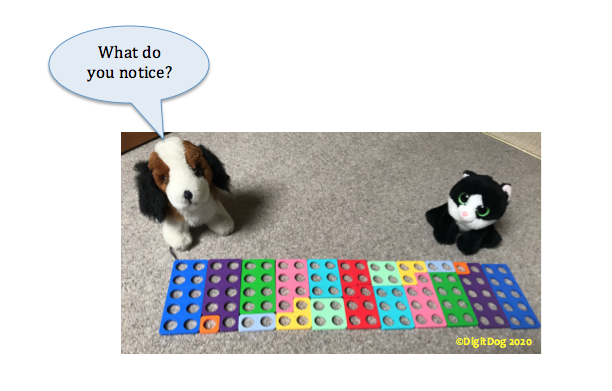
Numicon pairs to 10

Look at the Numicon shapes and find pairs of shapes that make 10. Check that you are correct by placing each pair on top of the ten shape.

Put your pairs in order.

Numicon pairs to 10 pattern

What do you notice? What patterns can you see?

Say an addition sentence for each pair e.g. 1 add 9 equals 10.

Write an addition sentence e.g. 1 + 9 = 10.

Say a subtraction sentence e.g. 10 take away 1 equals 9.

Write a subtraction sentence e.g. 10 – 1 = 9.

Play What’s Missing?

Set out your pairs like Digit Dog and Calculating Cat.

Player 1 closes their eyes, Player 2 removes one shape and says “what’s missing?”

Player 1 works out what shape is missing and explains how they know.

For more Numicon activities visit Oxford Owl for Home Maths.

Download and print the free Numicon shapes and the Numicon at Home Activity Kit for Years 1 and 2.

Posted in Additive relationships, Calculating, Fluency, Strategic competence

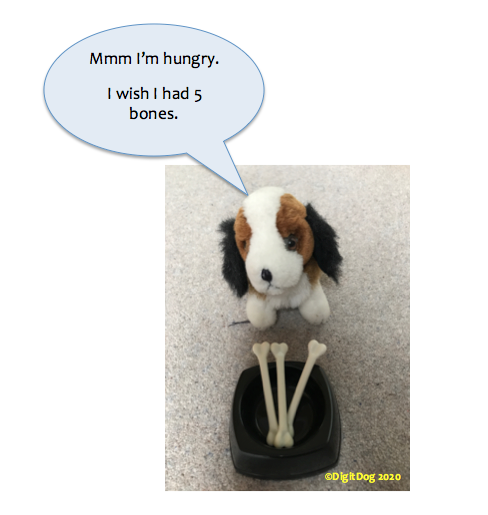
I wish I had……..

Screenshot 2020-07-01 09.48.30

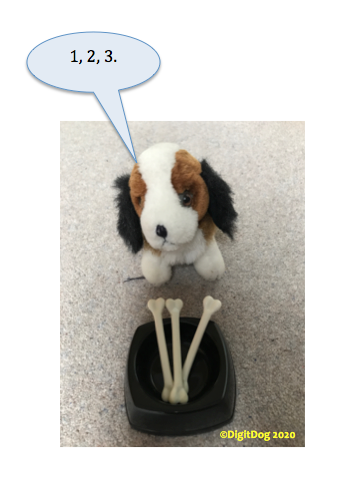
Digit Dog is counting his bones. “One, two, three.” But 3 bones are not enough.

Reason about numbers by asking questions about the number of bones:

What if Digit Dog found 1 more bone? How many would he have then? How do you know that? Can you convince me?

What if he found 2 more bones?

What if he ate one bone?

Screenshot 2020-07-01 09.51.41


What does Digit Dog have to do to make his wish come true? How many more bones does he need? How can you work it out?

Screenshot 2020-07-01 10.11.16


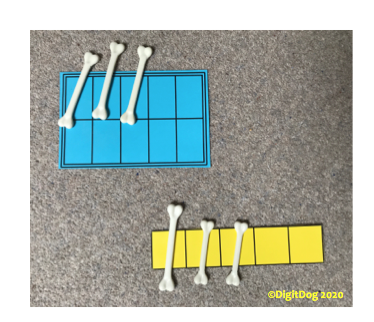
Use a five-frame or ten-frame to help learners work out how to make Digit Dog’s wish come true and explain their thinking.

Explore other numbers of bones.

Posted in Calculating, Fluency, Games

Go Fish 10

You play Go Fish 10 in the same way as Go Fish but the aim of the game is to make pairs that add up to 10.

Print Digit Dog’s cards here. You need 4 sets for 2 -3 players.

To play:

Deal each player 7 cards and spread out the remaining cards face down on the table. The aim of the game is to find pairs of cards that add up to 10.

Each player takes a turn. During a turn the player:

  1. Looks at the cards in their hand, if they have any pairs that add up to 10, they put them in front of them, face up.
  2. They then ask another player if they have a particular card so that they can make another pair. For example, player 1 might have a 4 in their hand and so ask aplayer 2 “do you have a 6?” – the card they need to make a pair that adds to 10. If player 2 has a 6 card, then they must give it to player 1. If they don’t have a 6 card, they say “go fish” and player 1 takes a card from the pool of cards on the table.
  3. If the player gets the card they asked for, either from the pool or from the other player, then they put their pair of cards in front of them, face up.

The game ends when one player runs out of cards or there are no more cards in the pool. The winner is the player with most pairs in front of them.

What if………

………….you played the game by making pairs of cards with a difference of 1?

Posted in Counting, Games

Play Go Fish

How to play Go Fish

For 2 – 3 players you need to print 4 sets of Digit Dog’s cards, onto card. The cards have numerals along with ten-frames.Screenshot 2020-06-29 08.58.52

The game can also be played with digit cards 0 – 10 or 0 – 20, or  a pack of playing cards.

To play:

Deal each player 7 cards and spread out the remaining cards face down on the table. The aim of the game is to find pairs of cards.

Each player takes a turn. During a turn the player:

  1. Looks at the cards in their hand, if they have any pairs, they put them in front of them, face up.
  2. They then ask another player if they have a particular card so that they can make another pair. For example, player 1 might ask player 2 “do you have a 5?” If player 2 has a 5 card, then they must give it to player 1. If they don’t have a 5 card, they say “go fish” and player 1 takes a card from the pool of cards on the table.
  3. If the player gets the card they asked for, either from the pool or from the other player, then they put their pair of cards in front of them, face up.

The game ends when one player runs out of cards or there are no more cards in the pool. The winner is the player with most pairs in front of them.

Posted in Counting, Number sense, Subitising, Ten frames

Ten frame games

1. Make the number

Screenshot 2020-06-24 11.27.44

You need:

For 3 – 5 players

Two sets of Digit Dog ten frames – large or small

Small objects such as pennies, buttons or counters.

To play:

One player is the leader and has the ten frame cards in a pile, face down.

Other players have a blank ten frame and ten small objects each.

The leader turns over the top card for a few seconds and then turns it back again.

Other players make the pattern they saw with objects on their ten frame.

The leader turns over the card again to check the patterns. Players who were correct score one point.

Play until all cards have been turned over, or one player reaches 10 points.

The winner is the player with most points.

Variations

  • Make the number on your ten frame one more than the number on the card.
  • Make the number on your ten frame two more than the number on the card.
  • Make the number on your ten frame one less than the number on the card.
  • Make the number on your ten frame two less than the number on the card.


2. Who has more?


Screenshot 2020-06-24 11.59.59

You need:

For 2 players

A set of Digit Dog ten frames for each player, in a pile face down.

To play:

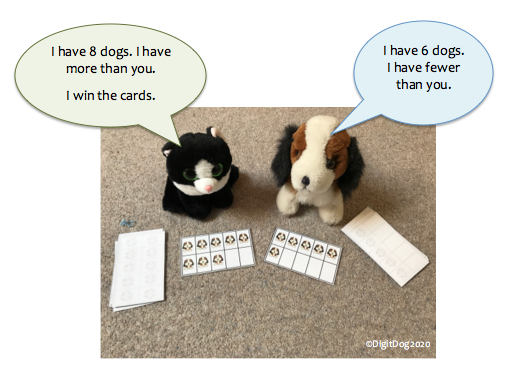
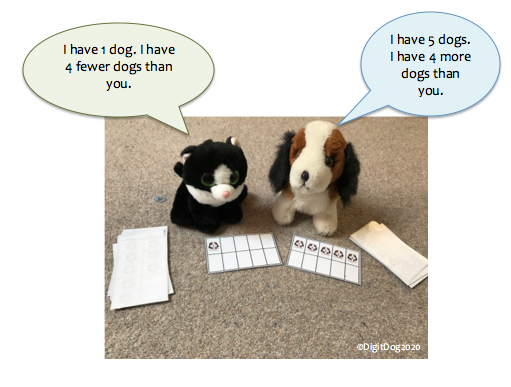
On the count of 3, players turn over their top card. The player with more dogs wins the two cards and says “I have …….dogs. I have more dogs than you”. The other player says “I have ……. dogs. I have fewer dogs than you”.

The game ends when all cards have been turned over. The winner is the player with more cards.

Variation

  • The player with the fewer dogs wins the cards.
  • Say how many more and how many fewer dogs there are.Screenshot 2020-06-24 12.10.41
Posted in Counting, Number sense, Subitising, Ten frames

Ten frame flash

This game practises subitising (see June 24th Post)

Screenshot 2020-06-24 09.51.27

To play Ten Frame Flash you need:

A few sets of Digit Dog ten frame flash cards – large or small

To play:

Place the cards in a pile face down.

One player shows the top card and then turns it back again, the other players have to say how many dogs were on the card. The length of time that the card is revealed can get shorter as learners get better at recognising the patterns.

Encourage learners to recognise patterns and to work out the number without counting each dog.

How did you know how many there are? Explain your thinking.

Variations

  • For learners still practising counting accurately, turn over the cards and count each dog. Place an object on each dog and count the objects.
  • Use the five frame flash cards.
  • For a challenge: turn over the card, show the dogs and then hide them again. This time say one more than the number of dogs or one less than the number, e.g. if there were 4 dogs on the card, you would say “one more is 5” or “one less is 3”.

Try these on-line ten frame games:

https://gregtangmath.com/tenframemania

https://www.nctm.org/Classroom-Resources/Illuminations/Interactives/Ten-Frame/

Posted in Counting, Number sense, Subitising, Ten frames

Using ten frames

Show these slides for a couple of seconds to practise saying how many objects there are without counting in ones.

To play:

Open slideshow.

Click once to reveal an image, click again for it to disappear.

Ask: “How many Digit Dogs can you see?”

At first learners will want to count each dog and you will need to leave the image on the screen. Practise recognising the groups of dogs and saying how many there are without having to count each one. How quickly can you do this?

Being able to look at a small set of objects (up to 5) and say how many there are without counting in ones is called subitising. Once children can count objects accurately we want them to move onto subitising, this is an important step in the development of number sense.

It is easier to subitise if objects are arranged in recognisable patterns, such as the dice dot patterns or on ten-frames. The frames are used so that learners can relate numbers to 5 and 10, an important understanding for calculation.

DD4
I know there are 5 spaces in each row, so I can see this 4 in relation to 5. 4 is one less than 5.


Perceptual subitising – instantly recognising a small group of objects, usually up to 5 or 6.

DD3.jpgDD4.jpg


How many Digit Dogs can you see?


Conceptual subitising – seeing smaller groups of objects within a larger group to say how many there are without counting in ones. We do this when there are more than 5 or 6 objects.


I know there are 7 because I see 5 and 2 more.

Screenshot 2018-03-15 17.01.54.pngScreenshot 2018-03-15 17.02.01.png

I know there are 7 because I can see 4 and 3 more.


Posted in Logical reasoning, Patterns

Patterns in names

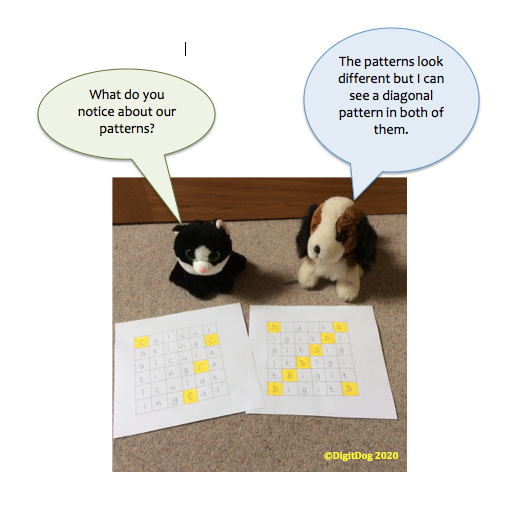
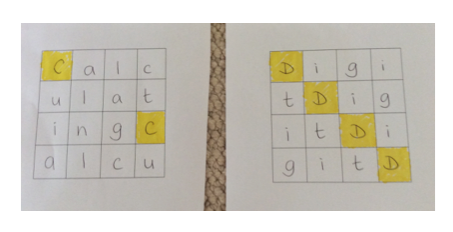
What patterns can you see on the grids? Describe the patterns on each grid. What do you notice?

Screenshot 2020-06-23 09.31.57

Screenshot 2020-06-23 09.51.40Screenshot 2020-06-23 09.50.21

If we added another row, can you predict which square you would colour in? Why do you say that? Explain your thinking.

Try your own name and look for patterns.

Print the 6 x 6 grid here. Write your name in the grid, one letter in each square, repeating it until all the squares are filled. Now colour in the squares which have the first letter of your name in them. What patterns have you made? Can you think of a way to describe the patterns?

Ask people you know to try it. What is the same and what is different about the patterns different names make?

What if you tried a larger grid?

Screenshot 2020-06-23 09.53.25

What has changed?

What about a smaller grid? What patterns can you see then?

Screenshot 2020-06-23 09.53.31

Try some different sized grids with your name.

Download grids

Grids 2 to 8,

Grids 9 and 10.

For more pattern activities go to Digit Dog’s home page, go to Categories and select Patterns