Posts

Posted in Logical reasoning, Problem solving

100 square jigsaw

Digit Dog and Calculating Cat are doing a 100 square jigsaw. They are looking at each piece and deciding where it goes on the grid.

Screenshot 2020-06-18 12.37.30

Have a go at completing the puzzle.

Download the blank grid here. Download this 100 square and cut along the thicker lines to create the jigsaw pieces.

Think about which piece you are going to put in first. Why have you chosen that one? Which piece has the lowest number on it? Where does that go? How do you know?

Where does the highest number go?

Whenever you place a piece on the board, explain why you are placing it there.

Can you see patterns to help you?

Challenge yourself

  • Turn all the pieces face down. Turn over one piece at a time and work out where it goes on the grid. Explain your thinking.
  • If you want to try an interactive version of this puzzle, go to https://nrich.maths.org/5572
  • Print this 100 square and cut out your own puzzle pieces for a friend to solve.


Posted in Calculating, Fluency, Games

Double your number

Play Double your number

You need:

A game board.

A set of counters for each player. One colour for each player. You can download Digit Dog counters here – print on card and cut out or print on paper and stick them on milk bottle tops.

A dice.

Screenshot 2020-06-16 11.35.19

To play:

Take turns to throw a dice.

Double the number you throw, find the answer on the board and put your counter on it.

The winner is the first player to get three counters in a row.

Variation

Use a set of digit cards 1 – 19 and this board. Take turns to turn over a card, double the number and cover the answer on the board.


Posted in Calculating, Fluency, Games

Pass the Peas, Please

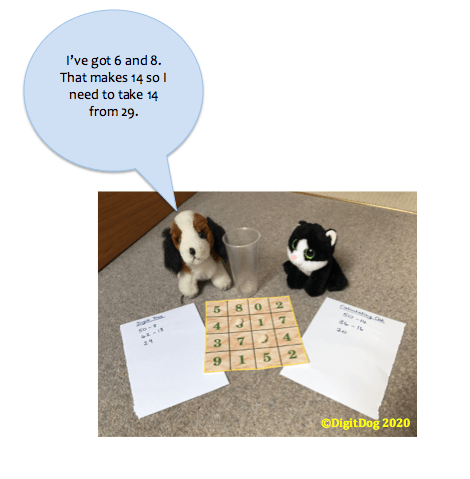
Digit Dog and Calculating Cat are playing Pass the Peas Please, a game they found on www.nrich.org

Screenshot 2020-06-16 10.20.55

A game for 2 or more players

You need:

A game board

2 dried peas (or beans or counters or sweets).

A plastic cup.

A piece of paper and pencil for each player.

To play:

Each player begins by writing 50 on their piece of paper.

Player 1 places two dried peas into the plastic cup and tosses them onto the game board.

They add the two numbers the peas land on and then take the total away from 50 and write the answer on their score sheet.

The next player takes a turn.

In the following turns, the players take the sum of the numbers away from the new remaining number.

The first player to reach zero wins.

Variations

Start with 0 on your score card and keep a running total of scores. The winner is the first to reach 50.

Use one pea instead of 2 and either subtract the number the pea lands on from 50 or keep a running total.

Use 3 peas to play the game.

Change the number you start with on your score card – make it higher or lower.

Each player takes a turn to throw two peas and add the numbers. The player with the highest total wins that round. Play 10 rounds.

Each player takes a turn to throw two peas and add the numbers. The player with the lowest total wins that round. Play 10 rounds.

Each player takes a turn to throw two peas and finds the difference between the numbers. The player with the highest difference wins that round. Play 10 rounds.

Use this board and start with 10 or 20 on your score cards.

Make your own boards. Choose the numbers you put on the board.

Posted in Additive relationships, Calculating, Logical reasoning, Making totals

Finding pairs

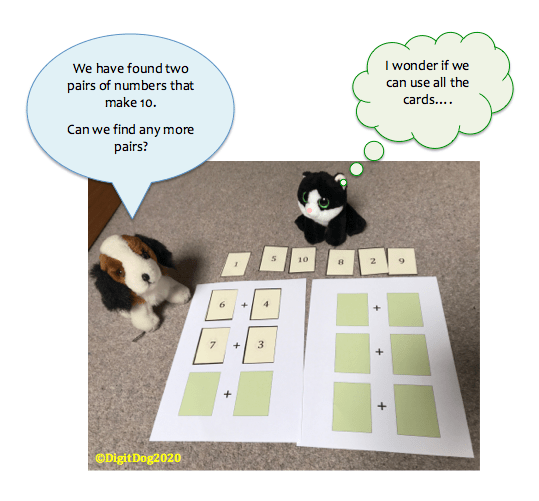
Digit Dog and Calculating Cat are using one set of digit cards 1 – 10 and looking for pairs that make 10.

Screenshot 2020-06-15 09.32.44

Download a set of digit cards here. You will need cards 1 to 10. Print double-sided to have Digit Dog on the back!

Download a baseboard here. Print two.

How many pairs that make 10 can you make? Put the cards on the baseboard.

Can you use all the cards? Which cards are left over? Why?

Try making some other totals – remember you can only use one set of cards from 1 – 10.

What if you make 9? Which cards are left over? Why?

What about 8?  or 12?  or 13?  or 11? Investigate the number of pairs and the cards that you cannot use.

Record your work. Write down the pairs of numbers and their totals.


Posted in Calculating, Fluency, Games, Logical reasoning

Playing with cards 5

Memory addition

Screenshot 2020-06-11 09.14.09

Any number of players or teams of 2.

You need:

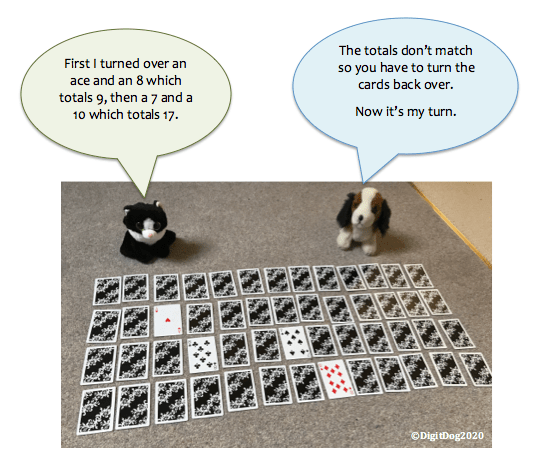
A pack of playing cards arranged in a 13 x 4 array, face down. Ace = 1, picture cards = 10.

To play:

Player 1 turns over 2 cards and adds the values. Player 1 then turns over another two cards and adds the values. If the totals match, player 1 keeps the 4 cards and has another turn. If they do not match, the cards are turned face down again and it is player 2’s turn.

The game continues until no more matches can be made.

Can you remember where cards are? How will this help you? Watch carefully when other players are turning over cards.

Variations

  1. Play the same game but subtract the pairs of cards. If the answers match, keep the cards and have another turn. If they don’t, turn them face down again.
  2. On each turn, turn over two cards. If the numbers match, keep the cards and have another turn. If they don’t match turn the cards face down again.
  3. On each turn, turn over two cards. If the numbers and colours match, keep the cards and have another turn. If they don’t match turn the cards face down again.
  4. On each turn, turn over two cards. If both numbers are odd or both even, keep the cards and have another turn. If they don’t match turn the cards back face down.
  5. Make up your own rules!


Posted in Calculating, Fluency, Games

Playing with cards 4

Odd addition

2 – 5 players

You need:

Digit cards 1 – 10 (a set for each player) or playing cards with the picture cards removed.

To play:

Shuffle the cards and place in the centre.

Each player takes two cards from the pile, adds the cards together and tells everyone the total.

If the total is odd, the player keeps the cards. If the total is even, the cards are returned to the centre pile.

Play ten rounds or until there are no cards left.

The winner is the player with most cards.

Screenshot 2020-06-08 12.22.57

Variations

  • Leave the picture cards in and give them a value e.g. J = 11, Q = 12, K =13
  • Subtract the numbers on the cards instead of adding.
  • Deal 3 cards to each person.
  • Keep adding the totals of the cards you keep. First player to reach a total of 50 wins.


Posted in Conceptual understanding, Fluency, Games, Logical reasoning

Playing with cards 3

Largest number

2 – 4 players

You need:

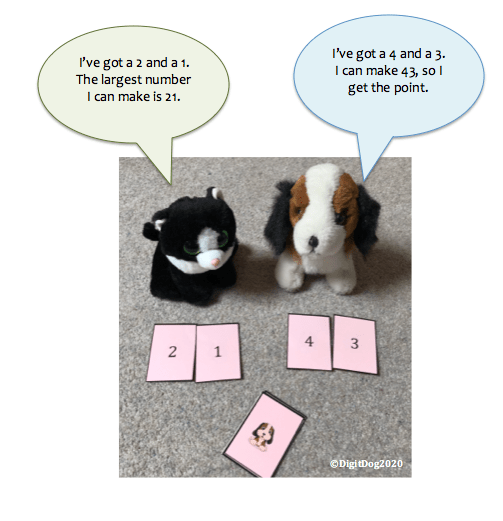
Digit cards 1 – 9  (one set per player, shuffled) or a pack of playing cards, Ace to 9 only.

To play:

Deal 2 cards to each player.

Players turn over their cards and make the largest 2-digit number they can with the cards they have been dealt.

The player with the largest number scores a point.

Play ten rounds. The winner is the player with most points.

Screenshot 2020-06-08 12.01.45

Variations

  • Deal 3 cards to each player and make 3-digit numbers.
  • Try 4 or 5- digit numbers.
  • Get a point for the smallest number rather than the largest.
  • Play more than 10 rounds.
Posted in Calculating, Fluency, Games

Playing with cards 2

Break the Bank at 27

A game for 2 – 5 players

You need:

A pack of playing cards – picture cards worth 10, Ace worth 1

To play

Deal out the whole pack of cards to players. Players put cards face down in a pile in front of them.

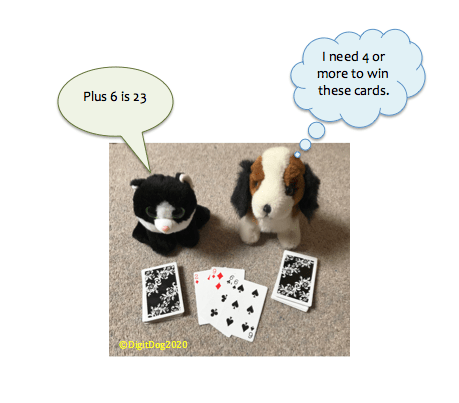
The first player turns over the top card and puts it in the centre. The next player puts their top card in the centre and adds the value of the two cards. Play continues like this, each player placing their card on the centre pile and adding the value to the total. When the total reaches 27 or more, that player takes the cards from the centre and puts them in their pile.

Screenshot 2020-06-08 10.44.23

For example, in this game:

Digit Dog put down 2 and said “2”.

Calculating Cat put down 9, added it to the 2 and said “11”

Digit Dog put down 6, added it to 11 and said “17”.

Calculating Cat put down 6, added it to 17 and said “23”.

Digit Dog is now hoping to turn over a 4 or more so that he can take the cards.

The game continues for an agreed time or until one player has no cards.

The winner is the player with most cards.

Variations

Give the Ace and picture cards different values e.g. A = 11, J = 12, Q = 13, K = 14.

Change the number that breaks the bank – make it more or less than 27.

Posted in Calculating, Fluency, Games

Playing with cards

Quick addition

Two players

You need:

A pack of playing cards – picture cards are worth 10, aces are worth 1

To play:

Deal out all the cards to the two players and place in a pile, face down.

Players take turns to say 1, 2, 3 GO! and both players turn over their top card.

Players add the two numbers on the cards and the first one to say “the total is…..” (correctly) wins the two cards.

Play until all cards have been used, then each player counts how many cards they have won.

The winner is the player with most cards.


Screenshot 2020-06-08 09.23.29

Variations

Play quick subtraction where players subtract the smaller number from the larger.

Play quick multiplication where players multiply the two numbers and say “the product is…..”

To make the game easier:

  • Remove the picture cards
  • Just use cards Ace to 5.
  • Play with digit cards – make several sets of 0 – 5 cards.

To make the game more challenging:

  • Give the picture cards different values: J = 10, Q = 11, K = 12
  • Have 3 or 4 players and add all the numbers.
Posted in Logical reasoning, Patterns

Making patterns 5

Screenshot 2020-06-04 08.30.08

Calculating Cat has made an AB pattern with the sticks:

purple, yellow, purple, yellow, purple, yellow……….

See if you can use her rule to make a pattern with sounds or movements. You could try:

  • Using your hands to clap, click, clap, click, clap, click……….
  • Making sounds such as whistle, shout, whistle, shout………..
  • Using movements such as hop, jump, hop, jump, hop, jump……or
  • stand, sit, stand, sit, stand, sit ……….or
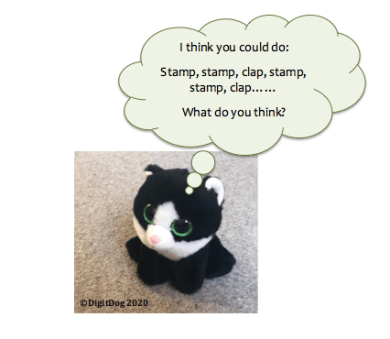
  • wave, stamp, wave, stamp, wave, stamp………….or
  • run, stop, run, stop……..


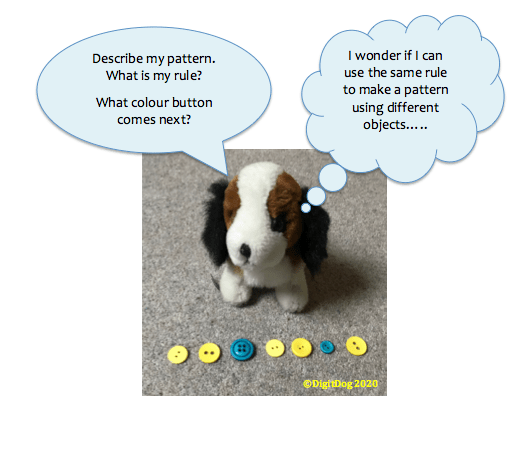
What about this pattern? Look for the rule then use it to make a pattern with sounds or movements.

Screenshot 2020-06-04 08.38.49


Screenshot 2020-06-04 08.45.36


Play with patterns:

  • One person makes a repeating pattern using objects. Another person works out the rule and uses it to make a pattern with sounds or movements.
  • One person makes a repeating pattern with sounds or movements. Another person copies it.
  • Look for repeating patterns in your environment. Say the rule and use it to make a pattern using sounds or movements.
Posted in Logical reasoning, Patterns

Making patterns 4

Screenshot 2020-06-03 10.38.51

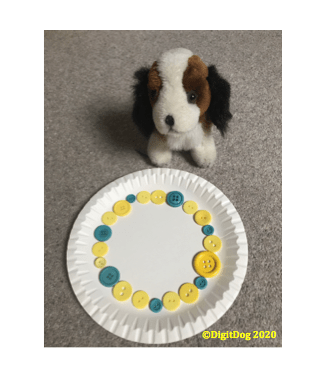
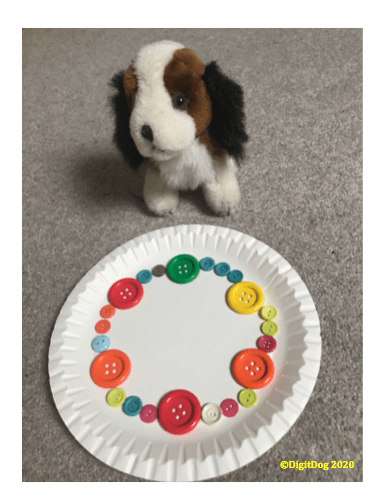
Digit Dog has made lots of linear repeating patterns, so now he is exploring cyclic patterns.

Screenshot 2020-06-03 10.48.38

What do you notice about Digit Dog’s pattern?

He had to make sure that the pattern continued round and round the plate.

Try making some cyclic patterns using plates and objects.

Draw a pattern around the edge of a page.

Make a pattern with a mistake and ask someone else to spot it..

Screenshot 2020-06-03 11.03.45

Spot the mistake.

What is Digit Dog’s rule?

Where has he gone wrong? How do you know?

What does he have to do to put it right?

Posted in Logical reasoning, Patterns

Making patterns 3

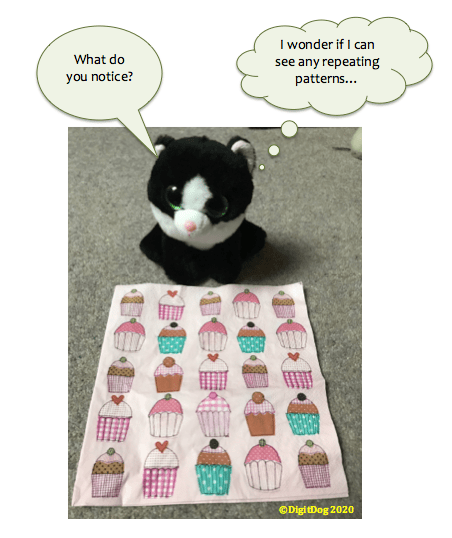
Calculating Cat has found a paper napkin.

Screenshot 2020-06-03 09.36.14

What can you see? What do you notice?

Look at the rows of cakes. Look at the columns.

Describe the cakes.

How many cakes with hearts are there?

How many brown cakes?

How many cakes have cases that are not pink?

Screenshot 2020-06-03 09.47.10

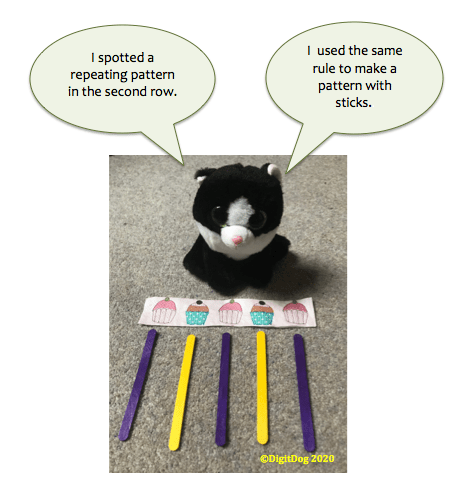
Calculating Cat noticed an AB pattern in the second row. She used the rule to make her own pattern.

Look at the two patterns. What is the same? What is different?

Try making your own pattern with different objects. Remember the rule. Your pattern can go on and on and on………….

Screenshot 2020-06-03 09.56.16

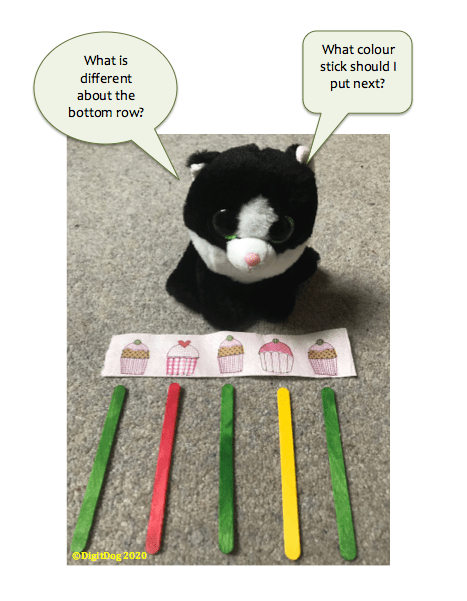
Now Calculating Cat has an ABAC pattern.

Draw coloured lines to copy Calculating Cat’s pattern. Continue the pattern to the end of your page.

Investigate the other rows and columns on the paper napkin.

Look for patterns that decorate other things around the house and outside. Which patterns are repeating patterns?